Saturday, October 19, 2013

Arctic Journey: Kangerlussuaq and the Greenland Ice Cap

On the morning of July 28th we were at anchor off Kangerlussuaq, the site of Greenland's largest commercial airport. The airport was created in 1941 as the American airfield Bluie-West-8, part of the United States' activities in the Second World War before Pearl Harbor. The fjord is silty and shallow near its head from sediments carried down by a river originating in the Greenland ice cap.
Zooming in, we can see the modest docks where we will embark and disembark. Even the zodiacs must thread carefully between silt bars, hence the orange markers on the hill to guide craft in.
The forty-four of us who are continuing on board the Explorer for its next trip, Greenland and the Canadian High Arctic, will spend most of this day on an excursion to the Greenland ice cap instead of flying home.

As long as I'm talking about the airport, I'll show those photos now, even though they were taken hours later. In this first shot, our bus is approaching Kangerlussuaq (population about 500) from the south after a late lunch.
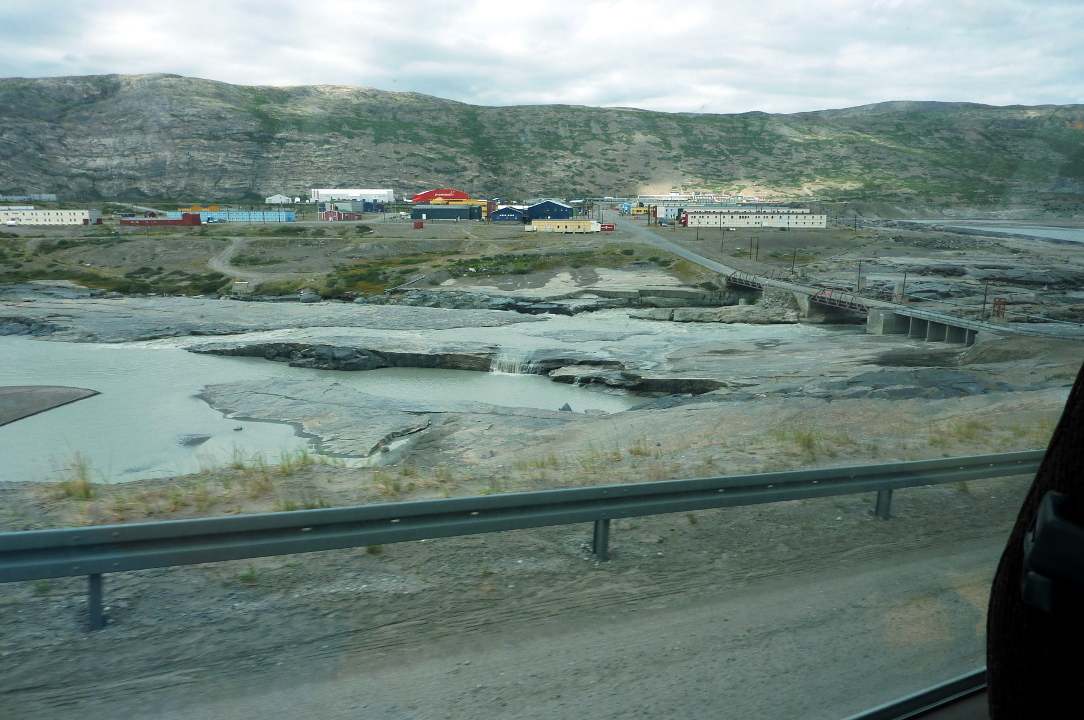
This is the hub for Air Greenland.

We had a couple of stops on the drive to the ice cap. The first was at the wreckage of a U.S. jet aircraft. During foul weather one day in the early 1950s three of four planes (probably Lockheed T-33s) couldn't the find Kangerlussuaq runway.
When the planes ran out of fuel the pilots ejected safely, and one jet crashed next to the road, scattering debris.
Of equal note to the berry lovers among us were low-growing blueberries with wonderful flavor.

The river has cut a broad, sedimented valley here, and there are miles to go to reach the ice cap. 
The gravel road between Kangerlussuaq and the ice is 40 kilometers (25 miles) long, the longest road in Greenland, and passes through the Issungua highlands. It was extended into the ice cap in 2000 as a testing ground for automobiles, but was abandoned a few years later. Since 2006 a padlocked gate bars entry into the further reaches except for tourist buses headed for the ice cap.

After passing through the gate we drove through an area with several lakes.

Photos of caribou taken through the bus window:


Shortly after seeing the caribou we stopped for a leg-stretch and a visit to the shore of one of the many lakes.


The sands of the lake were mantled with gently curving stripes.
Our guide explained that the dark bands were garnets. It's not impossible; there is a hill just south of Kangerlussuaq known as Garnet Rock.
As you can see from this window into Google Maps, the road winds its way past lakes and over hills until it arrives at a jumbled mass of rubble-covered ice at the edge of the ice cap.


We walked the final few hundred feet of approach.
The rocks and dirt left behind by melting ice blanket the remaining ice, which is occasionally exposed.
Flowering plants have staked out a toehold in this forbidding landscape. This is probably Thymus praecox, a species of the herb thyme.
The roadway became a path which became a track. Here, almost at the point where we'll be walking on ice, an improvised bridge is set up. Summer is well along and there is a great deal of melt water.
On the way in I paused at a spot where a small melting was visible. This dirty ice face just off the road had a slow-motion, muddy stream trickling down its center. It's just two or three meters tall.


After taking a few steps out onto the ice, I took this photo looking back. The ice is rough and pocked with coin-sized craters wherever dirt has settled and hoarded the rays of the sun.
Looking outward we see the fissured blocks of this arm of the Greenland ice sheet. This sheet stretches 1500 miles north to south and up to 680 miles west to east. It is three times larger than Texas!
Here is my portrait on the ice. I am smiling in this picture. Really.
The ice, water, and particulates at my feet made a wonderful composition.
While I wandered, admiring the ice and taking photos, a few were curious to see how far they could go in the time allotted (not too far).
Very soon it was time to return to the buses. It was already noon and lunch and a pit stop were far away, back in Kangerlussuaq. This through-the-window photo turned out very well. It shows how many different micro-environments can exist within a stone's throw of the glaciers.
As we passed through the area with the jet wreckage, we stopped and were treated to a better look at a musk ox we had glimpsed through binoculars on our way out. He was on a ridge top while the bus was down in the valley, but this picture is worth showing to you.
We drove through Kangerlussuaq and, south of town, arrived at a lakeside restaurant that specialized in the beer of the Nuuk brewery Godthaab Bryghus (click to enlarge).
The first order of business was the restrooms. Water bottles had been handed out on the bus ride, but there were no toilet facilities on the way to, from, or at the ice cap. A very long line formed as soon as we got off our bus. Our group self-organized into a single queue that didn't worry about which of the two restrooms was "gentlemen" and which was "ladies."

The restaurant backs onto a large lake.
Some of us had even brought their own fishing gear.
A closer look.
The lunch was a Greenlandic buffet, with lots of meat dishes. Soft or alcoholic drinks were extra, but Joan and I had brought our own water bottles, so no kroner were spent by us.

We forty-four "back-to-back" guests returned to the Explorer before the newly arriving guests, who also transferred by zodiac. This was an authentic introduction to the character of their trip.
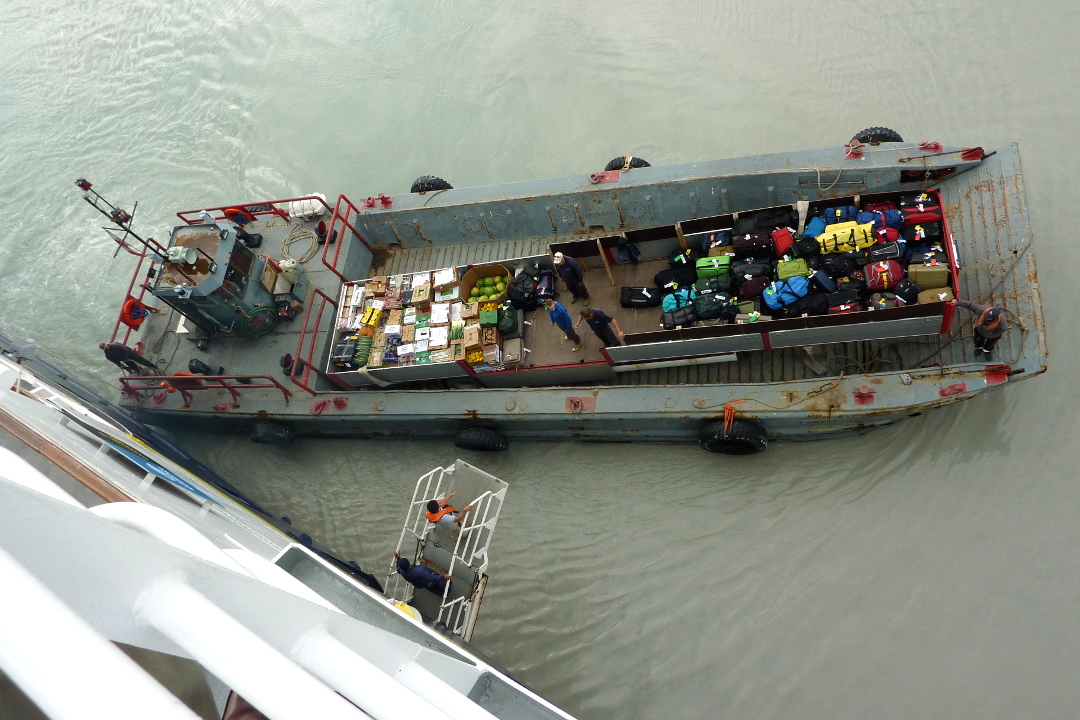
The luggage and produce for the kitchen were then brought out by a small barge.
Everything was transferred by hand, and nothing fell into the water.
It was a busy day for all involved. The Explorer set sail at 6:00, and after the mandatory safety drill, followed by an introduction to the ship, a buffet dinner was served at 8:00. (Dinner is usually served by waiters, and a little earlier, but turnover days are different.)

Sunset was not until 11:32, due to our location almost smack on the Arctic Circle. Joan stayed up until 11:00 admiring the many glaciers feeding into the fjord as we steamed past, but I couldn't keep my eyes open that long.

We were on our way to Sisimiut.

Monday, October 14, 2013

Arctic Journey: Atammik and Fjords

The morning of July 27th found the Explorer sailing past the small town of Atammik, which has about 200 inhabitants. The weather had distinctively improved from yesterday, and it was getting even better.
Things were looking good up on the bridge.
The clouds continued to lift as we sailed up a nearby fjord.
Soon we were going ashore to explore.
Our ship's puffin discovered an old caribou antler as we hiked towards the tall rock in the background.
This dwarf cornel, a plant in the dogwood family, was worth admiring. The white "petals" are actually leaves, and the true flowers are tiny, dark red, and all originate from a single point, an arrangement called an umbel.
We clambered up the rock and continued on. This photo is looking back at the next group of hikers to summit.
Our group, somewhat smaller than before, continued uphill towards a saddle in the ridge.
During a pause I took this self-portrait, or "selfie," protected by my cockeyed bug net.
Our group passed through a boggy area and then, as we gained altitude, the view began to open up.
There was a brilliant patch of Niviarsiaq, or broad-leaf fireweed, Greenland's national flower.
Or, in the other direction,
At the saddle we discovered a lake.
Looking back towards the Explorer, I could see that the first round of kayakers was paddling around the fjord.
Here's a view of our exploration. The zodiacs landed at 'a', the first, smaller rock we climbed is 'b', and we're now standing at 'c.'
Four of us decided to work our way up the ridge from the saddle, passing through the neighborhood of point 'd.' Soon I discovered this pellet of indigestible feathers, cartilage, and bone, left behind by some predator.
This healthy reindeer lichen, one of two species in the genus Cladonia, also begged to be photographed.
We came to a shelf and admired the view, we four.
From that spot we had to find our way down to the beach. This photo zooms down towards the beach.
Staff member Eric Guth was in the lead and found this caribou skull.
Half an hour after starting down -- we did have to admire the caribou skull, after all -- the beach was getting much closer and the footing was easier.
As you can see from the zodiac wake in the above photo, the trip back was not direct. There was a waterfall to discover, point 'e' in the earlier map.
These folks hove to for a group photo.
Once everyone was back on board the Explorer, it was time for the Polar Plunge. The kayaking platform was pulled next to the ship, and any passengers who wanted to jump into the waters of the fjord, as a point of Arctic honor, now had their chance.
Some found courage in plunging two-by-two.
Some were acrobatic,
some jumped fully clad,
and some preferred to push off rather than jump, in order to keep their hair dry.
After lunch there were a presentations in the lounge, but also a lot of open time. After all, tomorrow was the end of this trip, called Along the Viking Trail by Lindblad, and most guests needed to pack for their departure at Kangerlussuaq. Joan and I were staying on, two of forty-four doing "back to back" trips, and we spent much of the afternoon observing on or near the bridge. Early on a humpback whale swam close to the ship, fins visible through the water.
It coiled in preparation for diving,
and then gave us a good view of its flukes.
After an hour and a half we encountered three or four blue whales, the largest animal ever to have existed. Often they are difficult to photograph due to long dives and because they tend to remain low in the water. The captain would maneuver to give the guests the best view possible, as evidenced by our curved wake,
but often the prospect from the bow looked like this as we waited patiently for the whales to resurface.
Here is a photo not of a whale but of one of the Explorer's stabilizers.
Then it was time to change for the Captain's Farewell Cocktail Party followed by dinner. Tomorrow at Kangerlussuaq  the 44 of us staying on for the next trip would visit the Greenland ice cap.

Sunday, October 6, 2013

Arctic Journey: Nuuk

July 26th began overcast and rainy, but fortunately, this did not cancel any landings; the Explorer was still sailing towards Nuuk, population about 16,000 and the capital of Greenland. Several presentations were given before lunchtime.

First, Eyal Aronoff  -- founder of Quest Software (acquired by Dell), co-founder of Fuel Freedom, and autism activist -- gave a talk, Ending Our Oil Addiction, which made the point that humanity won't end its oil fossil addition by regulation or by fiat, by but developing less expensive alternative fuels. It was truly an eye-opener. Then the National Geographic photographers Sisse Brimberg and Cotton Coulson gave a talk (with lots of photos) of their assignments over the years, which was much fun.

After lunch we arrived in Nuuk, with overcast skies and intermittent drizzle.
Not the best day to show off the town, but we did what we could. Possibilities arranged for us were a city tour by bus, shuttles to/from the Greenland National Museum, and kaffemik (a visit involving coffee or tea and Greenlandic cake) with a Nuuk family. Joan and I had time for the city tour and the museum -- "Nunatta Katersugaasivia Allagaateqarfialu" in Greenlandic.

The city tour took us over all the major routes in Nuuk. We drove past or around the space-limited Nuuk airport, the nine-hole golf course, the University of Greenland (est. 1987), Queen Ingrid's Hospital, and through the newest developments in Qinngorput, middle right on this map, where Nuuk plans to expand. Due to the weather and the bus windows, I didn't take any usable photos during this jaunt. 


Joan and I disembarked at the National Museum, where we spent some time. Although photos were allowed the lighting was barely sufficient, and sometimes insufficient, for my point-and-shoot (or, as I learned on this trip, "aim-and-create") camera. Here is a picture of a typical Greenlandic dwelling interior.
There is no timber in Greenland, but as this sign explains, traditionally the Inuit collected driftwood that originated in Siberia.
The transportation building (kayaks, umiaks, dog sleds) gave me the opportunity for a few photos (click to enlarge).
There is a variety of style and innovation amongst the kayaks.

The area exhibiting dress and costume had wonderful clothing and gear on display, but lacked much explanation of the different pieces. It was fun to look at, but without explanation, we weren't tempted to linger.

Other photographs from the museum:
Interesting artwork with figures that, superficially, look grotesque but perhaps represent different spirits, emotions, or mythical figures.

The most moving part of the museum was the exhibit of the "Greenland (Qilakitsoq) mummies." These mummies were discovered in 1972 and have been dated to 1460. The six women, one boy, and one baby were buried under rocks and essentially freeze-dried in the cold and windy conditions. Their 78 pieces of clothing were also highly preserved. Half of the mummies are here, including the baby, and the others are currently at the Danish National Museum.

The mummies are displayed in a separate, black-walled room, kept in a large climate-controlled case that fills half the space, or so it seems. It is a very touching sight, and it inspired a reflective, somber mood in me. Although I could have, I did not take any photographs here. It seemed inappropriate, too superficial and perhaps "touristy."

We sailed from Nuuk and then, after dinner, landed in a fjord that the expedition staff recalled from the Explorer's previous trip to Greenland; in 2008 they had located the foundations of a Norse longhouse here. At the beginning all we found was an earth-sheltered cattle barn.
Joan is practicing the "Greenland wave." The bugs were out in force this evening, and although they didn't bite, they enjoyed landing on uncovered skin. Take a deep breath and you would get a tiny protein-rich snack, but having just had dinner, I kept waving. This is why south Greenlanders have a reputation for being friendly -- they are waving all the time.

Here is the interior of the barn.
This barn didn't look very Norse, so several of us tromped on through willows and high grass in search of the longhouse, stopping occasionally for photographs.
Joan and I and a couple of others tromped pretty far, but we never found anything. Given the bugs and the lack of directions to the supposed Norse longhouse, folks began drifting back to the cafe/bar of the small holiday resort that had been established here (center of the photo below, click to enlarge). Some of us had never gone further than the bar.
It was finally decided that the longhouse foundation wasn't visible any more, and possibly the barn had been built over it. Possibly. Eventually we all straggled back to the Explorer, which resumed its northward course. We're almost back to the Arctic Circle.