Wednesday, May 17, 2017

CR2016: Chester Lake, Three Lakes Valley ... and a Grizzly

On Monday, our penultimate day of hiking, Joan and I decided to visit the ever-popular Chester Lake and extend that journey up the Three Lakes Valley. This was our first visit since the floods of June 2013 damaged the parking area and lower reaches of the trail. Perhaps because it was Monday, the re-groomed parking area for Chester was empty when we arrived shortly before 10.
The day trippers from Calgary haven't arrived yet.
The lower reaches of the trail had been re-routed; there was a different starting point, and the first section was now a one-way loop.
It took a while for our well-used muscles and lungs to warm up after yesterday's climb of Windtower, but we settled into the hike. The route at first is a small road,
but eventually becomes a path after passing through a zone of old logging roads and cross-country ski trails. Mostly it climbs but sometimes it's level. In this photo Joan and I are approaching the last bump or two before reaching the lake.
Almost there. Most of the glacier lilies near the lake had been dug up, being a favorite treat for grizzly bears.
Chester Lake is popular for a reason. It's not too difficult to reach, and it's gorgeous. OK, that's two reasons.

There is also a formal "rest facility" here, the tubular toilet.
Joan and I did not linger but went around the left-hand shore until we reached the side trail leading to the Three Lakes Valley. After rising from the lakeside the trail passes by rock formations known as "Elephant Rocks."
The trail swung to the right and continued to climb after it entered the Three Lakes Valley. After fifteen minutes we encountered a lookout, a hoary marmot.
Here we are about to reach the first lake.
The first lake could be a destination in itself. This photo was taken from the up-valley side.
 The trail goes up a steep gully after the first lake, OK if dry but treacherous if wet or if snow lingers. Joan and I were glad for our poles. From the top, the lake looked like this.
From this point the route was a mix of visible trail segments and cairns. It wasn't possible to become lost, however, because the valley was narrow and it was obvious which way was up. But the horizon was close, as this photo shows, looking back.
The geology in the valley was full of striations, folds, and fossil corals.
We found this body of water, which is either a seasonal pond or the second lake.
Or a seasonal lake?
Joan and I decided to climb over one more rock band and discovered the third lake. Here we stopped and ate half our lunch.
Some algae here!
On our way back, still in the rocky zone but passing by a low, wet area with vegetation, we encountered pikas chasing each other away from choice spots. We counted at least three; it was difficult to photograph running pikas, but when they were on lookout (for a few seconds) or browsing, I had a chance.
I caught this one in mid eeep, the pika alarm call. (Click on the image to enlarge, and check out the lips!) 
A wind-ruffled fur photo. 
Further down, the guard marmot was still on duty.
As Joan and I descended to lake #1 we encountered our first other hikers, a party of three with a guide. The wife of one, not present, had lived in Columbus and so he was familiar with locations such as Broad St. and Bexley.

Down at the Elephant Rocks we circumambulated the impressive rocks on the other side of the trail and polished off what was left of our lunches.

We soon met a solo guy who inquired whether he was on the way to the Three Lakes Valley trail; Joan told him he was on it! He'd intended to go to Headwall Lakes, whose trail also leaves from the Chester Lake parking, but became turned around.

More people were at Chester Lake, with even more arriving. The cow parnsip was in full bloom and covered by buzzing flies.
Shortly after leaving the lake we met a man who was standing guard as his wife and daughter were taking an off-trail pit stop. He was skeptical of the bear warnings (we saw one covering the whole of Kananaskis the next day), having seen no scat, which he said he often saw while cycling Back East.

Fifteen minutes later I came around a bend in the trail and saw a grizzly at the next bend, headed our way. This was the first in-person in-the-wild meeting we'd had in fourteen years of hiking. I halted abruptly and said, "bear;" Joan was expecting "grouse" or something more prosaic. She started chatting at the bear, to let it know we were humans, and she reminded me to pull out the bear spray on my belt. I belatedly started talking too. The bear, of a size that made us think it was his first year away from Mom, swung his head back and forth. He took a hesitant step or two in our direction, wanting to stay on the trail rather than beat cross-country, but then he turned and trotted uphill through the woods. We were a bit rattled, of course, but the rest of the walk down to the car was uneventful. We reported the encounter back at Mt. Engadine Lodge.

Our last night at the lodge was a fine one. Joan and I certainly had a story to tell!
The moon was high in the sky when the sun set.
Time to go pack ...

Thursday, May 11, 2017

CR2016: Windtower! (Third Time's the Charm)

Yesterday's rain bequeathed Sunday with clouds blanketing the valley where Mt. Engadine Lodge nestles; at times the far side of the meadow would disappear. By breakfast the fog had begun to rise a bit, while the forecast was for a 40% chance of 1-2 mm of rain.

Joan and I decided that today we would tackle Windtower, which had thwarted us twice before, in 2014 due to a late start, and in 2015 due to the weather. The elevation of the top is a matter of disagreement between web sources, but let's use 8850 feet. The altitude gain from the parking lot is almost 1,000 meters, or about 3,240 feet. Definitely uphill!

Joan and I lingered at breakfast longer than we intended but, after a 20-minute drive from the lodge, were only the second car at the trailhead. The route starts with a hike to West Wind Pass, gaining the first 381m/1,250 feet of altitude.
The very beginning of the trail is steep and rooty, climbing above the deep cut of Spurling Creek.
Mists still filled the lower elevations.
As Joan and I chugged uphill we emerged out of the fog zone.
The view towards the east from West Wind Pass wasn't much; clouds were piled against the slope.
To the west, the way we had come, the Spray Lakes remained cloud-covered as well.
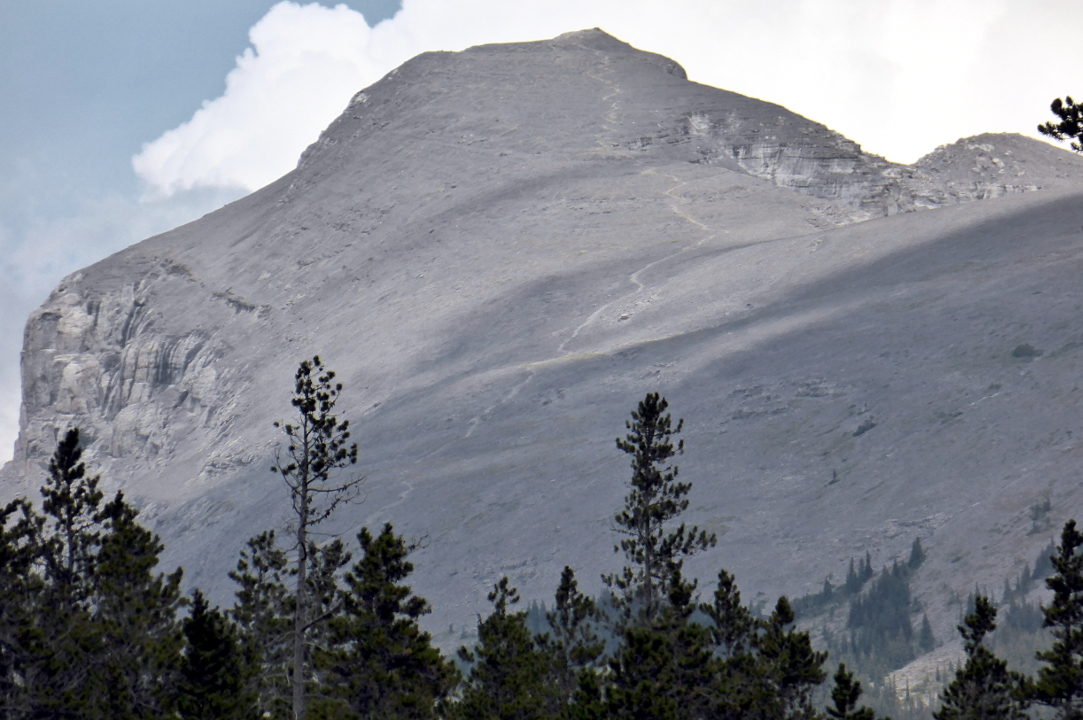
To the south of the pass was our goal, the peak known as Windtower, showing its vertical face.
By hiking along the flank of the mountain we could reach the less intimidating southern slope, as hinted at in this 2015 photo.
Here's an 3-D image of the trek overall.
There is no official route beyond West Wind Pass. Instead, the hiker chooses from a plethora of boot-beaten paths, as shown in another 2015 photo.
The paths weave through trees, open areas, and rock bands that may require use of hands and feet to clamber over. After the first couple of rock bands we spotted an opportunity to hike to a higher route also marked with tape and cairns. Joan and I had read an on-line account that higher was better in this section, so we tried it.

One rock band was uncomfortably tricky to climb; we managed to avoid it on return. This popular hike merits an official trail so that hikers would not need to guess where to cross each rock band.

As we proceeded the mists above the Spray Lakes began to dissolve.
Two women were a short distance behind us, but Joan and I slowly pulled away.
We reached the point where the trail swung to the east and north and more steeply up, as seen in this photo from the lakeside (click on the photo to enlarge). It was a slog the last time and it was a slog this time. It will always be a slog. Many sections demand deliberate placement of the feet, taking into account the scree depth, steepness of the slope, and dampness of the path (one day after the rain). Huffing and puffing, we climbed.
We appreciated our hiking poles and every bit of training acquired on this trip, and even so, we had to pause at times to catch our breath and let the blood flow refresh our legs. So far we had met only one other party, two women on their way back down.

Joan at the top!
The valley carrying the Trans-Canada highway is more than a mile below us.
Another small promontory is a stone's throw away.
But not easy to reach.
Rita and Margie took their turn checking out the view from the top seat. We learned later that a registry is buried in that pile.
They didn't break a sweat.
A small windbreak was a good spot to have our lunch.
More hikers arrived. We walked over to check out the "nose," a smidge lower than the top.
Behind us, other hikers reached the summit.
Clouds were snagging on Mount Lougheed (about 10,200 feet) as we began our return.
The scree wasn't as bad headed downhill, because sometimes the gravel was thick enough that we could crunch through it like a snowfield. But smaller scree rolled easily and was treacherous.

West Wind pass was spilling over.
No dark clouds, please.
Joan and I encountered more hikers headed up. One young woman was dressed in a tank top with a thin, knit, off-the-shoulder sweater and long feathery earrings. This wasn't mountain dress, but she had come this far and clearly intended reach the top alongside her boyfriend.

Then we encountered the mountain biker.
He was pushing his bike up the mountain for the ride down! Joan asked, "Does your mother know what you're doing?" We would see him later.

Sightseeing helicopters of several colors were busy this afternoon, some flying close to the deck through West Wind.
We continued to descend. In this photo clouds are billowing up to the south. The picture also illustrates one of the rock bands.
The hikers that arrived at the top after we did began to shoot by us on the way down. The pass gradually drew closer.
Just as we left West Wind pass the mountain biker whirred by. Given that the trail often clung to the ravine's edge, we hoped he dismounted and walked those sections.

Thunder began to the south, dimly at first, then louder. We kept up the pace as much as the trail allowed and didn't stop. Joan and I reached the car ten minutes before rain showers started; our round-trip time on the hike was 6:10, not bad! Also at the parking area was a woman standing in front of an open car door, shielding her husband, who was changing his clothes.

We drove back to the lodge, where it had obviously rained much harder. We were thankful not to have had rain on the rocky/muddy/rooty West Wind pass trail.

To cap a great day, the moose visited the lodge in the evening -- two males!
Not feeling territorial. Yet.

Saturday, May 6, 2017

CR2016: Tryst Lake and an Avian Revival

On Saturday, August 6th, the forecast was for a 90% chance of rain after 1 pm. Joan and I decided to hike to Tryst Lake, a journey shorter than most, and one we'd done in wet weather before. We took a while to get organized but we still had driven the very short distance to the trailhead by 10 am. It was drizzling already.
The beginning of the route is an old logging road which, if pursued to the end, will take a hiker into the valley of Commonwealth Creek. The Tryst Lake trail is a steep, narrow one that departs from the road at a spot marked by cairns and/or flagging tape, about half an hour of brisk walking from the parking area.

We met two groups of young hikers who were looking for Tent Ridge and weren't sure where they were. They had no maps, but each group had a GoPro camera. You can reach Tent Ridge from Tryst Lake, but it involves uphill bushwhacking (no trail). They weren't keen on that, so Joan and I directed them to the Mount Shark trailhead for Tent Ridge.

The climb, which we had last hiked in 2011, revealed damage from the 2013 floods and recently fallen trees from the very wet July. Short detours through dripping foliage were common. The upper reaches included pocket alpine meadows with gorgeous flowers, much like Purcell.

By the time we reached Tryst Lake it was raining steadily, and we decided to return to the Lodge rather than consume our bagged lunches in these dismal conditions. (Despite the wet July the level of the lake was surprisingly low.) Armed with our poles and a high degree of caution we began our descent, and nobody fell down. We met a friendly couple from Canmore headed up and compared notes for a few minutes.

Back at the lodge we had to hang up every wet thing, including the contents of the day packs and the day packs themselves; even with covers on the outer surfaces they were not 100% waterproof through several hours of substantial rain. Then we enjoyed our lunch in the comfort of the lodge's dining room, with hot tea to boot.

Towards the end of lunch we heard the smack of a bird strike against one of the windows. Joan took off her socks and slippers -- the lodge frowns on outdoor shoes inside -- and investigated. She found a small bird, later identified as a female pine siskin, lying on the deck. It fluttered some. Joan knew that if it hadn't broken a bone or fractured its skull the siskin would probably recover -- if given shelter from the cold, the wet, and any possible predators. She held it using both hands, keeping it warm and dry and giving it time to recover from its concussion/shock. At first it couldn't stand in her hand, then it managed an unsteady, wobbly stance, and finally it could balance even when she tilted her hand.
  It also pooped twice, a good sign.
Eventually the siskin started to blink and do some preening, but turning its head only to the right. Joan's bare feet were getting cold!
After forty minutes of protection the siskin suddenly flew away. During the recovery period Joan had spotted a northern harrier, for which the siskin would have been a helpless morsel.
Mr. Moose paid us an unexpected daytime visit, too, perhaps encouraged by the overcast and damp.
Tomorrow would bring better weather and a big hike.