In mid-February Joan and I visited the Hocking Hills area of Ohio, staying at the Inn and Spa at Cedar Falls. This post won't be a description of the Inn ... Tripadvisor does a good job of reviewing that excellent place ... but it will report on the surprising winter walks we took.
Our first stop was at the Hocking Hills Regional Welcome Center, where we collected brochures and visited the Pencil Sharpener Museum. Then, before even arriving at the Inn, we hiked at Old Man's Cave. Click on this map, which shows the location of the Inn and of the parking for Old Man's Cave, to enlarge it. (Thank you, Google Maps!)
We bundled up and each of us used two walking sticks, which were very useful because we encountered a landscape of frost, ice and snow as soon as we descended into the gorge.
There was both melt water and air flowing under many of the ice sheets. The combination sometimes looked like bubbles, other times like tear drops. Here is a short video clip; at first it's not in focus, but as the zoom pulls back the camera finds the right settings.
We moved upstream along the gorge until the path began to climb towards the rim, but then, a set of rocky steps appeared. The path was narrow and the stones were coated with ice and angled uphill. Even with two sticks apiece, it was too slippery for comfort. Joan and I turned around and proceeded along the trail in the gorge's depths towards Old Man's Cave. By this point my hands were aching from the cold, especially because we had been stopping and gawking so much. I removed my ordinary gloves and switched to thicker outdoor mittens, which helped a lot.
To reach Old Man's Cave we needed to cross an arched stone bridge, shown here in a picture taken later. Joan and I would have been crossing from left to right.
The surface of the bridge was ice-covered, and had already been traversed by a few people, slickening the surface even more. After taking a few tentative steps we decided to continue down the gorge to the lower falls, where we could easily cross the stream and then climb to the rim and approach Old Man's Cave from above, and on the other side.
The lower falls was enchanting too.
As planned, we climbed to the rim and then reached the spot for descending to Old Man's Cave. Partway down, it looked like this, with fascinating rock formations. Clearly we were on the lee side of the gorge, with hardly any snow or ice underfoot.
Lower down, Joan provides some scale.
After visiting the cave our route was back up to the top, where we crossed the stream again, above a stepped bridge we had gingerly used earlier on our way downstream. The sharp edge between the icy and clear zones on these steps was curious.
Crunching along in the thin snow, we reached the upper falls.
Joan provides some scale yet again in this closeup. From here the parking area was within sight.
That evening at the Inn we saw a fox hunting in the snow, partly obscured by the desiccated summer vegetation. The light was low, and I was taking photos through a window at maximum zoom, but this image is intelligible if not artistic.
After breakfast the next day we both enjoyed a massage at the Inn's spa, which we highly recommend. Afterwards we drove to Conkle's Hollow, where, with the sunshine brightening, we soon encountered more ice staircases (click to enlarge).
Towards the end of the hollow we crossed a shallow stream by carefully placing our weight on the translucent sheet of ice above it, or on strategically placed driftwood. At the hollow's end there was the familiar arrangement of ice created by falling water above ice created by fallen water.
Looking back at the way we had come in, it seemed a different world.
This wide view of the left side of the hollow reveals icicles in the deeper recesses.
Back at the car we had a snack, and then drove on to Ash Cave, which was a short walk from the parking area.
Zooming in on the large mound of ice beneath the falls,
Looking at it from the other side.
I couldn't resist taking a picture of the dangling ice from behind.
The ice mound beneath was intriguing, with a constant spray of water showering onto it.
Our next stop was at the Ash Cave fire tower.
We climbed to the top,
where this was the view. Not bad for February!
Our final stop for the day was at Cedar Falls.
These falls were pretty, but difficult to approach closely in the icy conditions.
There is a trail connecting Cedar Falls and Old Man's Cave, part of the Buckeye Trail, a cross-state hiking path. This section is dedicated to Emma "Grandma" Gatewood, a founding member of the Buckeye Trail Association, and three-time Appalachian Trail thru-hiker. Joan and I had time to hike about halfway to Old Man's Cave before returning. The trail had been rerouted in sections due to fallen trees (last summer's derecho?) and wear-and-tear. Sometimes the trail offered two choices, and which one was preferred wasn't always clear, but it was impossible to get lost.
We had seen a lot of ice by this point, but one formation seized our attention. First we noticed the frozen spray from above coating nearby branches.
Then the mystery of this ice mound grew as we studied it more closely.
Where the spray was currently falling there was a forest of tall, crystal spires, center in the photo above. To the lower right there are frozen flows, terraces of ice. Then, looking back into the walls, the half-caldera, it became even more astonishing.
In the foreground the ice is chunky, like demolition rubble. Then we have the land of vertical shards. But most interesting is the mound revealed as a row of separate columns of ice topped by a polished and terraced cap. Wouldn't you love to see a timelapse video of how this came to be?
We returned to the Inn at Cedar Falls for dinner and a good sleep. There was no rush the next morning, for freezing rain had fallen overnight and we decided to give it time to melt. By the time we departed the roads were in good shape, and we explored some of the county roads in this area. Laurelville, population 528, was our lunch goal because we needed to try out the Ridge Inn Restaurant. It was good, very good; perhaps we should have skipped breakfast! As it was we drove away with a half dozen of their fabulous donuts, which have just the right texture (not full of air, not too thick) and, again, just the right amount of sugar glaze. Too bad it's at least an hour away from our house.
The weather had cooperated for our visit, which doesn't always happen in February. We were able to take each desired hike, and visit both the Inn & Spa at Cedar Falls and the Ridge Inn Restaurant for the first time.
And our luck with the timing of the visit, to see the ice formations at the most interesting point in their evolution, couldn't have been better.
Monday, March 18, 2013
Thursday, February 28, 2013
Upgrading Juno
Towards the end of 2012 I upgraded my desktop computer, Juno, in several ways. I replaced the original solid-state drive (SSD) with a larger, newer one, I upgraded the BIOS, and I took a two-year leap in the software installed.
Going Forward
SSD swap
Juno was constructed with an Intel X25-V, a value-oriented 40 gigabyte SSD.
This device was large enough to hold the operating system (Linux) and applications, but all my user data was stored separately, on a regular spinning-platter hard drive. SSD drives were and are more expensive than regular hard drives, although now not so much as 3 years ago. Having the operating system and apps on the SSD made Juno fast to boot and fast to launch applications.
My choice to replace it was a Samsung 830, the 128 gigabyte version.
With this size, I could keep not only the operating system and applications on the SSD, but also all my user data except the extensive photograph folder, which remains on the hard drive. The Samsung device, being of a newer generation and not designed as a "value" item (not compromised to reduce cost) is, according to the specs, three times faster reading data and ten times faster writing data than the X25-V.
Fortunately, I also discovered while researching which SSD to purchase that SSDs using the new SandForce controller (interface between the SSD memory and the rest of the computer) did not play well with the I/O chip on my motherboard, the Nvidia MCP79. Many SSDs such as Intel, Corsair, and others now use the SandForce controller.
The MCP79 supports device speeds of 1.5 Gb/sec and 3.0 Gb/sec. (The newer SSDs also support 6.0 Gb/sec.) When the MCP79 negotiates the connection speed with a SandForce controller, they end up using the 1.5 Gb/sec setting instead of 3.0 Gb/sec! The Samsung SSDs use a Samsung controller and have no such problem. This, plus the excellent reviews of the 830, made the choice an easy one.
When I took the faceplate off Juno, it was clear that the dust filter needed to be cleaned again.
A dust vacuum wasn't sufficient; I ended up removing the filter and washing it.
Juno is constructed with the SSD installed in a drive bay underneath the optical (CD/DVD) drive. Thus, the first step was to remove the tray for the drive and disconnect the cables.
Here we see the Intel X25-V still in the drive bay.
Installing the Samsung was just a matter of removing the Intel (4 screws) and sliding in the Samsung, reinserting the 4 screws and reattaching the cables. By then the filter was dry, and I could reassemble Juno.
The upgraded system is certainly snappier than before. I'm pleased with it.
BIOS Upgrade
My motherboard, the Zotac gf9300-i-e, theoretically supported both methods of chatting with bulk storage devices such as hard drives and SSDs. The ATA specification is the much older of the two, and to support advanced features of newer hard drives and of SSDs there is the newer AHCI interface. However, when first building Juno, it became clear that the AHCI option didn't work. In fact, if I enabled AHCI in the motherboard's BIOS (embedded firmware), the computer would no longer see any of the attached devices: no hard drive, no SSD, no CD/DVD drive. Urk! I proceeded in ATA mode, which seemed to work well enough.
After swapping the SSDs I decided to try AHCI mode again. Same result, very disappointing. However, this time I stumbled across a Zotac forum posting mentioning a BIOS upgrade that had come out a few months after I assembled Juno, which solved this problem. There were some technical hurdles to overcome -- this motherboard, unlike some others, won't recognize a BIOS upgrade automatically if a USB stick is plugged in -- but eventually I applied the new BIOS, and voilá, AHCI mode was good!
Installing XUbuntu 12.10
I had ceased installing newer versions of Ubuntu, sticking with 10.10, because of the controversy over the new default user interface, Unity, and the changes in the GNOME desktop between version 2 and 3. I was happy with my GNOME 2.x desktop, and 10.10 was supported with updates and security patches for 18 months. Then those stopped. After two years on 10.10, Juno's software was showing its age and some new software packages would not install.
I had played around with some other packages on my ancient laptop, primarily LMDE (Linux Mint Debian Edition) with its Cinnamon and Mate desktops. But I wasn't completely pleased with Cinnamon or Mate, which were efforts to maintain a pre-Unity desktop environment. Finally I went with XUbuntu, which is an Ubuntu distribution that also installs a more traditional and lightweight desktop manager, xfce. I have a few quibbles with it, but xfce was my best fit.
Here are some miscellaneous points I noticed:
- The system will now wake up from sleep (suspend to RAM) when I press any key on the keyboard. Previously I had to push the power button. Hurrah!
- xfce can use either xfwm4, the standard xfce desktop compositor, or compiz, a fancier one. (Desktop compositors manage visual issues such as overlapping windows, partially transparent windows, wobbly windows, multiple workspaces, etc.) I finally decided that xfwm4 was more stable; occasionally windows would go black under compiz. I was willing to give up my wobbly windows for reliability.
- Some of the programs I use on a regular basis, such as the GIMP, an open-source Photoshop, were not installed by default. They can still be installed from the Ubuntu repositories, so it's not a large issue.
- LibreOffice, as distributed by Ubuntu, would crash on some of the spreadsheets I had created in the Ubuntu 10.10 environment. I filed a bug report, and it may be fixed in the next release. In the meantime, I installed OpenOffice, which worked just fine. Because of a file name conflict, I had to remove LibreOffice before I could install OpenOffice.
- The xfce desktop has, unfortunately, a mandatory snap-to-grid feature. That is, any icons/documents placed on the desktop are automatically lined up to use the center of one square of an invisible checkerboard dividing the desktop. I wish I could turn it off, as I could in GNOME 2.x. But I don't have very many desktop items anyway, so it's just an annoyance rather than an impedance to my workflow.
- The version of the C++ compiler supplied jumped forward two years as well. One of my programming projects would crash until I changed some global constructor usages that had worked OK with the older compiler.
- The audio/video command-line program ffmpeg is now deprecated, and a couple of the arguments have changed. The new version fails on some of my video projects where the old one did not -- arrgh! However, the program avconv, the immediate descendant of ffmpeg, did work. It leaves me wondering how or why the maintainers managed to break ffmpeg.
Going Forward
This is probably the end of the Juno upgrades. If it were inexpensive, I would increase the memory (RAM) from 4 GB to 8 GB, because sometimes when working on blog entries (many tabs open on the Web browser) and processing photos or videos Juno starts to swap (move some programs to disk to make room for other programs to run). This slows things down. However, this motherboard takes an obsolescent memory, DDR2-800, which is pricey when available. Perhaps next fall or winter I will build my next computer based on the upcoming Haswell generation of Intel CPUs, and I'll put 16 GB of memory in it. That would be enough RAM to allow me to experiment with virtual machines.
Wednesday, February 27, 2013
Fairfield 6: Return to the Raj
Last November I returned for another visit to Fairfield, including extended meditation and more ayurvedic treatments at The Raj. The photos and impressions I have to share cover three categories: updates to the MIU campus, changes in Fairfield, and a return to The Raj.
MUM Campus
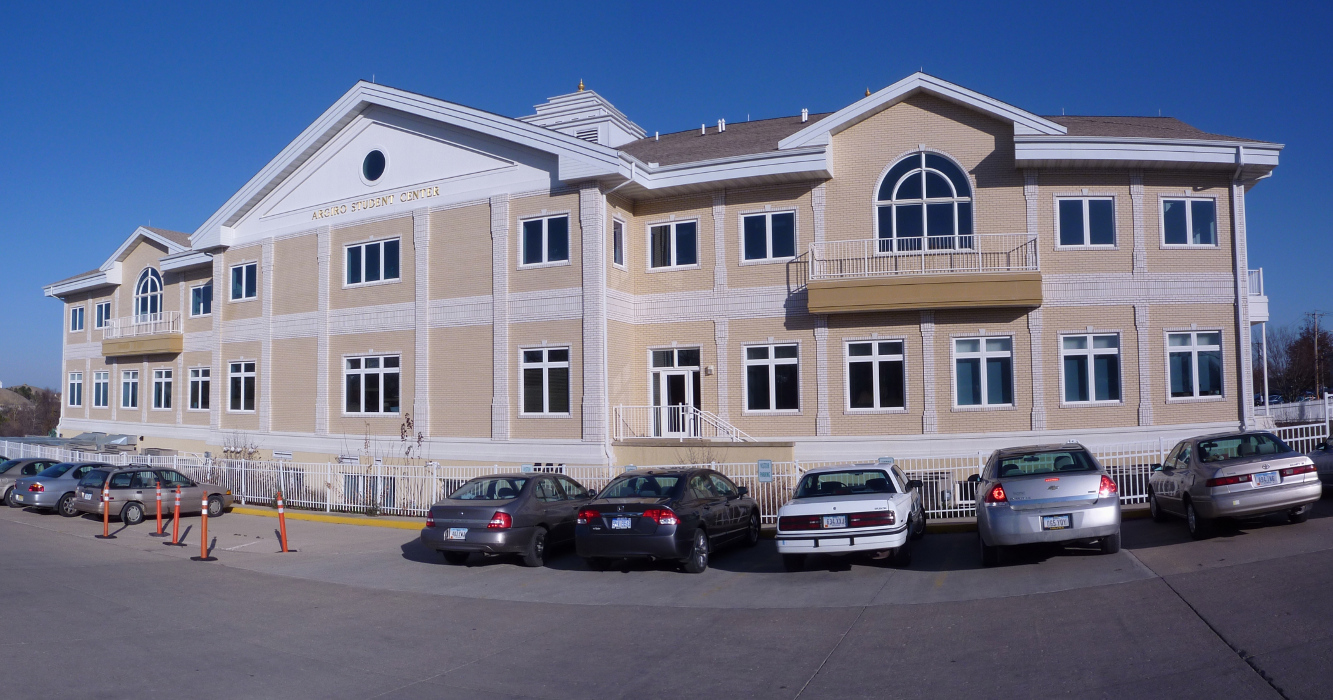
The MUM campus continued to evolve during the seven months since my previous visit. The stairs at the Argiro Student Center had been problematic since its opening with spalling (crumbling or chipping) of both the original and repaired concrete. Now, the stairs and entryway are tiled.
I hadn't taken a good photo of the west face of Argiro before; although it is the back of the building, it's also the side that faces Highway 1. In Sthapatya Ved, the most auspicious orientation for a building is to face east.
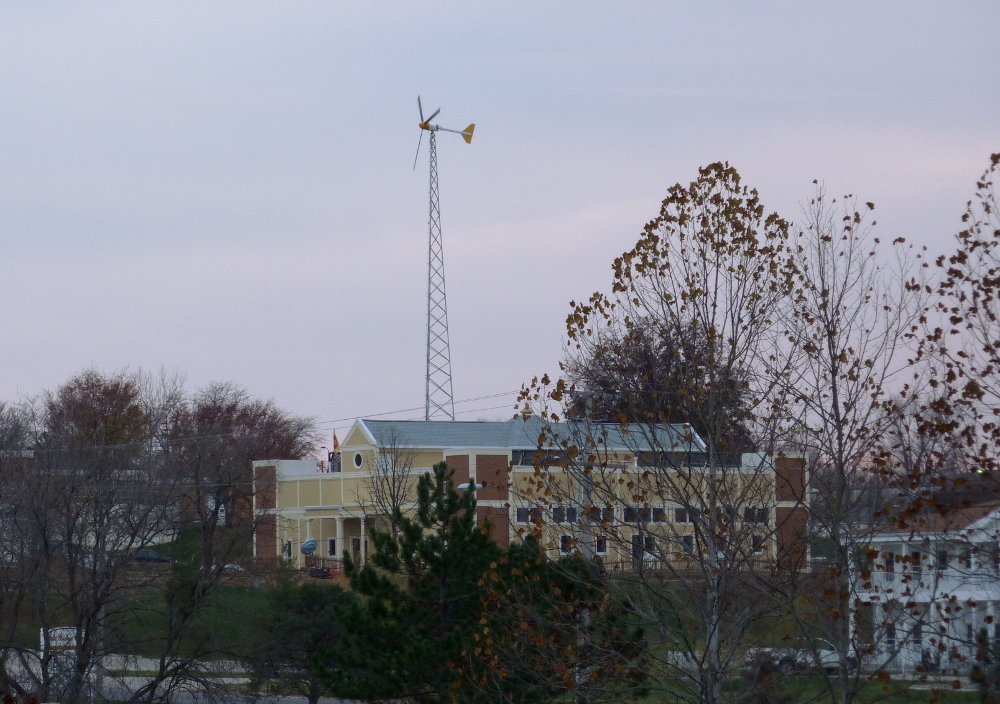
Across Highway 1 from Argiro, the wind turbine between the library and the new Sustainable Living Center -- which had its opening just a few weeks after I ended my April visit -- was now completely installed and generating power. Being a student project, it's a turbine of modest size.
On a sunnier day, a closeup of the turbine.
The big sign facing Highway 1 has received a facelift.
Nearby there are new tree plantings.
The railings of a campus bridge were replaced in a style whose arch echoes the Jefferson County recreational trail where it crosses Highway 1, only a few hundred feet away. Here is the refurbished campus bridge,
and here is an earlier picture of the trail bridge.
Many of the residential buildings known as "frats" received substantial makeovers, both inside and out. Here, a new roof is being installed.
New, energy-efficient windows replaced the old ones.
Here is a snapshot of a renovated lobby in one of the frats.
From in front of the frats the view encompasses the Maharishi Patanjali Golden Dome at left, the Victory Tower, the Bagambhrini Golden Dome, and at far right the Golden Dome Market and Cafe.
In previous posts I've shown the expansion of the Golden Dome Market from the outside, and now I can show you the effects on the inside. The northern extension on the ground floor is now the produce room.
Above it on the second floor is additional dining area.
As before the center of the second floor is the main serving and dining area. The southern extension is a new kitchen, so food no longer has to be transported from the kitchen in Argiro. I did not eat here during this visit, but I may make extensive use of it next time; if you're after a smaller meal, as opposed to all-you-can-eat, the Cafe is less expensive than the Argiro, albeit with a smaller selection.
The southern extension on the ground floor is several aisles of dry goods, and I couldn't take a meaningful photograph.
Around Fairfield
The biggest change in Fairfield took place just a few days after I left. After decades of 60 to 80 trains per day blowing their horns as they passed through, Fairfield is now an officially designated Quiet Zone. The crossings were all upgraded with long medians so that vehicles can't maneuver around the lowered gates. No more horn blasts! Here's a picture of one of the new crossings.
There is now a rotating display of Parsons College memorabilia in the Fairfield Arts & Convention Center. Parsons College declared bankruptcy in 1973 and was purchased by Maharishi University of Management, then called Maharishi International University, in 1974. That's how MUM came to be in Iowa.
The stained glass came from the Parsons College chapel. Let's zoom in on it (click on the picture for an enlarged version).
The folks behind the Cafe Paradiso purchased the building next door, and renovated it to offer both residential and office facilities.
The notes on the side of Cafe Paradiso, just noticeable in the above photo, intrigued me. Depending on the angle of the light, they were either clearly metal projections from the side of the building, or sometimes as if painted on the brick. First, the ironwork look:
Then, my attempt to capture the painted look:
Every time I reappear in Fairfield there seems to be a new shop somewhere downtown. This time, it was a combination tea and pottery shop.
The Raj
I documented my first visit to The Raj in some detail here. This time I'll add some more information without repeating the original stuff.
My biggest concern in returning to The Raj for another seven-day round of panchakarma (Ayurvedic treatments) was the possibility of the second-time letdown. That's when the first time you experience something, it's great, and you're eager to repeat it, but when you do the second time doesn't measure up to the first, leaving you with a vague feeling of dissatisfaction. This fear was unfounded.
It was necessary to budget nine days for the seven days of treatment. Because I was doing extended group meditation in the mornings as part of the Invincible America Assembly, arriving at the Dome during early November dawns,
only the afternoons were available for treatments or meetings at The Raj. The first afternoon was a meeting with the director, Mark Toomey, and Dr. Siju, a vaidya (Ayurvedic physician). They interviewed me, read my pulse, and prescribed the series of treatments for the next seven days. I would see them again in the middle of the treatments, so they could evaluate progress, and again after the treatments were complete, receiving advice for herbs, diet, and such when back home.
While taking treatments at The Raj special PK (panchakarma) meals are part of the program. The PK dining room is separate from the restaurant at The Raj; here's my photo.
The meals were a highlight of each day, especially because of the opportunity to converse with other PK diners. We came from diverse backgrounds and with different experiences, and usually found plenty to talk about. Also, across the eight days that I ate there, some guests would reach the end of their stay and depart, while others would arrive.
I took an illustrative photo of one lunch meal.
The main plate has, clockwise from bottom, a chapati (Indian flatbread), spinach, rice, artichoke with a green sauce, and mixed veggies. The bowl to the side is a lentil and veggie soup, while in the shot glass is a digestive decoction, which for me was fennel and coriander based -- there are two main types. This is consumed first. And there are two chutneys next to the decoction. Brought out later were a digestive lassi (yogurt drink) and a dessert, which is usually a stewed fruit dish but is occasionally one of my favorites, rice pudding. These meals are designed to complement rather than interfere with the treatments you're receiving. The idea is to not strain the digestion.
I'll close this blog entry with a final sunrise photo. There are so many when you're walking to the dome at 7:00 AM (I like to get there a little early; 7:30 is when the doors close).
After another springtime visit to Fairfield, I may visit the Raj again next November.
MUM Campus
The MUM campus continued to evolve during the seven months since my previous visit. The stairs at the Argiro Student Center had been problematic since its opening with spalling (crumbling or chipping) of both the original and repaired concrete. Now, the stairs and entryway are tiled.
I hadn't taken a good photo of the west face of Argiro before; although it is the back of the building, it's also the side that faces Highway 1. In Sthapatya Ved, the most auspicious orientation for a building is to face east.
Across Highway 1 from Argiro, the wind turbine between the library and the new Sustainable Living Center -- which had its opening just a few weeks after I ended my April visit -- was now completely installed and generating power. Being a student project, it's a turbine of modest size.
On a sunnier day, a closeup of the turbine.
The big sign facing Highway 1 has received a facelift.
Nearby there are new tree plantings.
The railings of a campus bridge were replaced in a style whose arch echoes the Jefferson County recreational trail where it crosses Highway 1, only a few hundred feet away. Here is the refurbished campus bridge,
Many of the residential buildings known as "frats" received substantial makeovers, both inside and out. Here, a new roof is being installed.
New, energy-efficient windows replaced the old ones.

From in front of the frats the view encompasses the Maharishi Patanjali Golden Dome at left, the Victory Tower, the Bagambhrini Golden Dome, and at far right the Golden Dome Market and Cafe.
In previous posts I've shown the expansion of the Golden Dome Market from the outside, and now I can show you the effects on the inside. The northern extension on the ground floor is now the produce room.
Above it on the second floor is additional dining area.
As before the center of the second floor is the main serving and dining area. The southern extension is a new kitchen, so food no longer has to be transported from the kitchen in Argiro. I did not eat here during this visit, but I may make extensive use of it next time; if you're after a smaller meal, as opposed to all-you-can-eat, the Cafe is less expensive than the Argiro, albeit with a smaller selection.
The southern extension on the ground floor is several aisles of dry goods, and I couldn't take a meaningful photograph.
Around Fairfield
The biggest change in Fairfield took place just a few days after I left. After decades of 60 to 80 trains per day blowing their horns as they passed through, Fairfield is now an officially designated Quiet Zone. The crossings were all upgraded with long medians so that vehicles can't maneuver around the lowered gates. No more horn blasts! Here's a picture of one of the new crossings.
There is now a rotating display of Parsons College memorabilia in the Fairfield Arts & Convention Center. Parsons College declared bankruptcy in 1973 and was purchased by Maharishi University of Management, then called Maharishi International University, in 1974. That's how MUM came to be in Iowa.
The stained glass came from the Parsons College chapel. Let's zoom in on it (click on the picture for an enlarged version).
The folks behind the Cafe Paradiso purchased the building next door, and renovated it to offer both residential and office facilities.
The notes on the side of Cafe Paradiso, just noticeable in the above photo, intrigued me. Depending on the angle of the light, they were either clearly metal projections from the side of the building, or sometimes as if painted on the brick. First, the ironwork look:
Then, my attempt to capture the painted look:
Every time I reappear in Fairfield there seems to be a new shop somewhere downtown. This time, it was a combination tea and pottery shop.
The Raj
I documented my first visit to The Raj in some detail here. This time I'll add some more information without repeating the original stuff.
My biggest concern in returning to The Raj for another seven-day round of panchakarma (Ayurvedic treatments) was the possibility of the second-time letdown. That's when the first time you experience something, it's great, and you're eager to repeat it, but when you do the second time doesn't measure up to the first, leaving you with a vague feeling of dissatisfaction. This fear was unfounded.
It was necessary to budget nine days for the seven days of treatment. Because I was doing extended group meditation in the mornings as part of the Invincible America Assembly, arriving at the Dome during early November dawns,
only the afternoons were available for treatments or meetings at The Raj. The first afternoon was a meeting with the director, Mark Toomey, and Dr. Siju, a vaidya (Ayurvedic physician). They interviewed me, read my pulse, and prescribed the series of treatments for the next seven days. I would see them again in the middle of the treatments, so they could evaluate progress, and again after the treatments were complete, receiving advice for herbs, diet, and such when back home.
While taking treatments at The Raj special PK (panchakarma) meals are part of the program. The PK dining room is separate from the restaurant at The Raj; here's my photo.
The meals were a highlight of each day, especially because of the opportunity to converse with other PK diners. We came from diverse backgrounds and with different experiences, and usually found plenty to talk about. Also, across the eight days that I ate there, some guests would reach the end of their stay and depart, while others would arrive.
I took an illustrative photo of one lunch meal.
The main plate has, clockwise from bottom, a chapati (Indian flatbread), spinach, rice, artichoke with a green sauce, and mixed veggies. The bowl to the side is a lentil and veggie soup, while in the shot glass is a digestive decoction, which for me was fennel and coriander based -- there are two main types. This is consumed first. And there are two chutneys next to the decoction. Brought out later were a digestive lassi (yogurt drink) and a dessert, which is usually a stewed fruit dish but is occasionally one of my favorites, rice pudding. These meals are designed to complement rather than interfere with the treatments you're receiving. The idea is to not strain the digestion.
I'll close this blog entry with a final sunrise photo. There are so many when you're walking to the dome at 7:00 AM (I like to get there a little early; 7:30 is when the doors close).
After another springtime visit to Fairfield, I may visit the Raj again next November.
Subscribe to:
Posts (Atom)


