On July 30th Joan and I awoke to see a red crossbill outside our window. The unusual beak (click on the photo to enlarge) allows it to pry seeds out of the cones.
We said our goodbyes at Mount Engadine Lodge, and spotted a morning moose across the meadow. We drove south towards the Kananaskis Lakes area, and Mount Indefatigable in particular. But just a few miles down the road there was a "Ting!" -- from the TPMS (Tire Pressure Monitoring System). A tire was low.
We pulled over and inspected. Visually nothing seemed wrong, so not having a true flat, Joan and I returned to Engadine and enlisted Riley's help. He hauled out the lodge's air compressor but had difficulty finding his tire gauge. Our rental car had an owner's manual but no tire gauge. (In the past we've even had a rental car with no spare, no manual, nothing on hand when we got a flat.) Then he found a gauge and we identified the low tire: driver's side rear. After Riley topped off all the tires, I consulted the manual and reset the TPMS, and then we were on our way. Thanks, Riley!
We left our car at the parking area between the upper and lower Kananaskis Lakes. Mount Indefatigable is in the background; our intention is to hike as far as the shoulder on the right for the view, not to try for the summit on the left.
We crossed the earthen dam to the other side of Upper Kananaskis Lake.
The drums and lumber in the lower left were in the process of being collected and taken away.
The Indefatigable Trail was and is popular, but it has been offically decommissioned, including the removal of viewpoint benches. Why?
The Park is very polite about it: "We request that you consider not hiking ..." But Joan and I wanted to do this just once, having heard much about it over the years from other hikers. I had bear spray, and we were prepared to turn around if we saw or heard a bear.
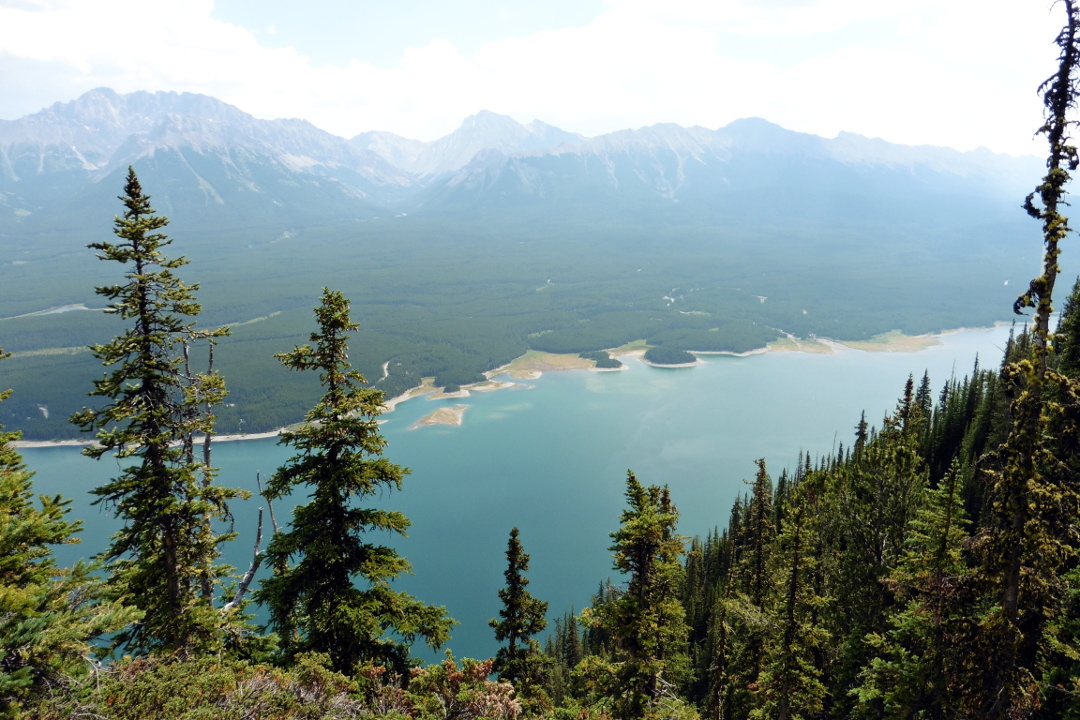
The route starts as a broad, needle-strewn trail but soon narrows and climbs amongst rocky outcrops near the edge of the mountain. Because the trail is decommissioned, it is no longer maintained, and has become braided with uncertain footing in places. The first viewpoint no longer has the Wendy Elekes Memorial Bench, but the view is still great, encompassing much of both the upper and lower lakes.
The trail continued to climb, and reached a fork where the route to the peak heads left. We continued a quarter-mile on the level to the final viewpoint, where we had our lunch. The trees here have grown up to obscure parts of the view, but I took a photo looking northeast,
and one looking southeast.
As we ate our lunch we also kept our eyes on a hawk soaring on the mountain breezes.
On our way back down, we paused at a meadow not far from the top, and I took another panoramic photo.
Clouds are gathering to take a vote on an afternoon thunderstorm.
Zooming in, the camera captured the parking area where we started.
Just a few steps beyond the meadow we encountered a blue grouse, hiding in the shade under a tree. His strategy was to hold absolutely still.
He looked big to us, bigger than the ruffed grouse we'd seen in the past. It turns out that the blue (lately subdivided into dusky vs. sooty) is the second largest grouse in North America, after the sage grouse.
Joan and I continued our descent, passing a few more people headed up. There were scattered drops of rain as we reached our car, but the thunderstorm convened at a different location.
We checked in at the Delta Lodge Kananaskis, now the Kananaskis Mountain Lodge, where they offered us an upgrade to an air-conditioned room with continental breakfast for a modest-enough fee that we accepted it.
Joan and I plan to tackle Wasootch Ridge tomorrow.
July 30th started with a cold breakfast buffet, then a hot breakfast buffet, and then a lunch fixings buffet at Mount Engadine Lodge. It wasn't an early start when Joan and I set out to hike West Wind Pass and on to the Windtower. Or at least as far as we could go, given our launch time. We agreed on an approximate turn-around deadline of 1:30.
Many of the guidebooks refer to a parking lot on the west side of the road. It doesn't exist any more after the floods of June 2013, so we parked off the east berm of the road. The trail to West Wind Pass begins at the level of a creek, which is now filled with rubble.
The route fluctuates between flat and steeply uphill, with the creek further and further below you on the right. The trail splits into braids from time to time, but we made it up to the pass without getting lost. Here's the view to the east from West Wind Pass.
At least two other groups preceded us to West Wind. One was from Yakima, Washington.
To the right looms the Windtower. Its geometry is similar to that of the nearby Ha Ling: a sheer face to the east and north, but a slope to the west.
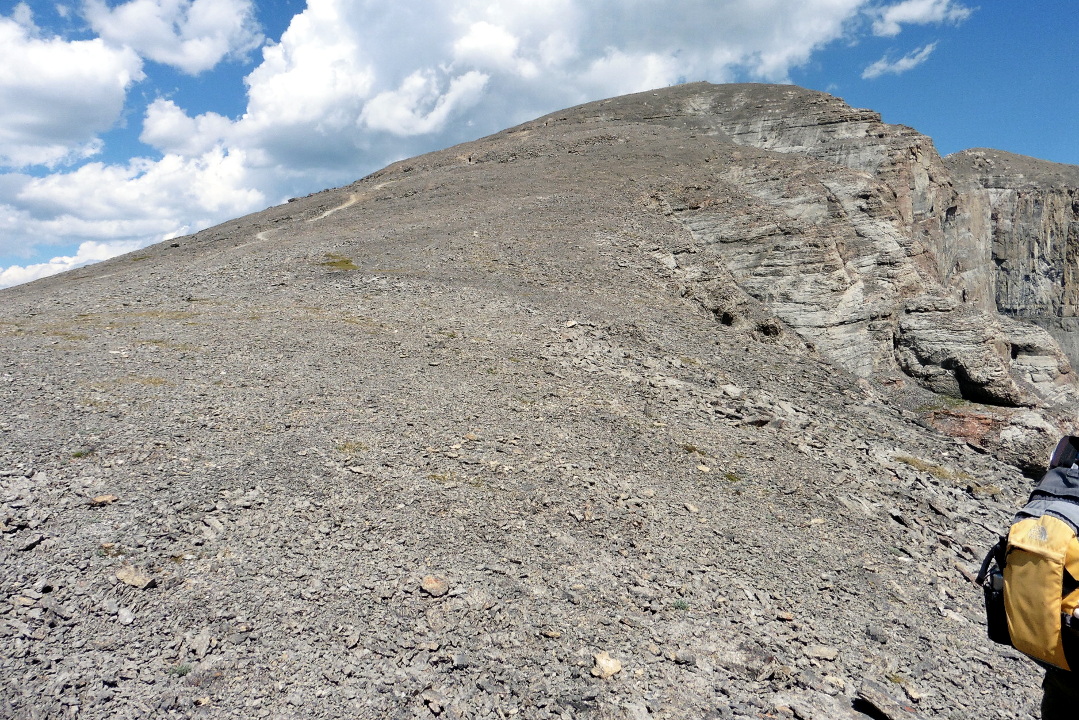
The route to the top of Windtower takes you south, gently rising, with occasional rock ledges to climb over. Then it takes a sharp left turn and climbs steeply through scree to a saddle, after which is the final bump of the Windtower. Let's look at an image again; click to enlarge. On the far slope there are at least half a dozen trails heading south, but they gradually combine. It can be confusing, even with a guidebook in hand, but if you keep heading south and, if presented with a choice, uphill, you'll arrive at the clearly defined sharp left.
This photo looks back to the pass at an early stage of our Windtower effort.
The trail became more difficult when it headed steeply huff-and-puff uphill to the saddle. It's full of loose scree, and sometimes I spent a moment pondering which route for the next fifty yards offered the best footing. This photo was taken from our lunch stop, where the trail has a green patch and temporarily is less vertical.
This was our view of the onward trail. You can make out that there is a saddle to be reached before the final push to the top.
Joan and I reached the saddle, and looked at our watches. We wouldn't summit Windtower, not this time. Here is the view to the east.
This was our view towards the top.
And here's the stunning view to the west, including the Windtower on the right.
The clock said it was turnaround time, and I didn't feel like arguing, even though the peak was issuing its siren song. The scree-filled path turned out to be easier footing going down than up; in places it was like walking on crusty snow. On the final approach to West Wind Pass we bushwhacked from one path to a better one, but being lost was out of the question with the pass visible in front of us.
Barreling down from the pass I took a wrong braid and after a while Joan halted my headlong rush. We backtracked a short distance (uphill) and then crossed over to the correct path, arriving at our rental car in decent time but tired and hot. To make it to the top of Windtower on some future hike, we would need to make arrangements at Mount Engadine Lodge for an earlier start. And I'd pack a couple of extra energy bars.
As we drove back to Engadine a convoy of three TransAlta utility trucks passed us in the other direction. They kicked up a stone that smacked our windshield at the level of my forehead, leaving concentric rings of fractured glass between two and three inches across. Thank God for safety glass! This was annoying, as well as scary, but we had dealt once before with windshield replacement in a Canadian rental car, so it wasn't intimidating.
Back at Engadine, in the evening light, the mountains were spectacular.
The other guests were admiring them as well.
Later on, it was moose time at the mud wallow, as it is almost every day.
The sun disappeared behind Tent Ridge, but continued to shine on the clouds.
Here is a two-moose photo, one on extreme left and one on the right.
Tomorrow would be an eventful transit day with another new hike.
July 28th was a transit day; we drove from Yoho National Park in British Columbia to Mount Engadine Lodge, in the Spray Valley Provincial Park, Alberta. On the way we took a detour on Highway 93, south to the parking area for the hike to Arnica Lake. This snapshot from Google Maps shows the parking area in the upper left, and Arnica in lower right.
Unfortunately, the trail first descends to the level of Vista Lake before commencing a relentless climb up the flanks of Storm Mountain. This early view of the trail doesn't yet reveal Vista Lake.
Along this stretch there were several towering concretions/agglomerations, looking like wanna-be hoodoos. We were also buzzed by a hummingbird near this location.
The trail bent to the left, continuously descending, and Vista Lake grew closer.
This shot was taken from the lake's outlet. As the Copelands' book Don't Waste Your Time in the Canadian Rockies notes, it's an odd name for a lake at the bottom of a viewless fold.
After forty minutes of steady climbing we had gained enough altitude to look back at the parking area. The trees are young, regrowth after the 1968 Vermilion Pass fire. Our bodies were throwing off copious amounts of heat from the uphill slog, so being in the sun wasn't as pleasant as it ought to have been.
Towards the top of the climb we left the burn area, and the trees became much larger and taller, a wonderful development. Our pigs were relieved when we arrived at the shores of Arnica Lake.
It was a beautiful spot to take lunch. A light breeze helped keep the bugs away, mostly, and dry out our sweat-soaked shirts.
This was the turnaround point of our day hike. Overnight backpackers continue on to Twin Lakes and a popular campground. We didn't encounter any other hikers on this trail, however, until after starting our return.
When we broke out into the burn area I took another panoramic photo. The horizontal white streak is the cut for Highway 93.
Vista Lake was still a long way down.
This panoramic shot of Vista Lake was taken after beginning the ascent to the parking area.
Joan and I arrived back at the rental car tired and hot, but pleased with our first visit to Arnica Lake, overlooked until this twelfth visit to the Canadian Rockies. It's well situated for a travel day from Yoho to Mount Engadine Lodge.
At the lodge we met Riley and Mallory, the new innkeepers, and settled in. After dinner the sun slid behind the mountains, shadowing the meadow behind the lodge,
and half an hour after that, the famous Engadine moose began to show up at the mud hole. They slurp up the muddy water for its mineral content.
I also captured a photo of this year-old male moose; check out the knobbly little antlers he's growing.
Tomorrow, Joan and I will tackle a truly aggressive hike.