Monday, April 25, 2016

CW: Canyon of the Ancients

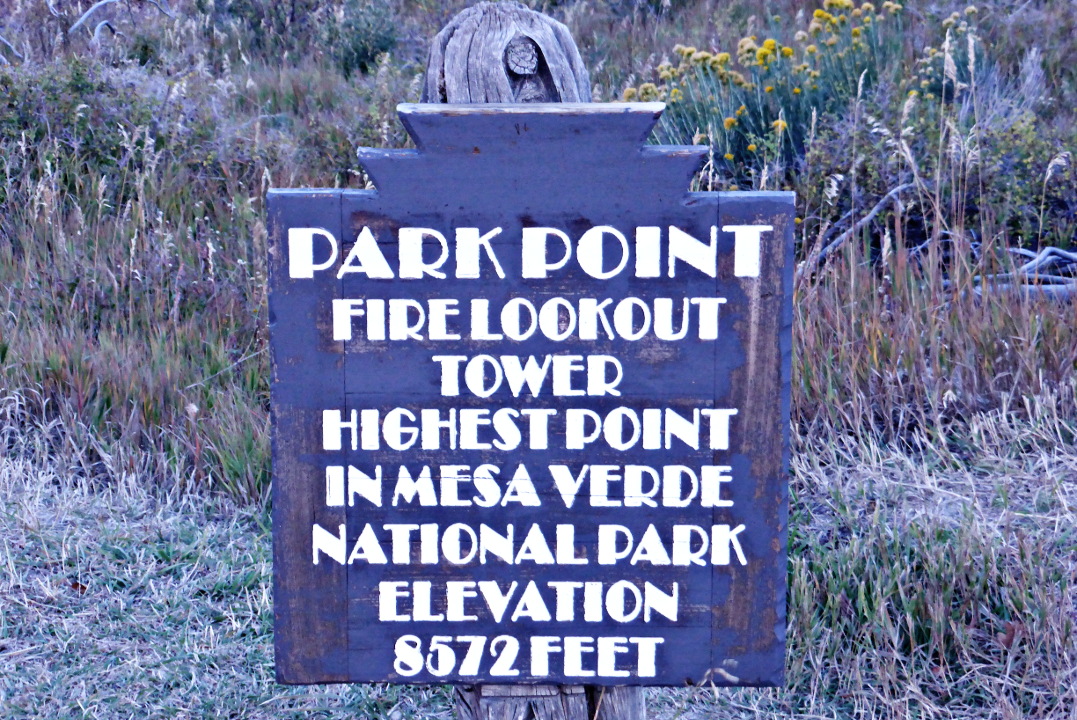
Our group started September 28th with a pre-breakfast jaunt to Park Point, the highest elevation in Mesa Verde.
The guides parked our vans at the bottom of a driveway to the fire lookout. Technically you aren't supposed to go further than the closed gate until a ranger arrives, but our Country Walkers guide Tim had cleared this visit ahead of time. The sunrise colors were spectacular.
After walking around the gate and up the driveway, I took panoramic shots in three directions, and still didn't cover the entire 360º of the view. One,
 two,
 and three.
At full zoom, my camera captured the Far View Lodge and associated complex, where we had spent the night.
In the other direction lay the town of Cortez, which we would drive through after breakfast.
And away in Arizona, Shiprock poked up out of the desert. This name resonated with Joan and me because we'd listened to or read many of Tony Hillerman's Navajo Tribal Police mystery novels.
Returning, we reached the closed gate as the ranger drove up. He hadn't gotten the word that our Country Walkers group had been cleared to visit the lookout prior to his arrival. Tim was able to smooth the ruffled feathers quickly; as the ranger departed for the tower, his final words were, "all goodness."

After coffee and breakfast at the lodge, we piled into the two vans and descended about 2,000' from the mesa to the valley floor. Beyond Cortez we found the Canyons of the Ancients National Monument. It was already warm and sunny, and at this lower altitude it was certain to be a hot day. Fortunately we'd been advised to bring plenty of water.
We would be accompanied today by Shawn and Sarah from the Crow Canyon Archaeological Center. Sarah was accompanied by her pack-rat, Peetie.
After an orientation near the entrance, our group launched into the Sand Canyon trail. From this southern trail-head it would be a 13-mile round trip to Sand Canyon Pueblo, so that's not within reach today.
Here we're listening to Shaun.
Not all of the desiccated relics in the monument date from the time of the ancient Puebloans. (Linguistic note: you may be familiar with the term Anasazi. This is a Navajo word for "ancient enemies," and contemporary Pueblo cultures prefer that you use a different tag.)
Early on we encountered this multi-layered hoodoo; hard capstones on top, softer rock in the middle, and chunky stuff on the bottom!
Much of the trail was out in the sun.
A small alcove was next.
Several structures follow this bluff.
This is a closer look at the left-hand side,
and then the right.
Our lunch stop was at the foot of the left-hand side.
After lunch there was a choice. We could return to the start with the two Crow Canyon guides for an atlatl demonstration, or continue with Tim, heading for a "surprise" about half a mile away that he and a friend had discovered several years before. Tim needed three or so tries to find it again, but now clearly knew the way. Joan and I decided to go with the surprise.

Over the past two days we'd learned about the various theories and discussions regarding the arc of the ancient Puebloan culture: how it started as hunting and gathering, then cultivating corn was introduced/adopted, then cliff dwellings became common, and finally this area was abandoned for points further south. Climate change (drought) and warfare have been the most prominent proposals for the exodus. IMHO the answer is probably "all of the above, and they're interrelated."

Here Tim shows us his surprise, what appears to be a watcher's post.
A view from the inside.
The walls had been built with a double course of stone, and at least one peephole or arrow port still exists.
This structure provides a good view of several approaches to the upper canyon.
In conjunction with other "watchtowers," this station could have been a link in a wall of vigilance.

Then we returned to the parking area and discovered that the atlatl demo was over, and the Crow Canyon guides and our other half had already departed. We piled into the remaining van and returned for the Far View Lodge for our second and final night atop Mesa Verde.

Tomorrow we would drive to Moab.

Friday, April 8, 2016

CW: Mesa Verde

On Sept. 26th, 2015, Joan and I began a southwestern trip, back-to-back one-week excursions with Country Walkers that would take us to spectacular locations in Colorado and Utah.

Today we are to fly to Durango, Colorado, via Dallas on American Airlines. But first, the gate agents told us there's no meal service because the plane wasn't stocked in Dallas. (Even though it has been sitting overnight in Columbus.) They gave us vouchers, which Joan and I planned to use in Dallas, and we boarded the plane. Then the pilot switched on the intercom. There was an issue.

The log documenting the overnight maintenance on the airplane hadn't been signed by the supervisor. We can't fly until it is signed. It's a Saturday, so the person who can sign it is not on site, but on call. He'll get here no sooner than an hour and half, likely two. Joan and I looked at each other. This is the second time we've been delayed recently by unsigned maintenance logs at Columbus. Everybody got off the plane, and Joan and I used our vouchers to grab and consume sandwiches as we waited.

Fortunately the gate agent was able to reserve us seats on a later flight from Dallas to Durango, the last such flight of the day. We had enough time in Dallas to amuse ourselves by riding the elevated train around the airport. On arriving in Durango, the small airport there was almost deserted. We shared our ride on the hotel shuttle (about a twenty minute ride) with the aircraft crew.

The next morning we met our enthusiastic guides, Tim Smith and Clint Fries, and our fellow travelers in the hotel lobby. After piling our luggage into two vans we headed out for Mesa Verde National Park; the first stop is the visitor's center. Outside there is a tall sculpture.
It illustrates how the ancient Puebloans used carved foot- and hand-holds to climb up or down to their cliff dwellings.
After driving to the top of the mesa, however, our first stop was not a cliff dwelling. It's the Far View Community, a collection of up to 50 villages that predates the cliff dwellings by at least 200 years.
Here Tim Smith is explaining the features of this site.
At this spot we could peek into the remains of a kiva. Kivas were used primarily for ceremonial purposes.
Another section of a village.
We then dashed to the Balcony House site, where a ranger-led tour began on the hour. The ranger warned us that the tour would include ladders, tunnels, and heights, so visitors must be able and willing to negotiate these to participate. Nobody from our Country Walkers group elected to stay behind.

This is a view from the top of the mesa at Balcony House.
After descending some stairs the ranger closed the gate behind us, and it wasn't long before we encountered the first ladder.
Up we go!
The Balcony House was already in shade when we reach it a few minutes later. It's situated to receive the warming rays of the morning sun, but to be in shade as the day grows hot.
Our ranger gave a talk here.
A long view down the balcony.
We gathered at the far end for an explanation of the kiva and its design.
A look into the interior of the kiva.
The central pit would hold the fire; the small block diverts fresh air emerging from the duct around the flame. In its day the kiva would have been covered with wooden poles.

We continued on. There's a crevice leading to the tunnel.
The tunnel is small enough that Joan and I removed our daypacks and pushed them in front of us.
After negotiating the tunnel there was one more (metal) ladder to climb to regain the top. The ancestral Puebloans would have used only foot- and hand-holds as illustrated at the visitor's center.
Next we took a quick swing by the Cliff House. This settlement is the iconic cliff-dwelling site, photographed endlessly. Today and the next few days, however, it's closed for some repair work! Our group walked down to an observation point, and we took snapshots.
Impressive, isn't it? It might even look familiar. Here I zoomed in a bit.
By now it's time for lunch, for sure. Back into our vans ...
... and on to a picnic ground, where our guides spread out the treasure that has been hidden in their coolers.
Supervised by guests, bluebirds,
and the two pigs Joan and I brought along, Zorba and Paco.
We all sat in the shade because the weather was dry and hot, even though Mesa Verde lies between 7000 and 8500 feet and this was the last tour of the season. Tim told us that sometimes the final tour encounters snow atop the mesa!

After lunch we drove on to Spruce Tree House. And we were very lucky, because shortly after we visited (Sept. 27th) the site was closed due to rock falls from above. A short, paved walk led us down, and we arrived at the dwellings.
A wider view.
One kiva is open for visitors. Joan goes in.
My photo of the interior. The ladder rungs are well-worn and polished.
From the Spruce Tree House our group embarked on the Petroglyph Point Trail, a 2.4 mile loop. About hour in, we came across some cliff structures, not open to the public.
Here's a view from the trail taken after another 20 minutes of walking.
We reached the petroglyphs, and in this picture Tim prepares to give us a talk on the possible meanings of these stone recordings. Perhaps they are a history of the migrations of the ancestral Puebloans. (Click on the image to enlarge.)
A closer peek.
Shortly afterward the trail bent upwards and we regained the top of the mesa for a gentle stroll back to the Spruce Tree House. An unconcerned collared lizard gave us quite a show. Look at that tail!
And again.
The lowering sun was lighting up the adobe when we returned.
What a day it's been so far! Our next stop was the Far View Lodge, also located atop the mesa, to unpack and have dinner. Close by the room that Joan and I received were two electric car chargers, a Clipper Creek and a Tesla destination charger (not a supercharger).
A tour group using a large bus was also staying here tonight, and the dinner service at the lodge was spotty -- one table waited two hours for dinner -- but the location was perfect. And tonight was the night of a total lunar eclipse. By dint of shooting dozens of photos with my point-and-shoot camera, bracing it against the railing of our room's balcony, I ended up with one passable image.
The nighttime sound track was the bugling of elk, a call I had never heard before. The males were trying to find mates, but, we were told, the females don't climb the mesa, so the vocal efforts were futile.

What a busy day this was! Joan and I were to discover that this would be the pace for the next two weeks -- Country Walkers wants you to see as much as possible in a one-week trip (weekend to weekend).

Sunday, March 13, 2016

Juno's Final Upgrade

Juno, my homebrew desktop computer, started out in early 2010 with a 40 gigabyte (GB) solid state drive (SSD) to hold the operating system, and a 500 GB hard drive to hold everything else. (An SSD is much faster than a regular hard drive.) About 2½ years later, I upgraded Juno to a 128 GB SSD (Samsung 830), putting aside the 40 GB drive (an Intel X25-V). Now the SSD could hold my personal files as well, excepting all the photos and videos, which still resided on the hard drive (Hitachi 2.5" 7200 rpm). This further improved Juno's peppiness. In early 2014 I moved Juno into a new case, just for the purpose of taking up less room on my desk.

Juno is equipped with 4 gigabytes of RAM (main memory). This was plenty starting out six years ago, but now, when I have my email program, web browser, thumbnail viewer, and photo editor running, they don't all fit into memory at the same time. A process called "swapping" takes place; the operating system (Linux in this case) picks something residing in memory that hasn't been active for a while and copies that to the hard drive, freeing up RAM for the program that needs more memory.

Swapping slows everything down. Badly. Click to bring a program to the front, and hear the little hard drive chittering away as it writes stuff out to make room for that program, and fetches the previously swapped-out program. Sometimes it can take 10 seconds.

I decided to experiment with reusing the old 40 GB SSD as the swap drive. In the early days this was discouraged, because it could lead to premature wearing out of the SSD. However, because Juno swaps only during peak loads, and because I anticipate needing only a year of service before building a fresh computer, I decided to go ahead. The alternative, buying more RAM, would have been more expensive and much more work -- disconnecting cables from the motherboard, removing the motherboard, and then removing the heatsink from the motherboard to access the RAM slots. Ugh.

Juno has one available SATA connector on the motherboard which could accomodate the SSD, but the interior of the computer is cramped after the transplant to the new case. I decided to use the external SATA port (eSATA) of the computer, and place the SSD in an enclosure to connect it in a tidy fashion. I chose one from Oyen Digital, which comes with any cable I might conceivably need, and ordered from Amazon.

Here is the opened box. In case you need lots of oomph, a wall-wart AC adapter is also included.
Here the old SSD has been inserted into the tray that pulls out of the adapter's housing.
It didn't work at first. After spending some time trying alternatives, including using a spare 2.5" HDD instead of the SSD, I finally figured out two things. First, the eSATA cable isn't carrying power, so I had to additionally plug in the supplied USB to DC-in cable. Second, although there was stuff on the SSD, an icon for it did not appear on the desktop even when the power issue was resolved. Disk drives and thumb drives plugged into the USB ports result in desktop icons, but the eSATA port apparently does not. Once I figured out that the lack of an icon didn't indicate a problem, everything began to work. Here's a view of the back of the enclosure, with the two cables.
This is how it looks from the front. The little box on top is the enclosure; its blue LED light is a power indicator.
When all goes well and the swapping takes place on the SSD instead of the HDD, a heavy-swapping situation induces a silent, 1 or 2 second lag instead of 10 seconds of disk chatter. That's pleasing. However, after a day I ran into problems.

Inspecting the system log (/var/log/syslog), I could see that sometimes the connection was established at full speed (3.0 Gbps). Just as often, however, Juno would back down to 1.5 Gbps. This wasn't fatal, but it was odd.

Then, while shorter sleeps ("suspend to RAM") appeared to work OK, the overnight sleep was a problem. (Interestingly, the LED indicated that the SSD had power even while the computer was asleep.) The connection to the external SSD would suffer several timeouts, and when the computer finally came up, the Internet connection was down. That should be unrelated, but a consistent coincidence isn't a coincidence, is it? 

I found messages that indicated some kind of SSD corruption; for example, the serial number of the SSD came out wrong -- it looked like a fragment of a pathname. I performed a factory reset with the command "hdparm --yes-i-know-what-i-am-doing --dco-restore /dev/sdc" and then the data from "smartctl --info /dev/sdc" looked sane again. However, I still had the problem the next morning.

It was time for step-by-step testing.

Test #1: turn off and remove the external device. Overnight wakeup is OK.

Test #2: install external device, but don't power it up. Overnight wakeup is OK, as you would expect.

Test #3: power up external SSD, but don't use it for swap or anything else.

At power-on:

Mar  6 14:32:43 juno kernel: [38604.492274] ata4: irq_stat 0x00000040, connection status changed
Mar  6 14:32:43 juno kernel: [38604.492278] ata4: SError: { PHYRdyChg CommWake LinkSeq TrStaTrns DevExch }
Mar  6 14:32:43 juno kernel: [38604.492286] ata4: hard resetting link
Mar  6 14:32:44 juno kernel: [38605.328024] ata4: SATA link up 3.0 Gbps (SStatus 123 SControl 300)
Mar  6 14:32:44 juno kernel: [38605.328241] ata4.00: ATA-7: INTEL SSDSA2M040G2GC, 2CV102M3, max UDMA/13
Mar  6 14:32:44 juno kernel: [38605.328245] ata4.00: 78165360 sectors, multi 1: LBA48 NCQ (depth 31/32)
Mar  6 14:32:44 juno kernel: [38605.328478] ata4.00: configured for UDMA/133
Mar  6 14:32:44 juno kernel: [38605.328506] ata4: EH complete

After overnight sleep: everything was OK!

Test #4: activate the SSD as a swap device, and don't turn it off overnight. (I reduced the size of the swap area from the entire 40 GB to 12 GB, just in case it was too much. Twelve is still 50% larger than the swap area on the hard drive.)

Everything is OK! Hmm. Also, there has been no resetting the link down to 1.5 Gbps from 3.0. Perhaps the factory reset on the SSD followed by turning it off and back on fixed something?!

Test #5: turn off the HDD swap device, "swapoff /dev/sdb1," so that the SSD is the only swap device. Overnight? Still OK!

This will probably be Juno's last upgrade -- six years is a long time in the computer world. The next project will be to build a new one.

Tuesday, March 8, 2016

Red-shouldered Hawk and Starling

Back on February 13th Joan spotted a red-shouldered hawk with something in its talons. Followed by a second hawk, it flew to a tree in front of our neighbors house. The trailing hawk perched above it, hoping for a morsel, but received none, even though we are certain they are a mating pair.

At first the hawk was on a tree branch.
It began working on the starling up there, plucking feathers. It takes a while to get to the meat.
The desperate starling suddenly began thrashing, or perhaps it was just its death throes. In any case, the hawk lost its grip on the carcass and had to land on the ground to retain possession of the prize.
Here's a video clip of the hawk working on its lunch. Note the regularity with which its looks up and scans its surroundings, checking for any threats.


Life and death in the woods!