The ferry took us to Stromness, on the main island, or "mainland," of Orkney, in about an hour and a half. Our group had a substantial lunch on board, and then, as the ferry approached the southwestern-most island of Hoy, we stepped out into the sea breeze to view the impressive sea stack called the Old Man of Hoy, 450 feet tall.

Then we arrived in Stromness and boarded our bus for the drive across the mainland. We passed several sites that we would visit the next day, and stopped briefly at Scapa Flow to visit the Italian Chapel. This chapel was built in a "nissen hut", what I grew up knowing as a Quonset hut, by Italian prisoners of war in the early years of the Second World War. The prisoners were laboring to secure the eastern entrances to Scapa Flow, the main base of the British Home Fleet, with "Churchill Barriers" after the German submarine U-47 entered the flow, maneuvering around sunken merchant ships, and torpedoed the battleship Royal Oak. (Scapa Flow is also known as the place where the German High Seas Fleet was interned at the end of WWI, and was scuttled in June 1919 to avoid turning it over to the British.)
These prisoners found there was no Catholic place of worship in Orkney, so they built their own out of what they had at hand, or could beg from the British officer in charge: paint, wood scraps, cement, and two nissen huts from the prisoner barracks. The view from the front does not hint at poverty of resources, although it is small.

Stepping to the side reveals the huts.
Inside, the trompe-l'oeil painting of the interior walls is stunning. You must put your nose inches from the walls to see that they are not truly tiled, and my photograph doesn't do justice to them.
The altar area is also exquisite.
The chapel was restored in 1960, including a three-week visit by the guiding light of the original construction, Domenico Chiocchetti, paid for by the BBC.
A brief shower on the way to our hotel, the Lynnfield, freshened these flowers.
After dinner, we had an enthusiastic presentation from a local booster. It's clear that if you bend over to tie your shoelace in Orkney you'll probably discover a new neolithic archaeological site.
In the morning we set off for Skara Brae, a five thousand year old village discovered when a violent storm in 1850 eroded its protective grassy mound. The village, originally a bit inland, is now threatened by the sea.
The walk from the visitors center to the village is demarcated by blocks representing how far back in time you have gone. Here is the first one.
It's a loooong walk back to Skara Brae time.
Another marker ... but not quite halfway there yet.
OK, here we are!
The site is well-marked with signs (don't worry, I won't show you them all.)
It is remarkable, and humbling, to see what people could do 5,000 years ago. They were only at the beginning of the long "by your bootstraps" accumulation of science and technology that we enjoy, but they were every bit as intelligent as we are.
The climate was also more benign in 3100 BC than today.
The houses were connected by walkways.
Waste was not wasted.
Back near the visitors center was a reconstruction of of a Skara Brae house, complete with roof. Unfortunately, we had to dash in and back out for lack of time; Skara Brae deserved an extra 15 minutes (30 if you wanted to browse the gift shop.)
Also on site is Skaill House, the manor house associated with the Bay of Skaill, where Skara Brae sits. As usual ...
I'll give Skaill House no more words, but move on to our next stop, not far away, the Ring of Brodgar.
The remaining 27 standing stones are part of a perfect circle about 340 feet in diameter, with two entrance passages through the surrounding deep ditch. Although the center of the ring has not been excavated, it is estimated that the ring was built between 2500 and 2000 BCE, which would make it the last great Neolithic monument on the Ness of Stenness. The Ring of Brodgar was declared a UNESCO World Heritage site in 1999.
Joan cheerfully provided some scale.
Our local guide for the day, Thelma, points out some faint Viking graffiti carved into a stone.
Not far, just a stone's throw, from the Ring is a dig begun just last year -- 2009 -- which has uncovered a complex alternately called 'the cathedral' or 'Structure 10.' We had neither the time nor permission to visit it, and were soon on to Maes Howe, a chambered cairn. From the outside, it appears like this.
The cairn can be entered only as a group, at certain times, with an official guide. Interior photographs are not allowed. But I do have a couple of signs to show you.
Of particular interest were Viking runes from 1153, when a band of Vikings sought shelter from a blizzard by breaking into the mound. Looking back from the Howe, you can see the Ring of Brodgar across the loch.
From Maes Howe it was back to the Lynnfield for a light lunch, followed by a tour of the Highland Park distillery, just a few blocks from the Lynnfield. Highland Park was founded in 1798 and by some accounts is the northernmost whisky distillery in the United Kingdom.
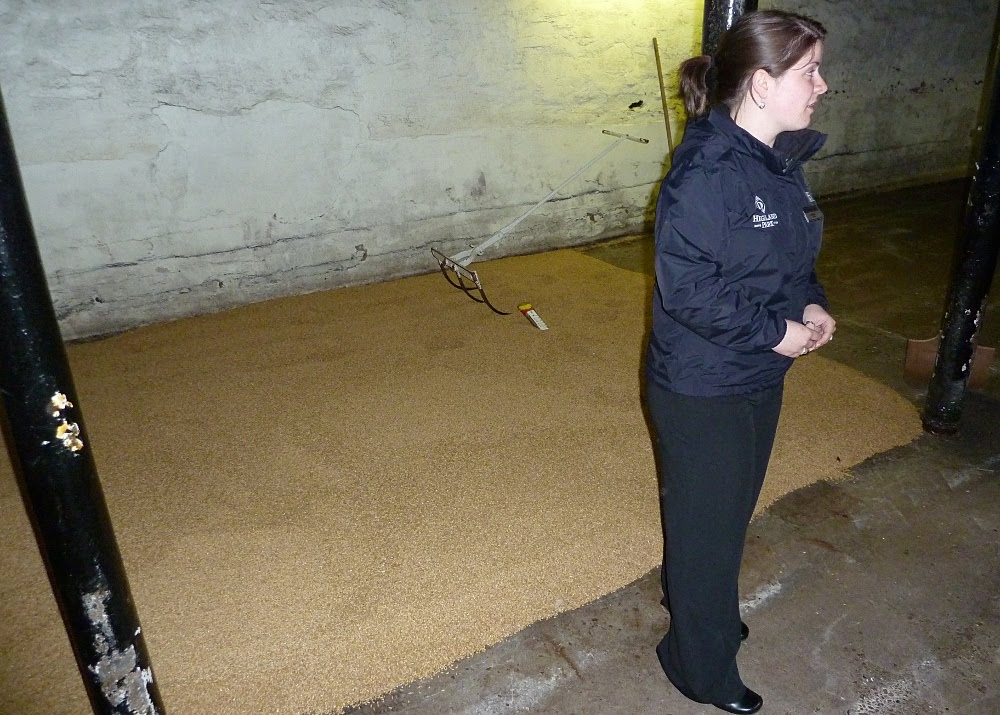
We dashed through a brief but intense shower as we got off the bus, and, after watching an introductory video, took the distillery tour. Our first stop was the barley spreading area.
The photograph covers a small section of one very long room, where soaked barley is allowed to germinate. The grain must be turned periodically to air out and prevent overheating during this process. We were visiting the distillery during their mid-summer "off" weeks, when production is suspended to avoid problems with days too hot for the barley, and to avoid taxing the springs upon which the distillery sits during dry season. Here are the traditional turning shovel and a more modern contraption.
Only 20% of the barley needed by the distillery is processed at Highland Park; because of the great volume of barley malt consumed, the other 80% comes from commercial suppliers.
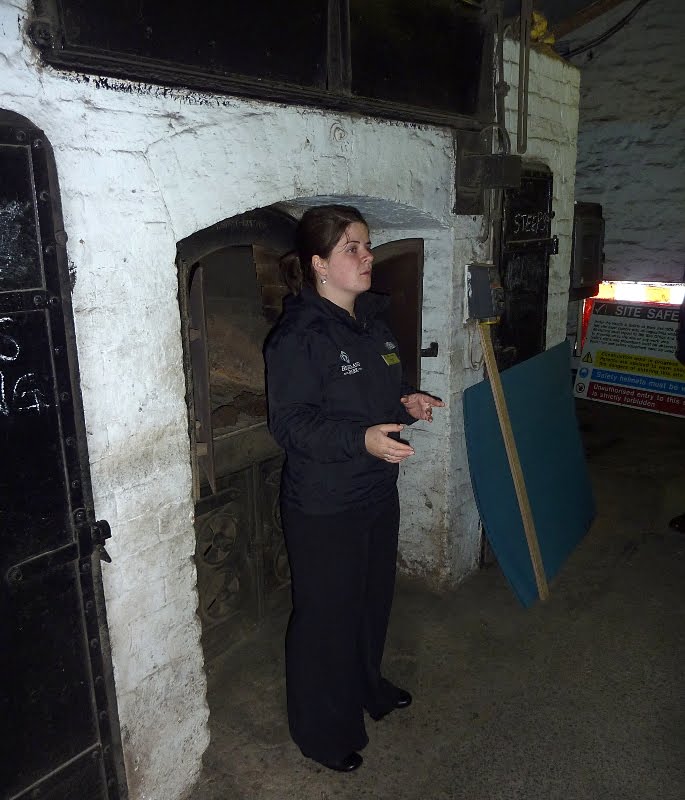
Here is the peat kiln, which uses only local peat. The germinated barley is dried and heated (halting the germination process), and absorbs flavors from the heavy peat smoke.
The fermentation tanks, still traditional oak, were quiet and still, which allowed us to hear our guide without straining. The big stainless vat might be the grinder.
A display case shows the stages of the barley, from raw grain to ground malt flour.
The distilling pots were fascinating, huge copper gourds that we were required to photograph from the entrance to the building, in case lingering alcoholic vapors might be ignited -- not so much a risk during summer suspension, but rules are rules!
I learned that the liquid is distilled twice; the first pass takes the alcoholic content up into the 25% range, roughly, and the second pass transforms it into strong whisky.
By law the whisky must be aged for at least three years, but the youngest Highland Park whisky is aged for twelve. Both American and Spanish oak are used for the aging barrels; the Spanish oak is recycled from sherry barrels, and so adds a denser and less medicinal quality to the product (to my taste buds).
Here is one of several buildings where the whisky rests. As it ages, small quantities of alcohol seep through the oak and are lost to the atmosphere, the "angels' share."

At the end of the tour we had a free tasting; one wee dram of 12-year-old (American oak) and one 18-year-old (Spanish oak). Joan and I had our chance here to add a splash to water to the whisky, which did improve it by releasing some extra flavor, perhaps making it more accessible to the tongue and palate. Still, and I am no whisky connoisseur, I'd be tempted to take the "first pass" (25% alcohol), add a splash of sherry (who needs oak staves as a middleman?), and call it a day. Maybe it would still need aging. Maybe it wouldn't. I'd get thrown out of Scotland for trying, though.
We weren't through with our day yet, and this means you're not finished with this post yet. Down the hill from Highland Park, in the center of town, is the Saint Magnus Cathedral. Here is the official web site of the Cathedral.
The Cathedral is dedicated to Saint Magnus, from the late 11th and early 12th Century. He met his demise in disputes over who governed Orkney. His nephew, Rognvald, invoked St. Magnus as he (Rognvald) took his turn disputing the earldom of Orkney. At the suggestion of his father, Rognvald told the people of Orkney that if he became earl, he would build a magnificent cathedral to St. Magnus. This "hearts and minds" tactic (as well as the kidnapping of his rival) was a complete success.
I must note that the Church (any church) has never been the owner of the cathedral. To quote,
St Magnus Cathedral is unique in that it actually belongs to the City and Royal Burgh of Kirkwall. It is not, and has never been, the property of the Church.
In 1468, when the islands were transferred to Scottish rule, King James III had no means to look after the building so granted it to the "Magistrates, Council and Community of Kirkwall". This act meant that the cathedral had to be classed as a heritable possession and therefore charged the town with its maintenance.
The situation is the same today - St Magnus' Cathedral is, quite literally, Kirkwall's cathedral.
The Cathedral is built of red and yellow sandstone. The abrasive action of the howling Orkney winds has worn the outside down in the intervening centuries, and some bits are newly restored. Here is the exterior view.
Next, the view from the entry.
A partially successful attempt at photographing some of the stained glass.
In continuous use for over eight centuries, the cathedral often reflects an evolution of attitudes towards death from the medieval to the modern times. Here are the two sides of a "death sign," or, more properly a memento mori.
Much more modern is the tomb of John Rae, an Arctic explorer. The men of Orkney were heavily represented in Arctic expeditions and in the ranks of the Hudson's Bay Company, because they were accustomed to deprivation and a harsh climate.
There is a tribute to the men of the Royal Oak, 833 of whom were lost when she sank.
The bell is from the Royal Oak, but it is not the official ship's bell, it is just one of the bells from the ship. The ship's bell lies undisturbed on the Royal Oak, which is an official war grave much like the Arizona in Pearl Harbor.
At the head of the cathedral are the figures of Rognvald's father Kol, who supervised the early stages of construction, Rognvald, and St. Magnus. I get the feeling that Kol was the brains behind Rognvald's throne.
Lastly, a shot of the pulpit in the center of the cathedral.
Then it was time for a deserved rest and dinner. Sticky toffee pudding may have been called for. The next day we were off for two nights on the island of Westray and more adventures. I'll sign off with two hints: puffins, fattie cutties, and the shortest airline flight in the world. OK, you're right, three hints.