The next morning we assembled ourselves for an overnight trip to The Wilds, a wildlife conservation center in southeastern Ohio, about an hour and a half from our place. The Wilds is one of the largest conservation centers in the world, nearly 10,000 acres, situated on land strip mined in the 1960s and 1970s and reclaimed in the early 1980s. (The world's largest dragline, called Big Muskie, removed twice the soil moved in building the Panama Canal to uncover the coal.)
That day Columbus was on the edge of a conveyor belt of storms streaming up the Ohio River valley. As we drove towards The Wilds, the ash-gray sky became darker, sprinkles transformed into a steady rain, and the wind picked up. Clearly we would postpone our Open Air Safari until tomorrow, fingers crossed.
On arrival we checked in at Nomad Ridge, the one-year-old group of yurts that provides a lodging choice for groups too small to stay in The Lodge.
During a great dinner at the Overlook Cafe -- we were the only diners, unsurprising on a rainy Sunday evening on the first weekend Nomad Ridge was open -- Joan and I learned the French term for raccoon. (The Overlook Cafe gets a regular visitor.) It is raton laveur, "washer rat," very apt. We then spent some time on the observation platform next to the yurts, even if it was too wet to light the fire pit.
There were white rhinoceroses swimming in one of the lakes, best seen through binoculars. We were in the "contented" zone and hung out until it got too dark to see much.
As Joan will tell you, it rained and blew all night. (I think she was getting discouraged.) As we were rising a tangerine stripe to the north and west began to pry away the gray sky, and by breakfast time Chef Todd had already set up an outdoor table.
Then it was time to begin the first part of our day, the Wildside tour.
From the back of the truck we had an unimpeded view, and the truck could go off the road, unlike the buses. Some of us got a touch of pink from the unaccustomed sun.
It was spring, of course, so there were lots of young'uns.
Keep your hands inside the truck, please.
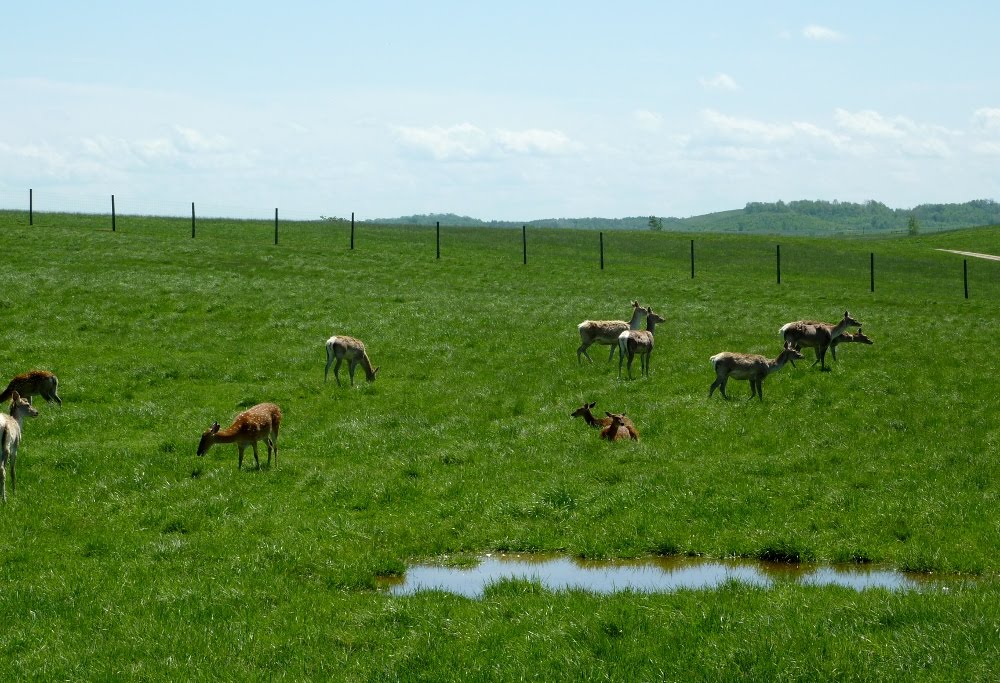
The Wilds is engaged in many facets of wildlife conservation: preserving species that are critically endangered, or have even been extinct in the wild, such as Pere David's Deer, species reintroduction, land restoration and ecology, conservation education, and conservation research. The Wilds gives researchers a chance to observe the animals in natural conditions, allowing them to experiment with and fine-tune protocols and equipment, such as anesthetic doses and radio collars, before embarking on research on truly wild populations. They also rehabilitate animals that have been kept in unkind conditions, such as a rhinoceros that had lived on concrete for so long that he had to be coaxed to step out onto grass.
Here's a pair of Bactrian camels. There's a male Bactrian who must think he has gone to heaven; previously confined for many years, he now lives with grass, girls, large spaces to roam, and a healthy diet.
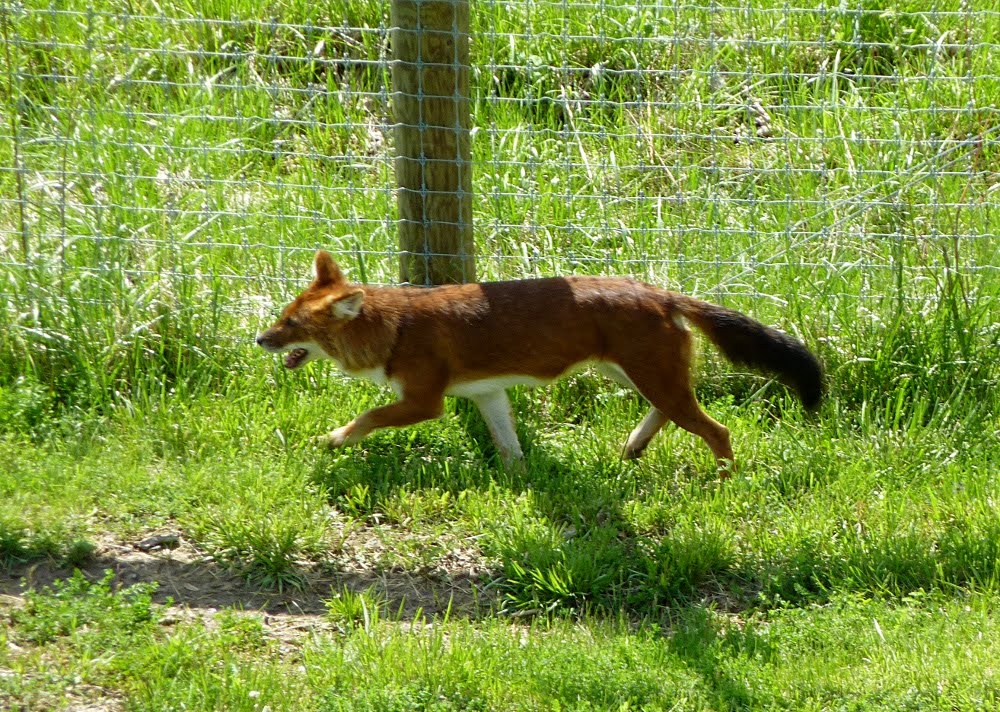
In the last few years the Wilds has expanded its efforts beyond herbivores with the 2007 opening of the Mid-Sized Carnivore Conservation Center. Here you will find African wild dogs, cheetahs, and dholes (Asian wild dogs).
Serge captured a good closeup of one of the African dogs through the fence.
The African wild dogs are pack hunters, and very intelligent. They outmaneuver and devour any Canada geese that land in their compound, feinting and confusing the geese with multiple threats. Keepers and handlers rarely enter their compound, even in a large group, because the dogs will instinctively identify the weakest member and target them. At the Wilds there is an extended family of the dogs.
The dholes are much shyer than the African dogs. They strongly resemble foxes.
But for sheer lithe beauty and grace, you can't surpass a cheetah.
To keep the cheetahs alert and interested in their environment, they are not fed one day a week. At the Wilds, fasting day is Monday. Today was Monday. A side note: if a cheetah is following you and/or your kids along the fence, he's not being cute; he's sizing up the smallest member of your party. It's what they do.
Chris, our guide, had a special opportunity for us at the normally off-limits cheetah quarters. The cheetah caretakers were closely watching a female, who they thought was approaching estrus. The female cheetah is interested in mating for only 12 to 48 hours in a year, so breeding cheetahs in captivity requires diligence. Only some males are tolerated by the female at any time of year, winnowing the number of potential suitors. The males are introduced into a plot that the female has recently inhabited, to expose them to her scent and gauge their behavior. Then they are returned to their own spaces.
We stood along one side of a roadway between compounds when the keeper released the males from the plot they'd been visiting, and they loped past us back to their own housing. The cheetahs came within a yard or two of us as we stood very still. Here's a look down the roadway as the last of the cheetahs reaches the end and slows down. Another, on the right, has paused to converse with the female inside the fence.
The female and the male she appeared to get along with were introduced into the same area.
Two of the video clips I took turned out OK; the wind muffles some of the sound. They show the two cheetahs getting more familiar with each other, but the male clearly understands that it's just not time yet.
Before we left, Chris cut off some willow that was growing in a streambed near the cheetah quarters. This will come up later.
As we drove on, we passed many critters. Here are some zebra.
The advantage of traveling in the truck became apparent as Chris sought out the takins for us. Joan and I have admired takins ever since seeing them in Bhutan, where they are the national animal. (These takins are a different subspecies, Sichan takin, B. taxicolor tibetana.) Chris drove offroad and cross-slope, on soggy ground from yesterday's rains, to arrive at a lakeshore woods where the females and the babies usually browsed. The takins have thrived at the Wilds, and their numbers have increased.
There were a couple of takin infants that were a mere two weeks old.
In one pasture various ungulates happily grazed together.
The male takins were taking it easy in a shelter house.
Then we hit rhinoceros country.
This giraffe knows that she looks elegant,doesn't she?
Now we learned why Chris had cut the willow branches.
We all got a chance to feed her. Hold on tight to the willow, though, or she'll pull it right out of your hand.
She'll also eat an apple slice from the palm of your hand. While she's distracted by eating it's OK to touch her face and feel the bristles.
The cab of the truck makes a good dining-room table.
This giraffe is the only one that has learned, or let her guard down enough, to accept Chris' treats. The others stand off and watch.
But now it's time to move on. More charismatic megafauna await, including this young rhino.
Another truck passed us by, a team looking for a day-old scimitar-horned oryx. They needed to give it an initial medical exam (largely drawing a little blood) and to tag it. Needless to say, the mother oryx was not pleased when her baby was discovered in the tall grass and abducted by the truck.
The exam went quickly.
And soon they were reunited.
Our next destination was back at the Visitor's Center. Usually our Open-Air Safari, as a group staying at Nomad Ridge, would have been the previous afternoon, but the skies were pouring then. Joan had verified before we left Reynoldsburg that we would be able to Safari after the Wildside tour if the weather was bad. While she tried, not for the first time nor the last, to check out of Nomad Ridge (they had a new computer system), I asked at the center about the Open-Air Safari. They radioed for a bus. The oil pressure on the first bus conked out as it reached the center, so we waited for another, which arrived after a few minutes.
I was concerned that riding in the Open-Air Safari after the Wildside tour would be anticlimactic, but the mood was cheerful and everyone had a good time, including the driver/guide.
One of our early stops was new to Serge and Jeanne, having been bypassed on our Wildside tour. (You can't see everything in just one morning!) There is a short gravel path that switchbacks down to a platform on one of the lakes, where you can feed the ravenous catfish and admire the trumpeter swans.
At the Mid-sized Carnivore Center, the African dogs were snoozing away the heat of the day.
The dholes, however, were more active than they had been. Their dark tails looked as if feather dusters had been glued to their rumps.
I won't inflate this post by repeating the zebra or many other pictures, but I do have a few more that I must show. This male takin had decided to chill in a small pond.
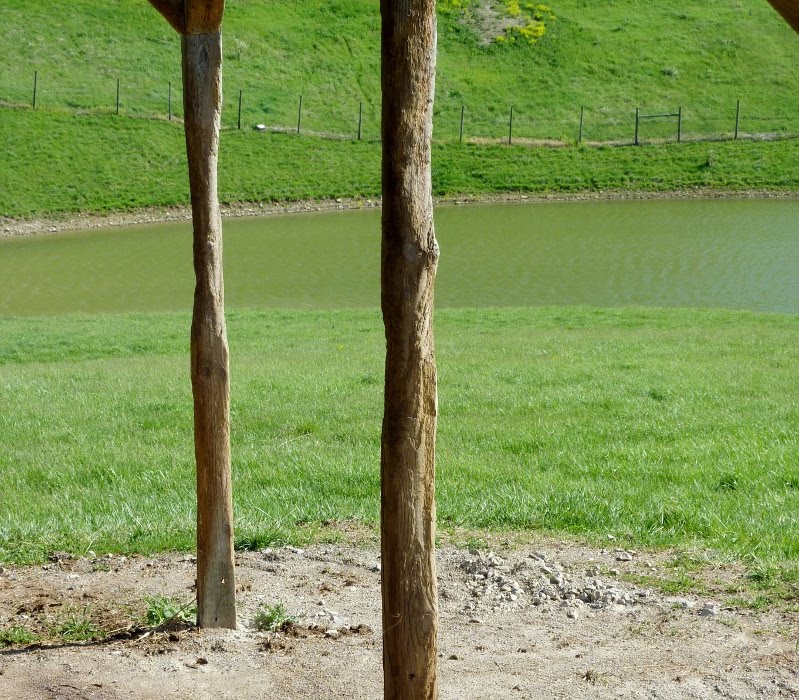
The camels nibble and scrape the shelter house poles until they resemble eroded pillars.
Here three rhinos are browsing amongst the autumn olive.
The autumn olive, Elaeagnus umbellata, or Japanese silverberry, is an invasive. While AEP (American Electric Power) did state-of-the-art restoration of the strip-mined area thirty years ago, the autumn olive is today a migraine headache for the Wilds, and they are experimenting to discover how to control or eliminate it without damaging the rest of the ecology. The autumn olive prevents erosion and fixes nitrogen in the soil, but it also crowds out native species. The ecological restoration work that goes on at the Wilds is not merely academic, but has practical applications in many situations, including their own.
Finally it was time for us to go home. Jeanne captured this image of the downtown church in Zanesville, Ohio.
Tired, dusty, and sometimes sunburned, we weren't eager to dress up to go out for dinner. Instead we stopped on our way, close to home, at the Wine Guy wine shop and bistro in Pickerington (now defunct). Serge and Jeanne found this fascinating. In their experience in France, a wine shop is a wine shop and a bistro is a bistro, and the two do not appear together! We had a good dinner and each indulged in a red wine flight, where you get a smaller quantity of four different wines, organized on a theme (Cabernet flight, Italian wines flight, and so forth). At the end of a long, sunny day, everybody was happy.
In our backyard, focused on the birdbath, we have a BirdCam (version 1). Creatures other than birds often come to the birdbath, of course, and I recently discovered a few after downloading the last seven months (!) of pictures. A chipmunk poses for his publicity shot.
Here, a squirrel is mystified at the absence of the birdbath on a day when it's been taken in for cleaning.
It's been an interesting month, house-wise. We've had both the top (roof) and bottom (basement) worked on. The roof needed cleaning and the basement was leaning!
Although the roof is only 7½ years old, the aerial environment at our place is much shadier than it was when we moved in 23 years ago. Already, it was staining, but I thought that was just cosmetic.
Then I saw that moss was growing in the most shaded areas. Look at where the upper gutter meets the roof, above (click to expand). Below, see some green locust leaves but also moss at the shingle edges. I freaked. Something had to be done ...
We had the roof cleaning done by a local outfit with excellent references and reports on Angie's List. The cleaning required part of a morning and all afternoon; partly because of our steep pitches and partly because of the techniques and thoroughness of the job. (About 70% of our roof surface needed treatment.)
First, a commercial cleaning product that is basically a sodium hydroxide solution is applied. After working on the algae and moss for twenty minutes, a moderate pressure wash (100 psi) takes all the stuff away. The gutters get cleaned (yay!) and our aluminum gutter guards came out shining. (As a high school geek who inflated dry cleaning bags with hydrogen generated from sodium hyroxide, water, and aluminum, I wasn't surprised.) A fringe benefit was that ¾ of our deck got cleaned by this process as well.
The final step is installation of zinc strips to prevent the return of the algae, which in turn prevents the moss from taking root. Left alone, these organisms will consume the mineral (limestone) components of the shingles. Keeping it clean, we were told, instead of letting the moss have its way, should add 10+ years to the life of the roof.
Here are the "after" photographs. The lighting is, of course, different from the "before" pictures.
The basement was a stellar example of familiarity breeding invisibility and hence delay. There had been small cracks in a couple of spots in the basement for years. Had they been growing larger? Well, maybe. We didn't know how serious it might or might not be. Earlier this spring Joan asked me about one corner of the basement. Yes, I had seen the cracks there. I looked more closely, and saw that things had progressed. The upper courses of blocks had separated and, at the very top, had moved in an inch.
The top course had a newer crack along much of its length, and along the crack the blocks were developing a tilt.
Another wall joins this wall at a 90-degree angle, and behind shelves of slides we knew there was a crack. Hmm ... it had gotten wider over the last few years.
It was time to get a professional opinion. Angie's List turned up lots of basement waterproofers, but only a couple of basement repair firms. We contacted the one at the top of the list, and learned about 'curb creep.'
The affected walls were around two faces of the garage. Concrete, it turns out, is very stiff and transmits force. (Note that asphalt surfaces can develop slumps and ridges but concrete surfaces just crack.) Our driveway and garage floor were, of course, concrete. For 23 years the parking of cars had been transmitting shocks to the top course of blocks, where the garage pad meets the foundation.
We were told that this was not a serious structural issue, in a safety sense -- our walls would not come tumbling down -- but that the walls of the house supported by these blocks would warp and could cause drywall cracking, sticky doors, and such. We hope to stay in this house for another 20 years, so we decided to have it fixed.
The remedy was to install four "Power Braces", 4" steel I-beams, to prevent any further shifting. They are five feet apart and 2½ feet from the corner.
One of the braces had interference from a cold-air return duct. Its position was shifted to a point where only a minor cut-out of the end of the duct was needed, as seen above.
Here's a closer view of the corner.
The cracks were all sealed.
No bracing was needed on the other wall, above, because it was felt that it was cracking solely to accommodate the shifting of the first wall. If the crack reopens, that theory will have to be revisited.
Here's a closeup of the top of the Power Brace. It's connected to the floor joist, which can disperse and rebound from the stresses applied to the wall. Proper torque on that compressing bolt is 40 ft-lbs and no more. If the blocks retreat a bit, one can retighten to 40 ft-lbs.
We're hoping this will satisfy the domicile deities for a while. As it was, this gave me an "opportunity" to reorganize those portions of the basement that had to be cleared out for the work.
The next morning was our second and last breakfast at the Lamplight Inn -- the "home of the singing innkeeper." This time, I captured some of Larry's efforts.
Larry talks enthusiastically to the diners in between numbers.
Here's one that's closer and more complete. Then it was time to take Serge and Jeanne to our home in Columbus. Driving back from Berlin, Ohio, we stopped at the Great Circle Earthworks, previously Moundbuilders State Memorial, in Newark, a large ceremonial circular Indian earthworks, part of a much larger complex, now largely obliterated. The best remaining piece is the Octagon Earthworks, which we visited next. The multi-part structure has alignments which indicate that it was oriented to an 18.6-year-long lunar cycle.
In a deal originating in the early 1900s, the earthworks here are preserved by a country club, which uses the grounds as a golf course. There is a short observation tower and a couple of signs, which you see here, but otherwise access is generally restricted to four open days per year. People have been arrested for challenging the country club's authority to eject trespassers.
This is the sign at the terminus of the short asphalt path that takes visitors to the western end of the earthworks.
Then it was time to go on to chez Branch-Campbell and greet the owls.
The next two days were our chance to show Jeanne and Serge some of the spots we find appealing in Columbus. We started at the Grange Audubon Center, a new center and park just a mile from downtown on reclaimed land.
Nearby there is an observation deck overlooking an arm of the Scioto River. We watched herons, turtles, and visiting schoolchildren.
Next we drove to the Ohio State University campus, to hit just a few highlights. Of course, we were obligated to drive by the Horseshoe, the home of the OSU Buckeye football team. It's a shrine for much of the state.
After parking we crossed the Oval, which was packed with students enjoying one of the first warm, sunny days of the year (April 30th).
We all experienced some culture shock, or at least displacement, having been in Amish country and then finding ourselves surrounded by nearly nude sunbathers! Our first goal was the completely renovated library, which Joan and I had never seen.
One novel feature is that different scripts -- musical notation, real languages, imaginary languages (for example, Elvish) -- are embedded in the floor and also appear on the elevator doors. A key to all the markings is included in the visitor's guide.
The top floor is a reading room with wonderful views in all directions. (This photo has some reflection from the window, but it gives you an idea.)
Next we visited one of Joan's favorites, Orton Hall, with the lobby pillars made of stone from different Ohio geological formations, and the Orton Geological Museum.
Our final campus stop was the newly rebuilt Ohio Union (the student union), where Jeanne and Serge had an opportunity to chat with Brutus Buckeye (the OSU mascot).
The new Ohio Union is a multi-tiered affair with lots of natural light, very cheerful on a sunny day.
We had a late lunch at one of our favorite Short North establishments, the North Star Café.
And then we went home and rested. Or did laundry. And, of course, admired the owls.
Our destination the next day was the Franklin Park Conservatory. The Conservatory has rearranged and rotated its Chihuly glass collection.
The orchids were still on display, in addition to the themed environments (Himalayas, Rain Forest, Desert, and so forth).
I think Jeanne took this photo in honor of Serge's military service back in the 70s. He was stationed in Madagascar.
I also couldn't pass up the opportunity to use Jeanne's picture of the cacao tree -- the source of that most important of natural resources, chocolate. The blooms and hence cacao pods are spaced along the trunk and branches, a design called cauliflory.
We enjoyed the Hot Shop, a seasonal outdoor glassblowing exhibition. You can buy the output of the Hot Shop at the Conservatory's gift shop.
Here's a closeup of the Glory Hole.
And a video clip of working some of the glass at a later stage -- with wet newspaper!
There's always a lot to see at the Conservatory. Don't skip the courtyards between buildings.
According to the placard, this bonsai is 365 years old. (Do they update the placard every year?)
We reached the Pacific Island Water Garden just after they had done a butterfly release. (Don't miss the blue one at the lower left. It's hard to get an image with the wings open, because they close when the butterfly lands on something.)
We had a few friends over that evening to meet Serge and Jeanne, and for the occasion, Joan baked some fabulous cookies.
The next two days would be our Ohio safari adventure.