Saturday, June 5, 2010

Travels with Jeanne and Serge: in Amish country

The next morning was chilly at first, but sunny. After a hearty breakfast at the Lamplight, our first stop was Yoder's Amish Home, which Joan and I had visited back in the 90s.
Yoder's opened to the public in 1983 as a way to restore and retain an old farm. You can tour a schoolroom, take a buggy ride, visit the animal barn, and be guided through the little house (often the grandparent's house) and the big house. We first took the buggy ride, around a track on the property.
It required two buggies for the four adults. At the end, we were chatting with one of the Amish drivers, and asked if one of our horses, Sadie, got along with the others. To paraphrase, he replied, "Well, she doesn't like Sam here so much. He's a gelding, and she prefers the males with the dingleberries." Who says the Amish are always dour and serious?

Close by the barn was the schoolhouse. In its one large room was a confident, poised young woman who was an Amish schoolteacher. She had not aimed to be a schoolteacher but, as is the Amish custom, had been approached by teachers who felt that she would make a good schoolteacher. (The Amish go to school through the 8th grade, which is felt to be enough.) The Amish teachers are employed by the community on a year-by-year basis, and our woman was taking a year out to catch up on her reading and sewing. She felt that she would likely return to teaching. The pure Amish schools, such as the ones she taught in, were out for the year already.

The 'little house,' on the right, we visited next in a guided group.

Then we went on to the main house. Have you ever seen a straw hat box like this one before?
Here our guide is showing us Amish dress, everyday and fancy, and describing the various regulations and meanings. Some good references for many of these topics are here and here.
Formal wear is very somber, naturally.
Men of all ages never wear belts, only suspenders. This, as with their haircuts and beards, may be an attempt to distinguish themselves from the authorities who persecuted them in Europe.
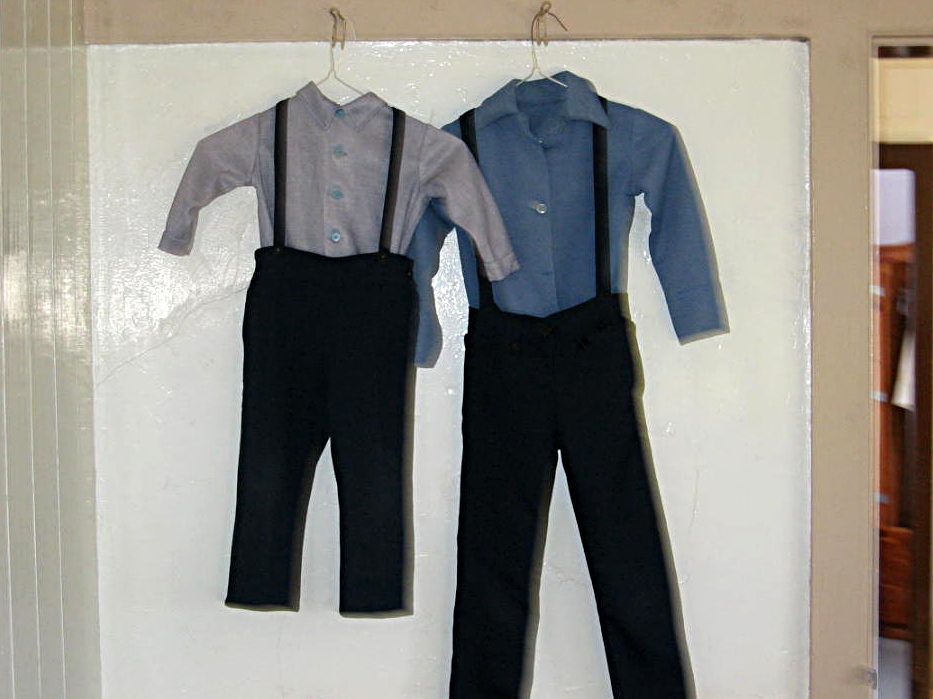
Everyday wear is plainer, mostly shades of blue.
The young girls can enjoy a little color.
On the way to the animal barn we passed a bench wagon. Because the Amish do not have a fixed, separate church building, but rather rotate services from household to household, the extra furnishings for a service must be transported.
Inside the barn a young lady introduced us to the various animals housed there, including a very new colt.
I've always thought that the working horse breeds are one of the most impressive terrestrial animals.
Here Jeanne checks out some of the littlest creatures.
Our last meeting was with another youngster. It was spring, after all, so there were young ones everywhere.
Including these ...
Then it was time to drive up to Lehman's, the sprawling store that sells non-electric goods (anything from books and small oil lamps to propane powered refrigerators) to the Amish, survivalists, and off-the-grid folks across North America. Along the way Serge snapped this action shot of two young boys and their Amish go-cart.
We arrived at Lehman's and began to browse.
There are maps so you don't get lost; the store has grown over the last 55 years by suturing one building onto another.
But the highlight of our visit was the piggie grill.
Don't you love her eyelashes?
On our way back to the Inn there were opportunities for surreptitious shots through the car window.
I must give credit for these photos to Serge Brasset.

We had some time before our special dinner that evening, so we walked into Berlin and visited several shops. It wasn't tourist season yet, so the pace in the shops was relaxed, and we could enjoy the quilting and other works. At one store, the proprietor, upon learning that Serge and Jeanne were from France, told us we must visit the jewelry store a door or two down Main Street, for the lady who runs it is from France. So we did. The woman at the jewelry store spent many years in Albuquerque, which explains the Southwestern theme of her store that otherwise seems oddly placed in Amish country. As she chatted with Jeanne and Serge, they discovered that the Brassets live no more than 8-10 miles from her mother back in France. Another small world story!

Then we were off on a short drive to our dinner with Elsie and Samuel Bowman and their four children, an Amish family dinner. (Because they were Amish, we of course have no photographs of the evening.) Elsie has been offering Amish home dinners for 2 to 75 persons for about a year -- for the larger dinners she gets help from family, especially a sister-in-law.

As we drove up the house looked "normal" and quite new. Inside there was lots of open space, partly, I'm sure, to have room for a large family, partly because it was new, and partly because many of the distractions we "English" stuff our houses with -- televisions, computers, audio systems, electric clocks, telephones -- weren't there.

The oldest of Elsie and Samuel's children (two boys, two girls) was a first-grader, and the youngest was three weeks old. While the Amish children are taught to be reserved and well-behaved in public, these were indulged at home just like any family. The first-grader had been on a school field trip that day, and she was tired and warmed up to us strangers slowly. (She was attending a mixed Amish/Mennonite school, not a pure Amish school, because it was much closer, and so she had another week or so left in the term.) The two middle children alternated getting attention from Dad, while the three-week-old stayed with Mom. The kids were addressed in both English and, mostly, in what Samuel said was a highly dialectal German. The Amish must learn at least three languages: English, High German (for the Bible and religious services), and their informal dialect.

A hearty meal was served. Some of the details are now fuzzy in memory, but I clearly remember a seven-layer salad, meatballs, luscious noodles that had been cooked in a rich chicken broth, bread and jam, and date pudding. I'm less sure but believe there was also carrots and baked beans. We began with a blessing, with the family singing a blessing song to the tune of Frère Jacques, the French nursery tune that many of us learned in grammar school. Elsie and Samuel had never heard of its musical origin.

The conversation started with some of the traditional warm-up topics, such as "what do you do?" Samuel works in a company (with uncles and cousins) that makes machines that make pallets. His job title is "foreman" but he does just about everything, including troubleshooting. One selling point of their equipment is that it is not computerized, so if there's a problem, it should be visible and the valve, cog, or nut can be easily adjusted or replaced. He would like to find a way to work more from home.

Elsie and Samuel encouraged us to ask any questions we wished about the Amish way of life. Interestingly, neither one of them took the year of "running around," or Rumspringa, and apparently this is not unusual; the popularized view that most Amish teenagers go through a period of experimentation is a misconception. Many do, but not most. Samuel explained that for him, it would be disobeying his parents, which would be very much against his religious principles. Elsie had a practical reason as well, because she had a brother who left the Amish life for a couple of years and, when he came back, felt traumatized and, in a sense, damaged by his experiences.

Joan asked how Elsie and Samuel had met. There is not much casual socializing amongst the youth in Amish culture; organized church or school activities (volleyball is catching on) are the only options. Samuel developed a crush on Elsie from seeing her at Sunday evening hymn singing; Elsie's sister suggested to her that Samuel liked her, but Elsie thought it unlikely. Then there was a lunch auction, where the young men bid on lunches prepared by the young women, and lo, the lunch he won was Elsie's! Eventually Samuel gathered his nerve and wrote Elsie a letter. It was fortunate that a letter could not be recalled, because he might not have had the courage to visit in person -- a friend of his turned around more than once in a similar situation. As we know, it all turned out very well.

Two of Elsie's children were born at home, with the help of a midwife, and two were born in a hospital. We later thought of many questions to ask about this, such as, how do you summon the midwife? How do you go to the hospital (would a car be allowed)? But we failed to follow through on that. We do know that the Bowmans have a telephone, which you can call to contact Elsie as Riverside Home Cooking, but it's out next to the barn. An answering machine will take your message and Elsie will then return your call. In this district, then, it's OK to own and use a phone, but stringing the lines into the house is still forbidden for bringing worldly influences into the home.

Samuel mentioned a talk or paper that his bishop had written about the Internet and cell phones, and it is clear that those devices are to be shunned. We all find the Internet to be equal parts invaluable resource and time waster, don't we?

At some point in the dinner the second oldest had finished his meal and was eager to put on his headlamp (think camping light or hands-free work light), even though it was still light outside. For him, it was a treasure item, and for us, it showed that batteries were OK while bringing wires into the home were not. Batteries are safe, and do just one thing, but wires are ... suspect. Who knows what they might let in? Which made us wonder, after the fact, would electrical appliances driven from solar cells be permitted, or would that be seen as the start of a slippery slope?

After dinner we all stood to sing several religious songs from the Bowman's songbook, another method of reinforcing proper and beneficial attitudes and feelings in the children (and other diners). The children were more relaxed with us by now, and Serge clicked into grandfather mode and was having a good time with the older two.

Samuel was more comfortable as well, for at this point he started discussing JuicePlus. He pulled out his literature and some sample capsules. It was a lot like an Amway presentation, or a Shaklee presentation. I don't know if it is technically multi-level marketing, but the JuicePlus web site encourages a "virtual franchise" for part-time work. Well, Samuel was looking for ways to work more from home. Serge was being politely interested, which, if you have seen the photos of Serge in this blog, you will understand comes across as definitely interested, even enthusiastic. Joan extricated him by suggesting that Samuel research the details of JuicePlus in France (he knew they had a French presence) and forward them to her to send to Serge.

After a two-hour dinner we took our leave of Elsie, Samuel, and the little Bowmans, just in time to watch the sunset from our Inn.

Sunday, May 30, 2010

Travels with Serge and Jeanne: north to Amish country!

After a hearty breakfast in Blowing Rock we started north again on the Blue Ridge Parkway. At our first overlook we saw that any kind of weather could be developing.
Although it grew overcast the precipitation held off for much of the day. The travel schedule called for a series of smaller stops, but covering a lot of miles. First stop: E. B. Jeffress Park, which has a moderate trail to a cascade.
Here Serge and Jeanne admire the waterfall.


Serge was kept busy taking flower photos on the loop trail, including jack-in-the-pulpit and doghobble. The latter's common name comes from the entrapment of hunting dogs; if bear-hunting dogs became stuck in a thicket of doghobble the bear could play turn-about on its pursuers!

Here Joan provides scale for a jack-in-the-pulpit. They were easy to find on this trail, more so than back in Ohio.
Doghobble is very toxic, although the pendant blooms are pretty.
Continuing up the Parkway, the landscape shed some of its extremes, and more settlement was on either side. We had to turn the car around to admire this fellow.
The next step was Doughton Park, where we briefly investigated the Brinegar pioneer cabin and its grounds.
Just down the road was the Mahogany Rock Overlook. Opposite the parking area there were views of hard granite hills, on which vegetation finds it difficult to gain a footing.
Language diversion: we needed to explain to Serge and Jeanne that an overlook is a place to get a good view, and to look over is to inspect something, but to overlook something is to miss it, to inadvertently ignore it. It helps to be a native English speaker.

We crossed into Virginia and left the Tarheel State behind. Lunch beckoned to us at the Lake View restaurant in Fancy Gap, just off the Parkway. Jeanne took a good photo of the interior of this down-home local restaurant.
Afterwards we refueled the car and prepared to leave the Blue Ridge Parkway behind, to take I-77 up to Beckley, West Virginia. Here Jeanne caught Joan and Serge in a squeegee competition while I pumped gas.
Serge took this church photo from the moving car on our way to Beckley.
He found the US proliferation of churches of all types and in all locations interesting. Historically France has been 80% or more Roman Catholic, although this has been changing in modern times. Serge and Jeanne are accustomed to seeing one and only one church in each small French town, a Catholic church near the town center (along with a bakery).

Further north, in Ohio, Serge spotted roadside banners and calvaries.
It began to rain as we crossed into West Virginia, so there aren't any photos of that evening's activity. We checked into our hotel/motel in Beckley, and spent the evening at Tamarack, which features a café administered by the famous Greenbrier resort, and arts and handicrafts from West Virginia artisans. It's a stellar place to shop, with items ranging from postcards to exquisite glass, jewelry, and woodworking. Again, I can say that some purchases were made.

The next morning we continued up I-77, headed for Marietta, Ohio, on the Ohio River. Serge captured the West Virginia capitol in Charleston, WV, from the moving car.
Eventually we crossed the Ohio River and visited the town of Marietta.
Marietta, the first permanent American settlement in Ohio (in all of the original Northwest Territories, actually), has French connections. It's named after Marie Antoinette, and the Revolutionary War hero the Marquis de Lafayette stopped here during his 1824-1825 grand tour of the young United States. Serge and Jeanne eagerly took pictures of these links to their home country.
The name 'Lafayette' is everywhere in Marietta, including the grand downtown riverfront hotel.
We strolled and drove around the town. One friendly citizen directed us to "the best place for lunch in town," but it was full, so we ate later on the drive. An old railroad bridge is now a pedestrian walkway over the Muskingum River where it flows into the Ohio.
There's a duck nesting in the closest hanging planter.
From the walkway, we could see a canoe being paddled up the Muskingum.
We continued north, had a late lunch and finally reached Dover, Ohio, for its must-see stop of the Warther Museum. Ernest "Mooney" Warther started carving at age 5, and continued to develop his skills even while working at the local steel mill between the ages of 14 and 38. The centerpiece of the museum is the collection of historic trains that he carved during his lifetime, piece by piece; the largest were up to 8 feet long and assembled from up to 10,000 separate individually carved pieces. We have no pictures, but you owe it to yourself to see the museum if you're ever nearby.

A short distance from Dover is Berlin, Ohio (pronounced BURR-lynn), the heart of northeastern Ohio's Amish country. We were to spend the next two nights at the Lamplight Inn bed and breakfast, two blocks north of downtown. The skies had cleared this far north.
We had dinner that night in Berlin, at the Boyd and Wurthmann restaurant. Their motto is "where the locals eat," and we'll vouch for that. Inside there's a whiteboard where the pies that are still in stock are tallied in eraseable marker. We came away well satisfied.

On our way back to the Inn, we passed a parked horse whose owner had an ingenious safety system.
As you see, each leg had a reflective strap, such as a bicyclist might wear. The owner of this horse must have a less-strict bishop. (An Amish bishop, elected for life, makes many of the decisions about what is permissible for his district of 25 to 30 families.) The buggy was parked next to the horse.
We would see a lot more of Amish life the next day.

Tuesday, May 25, 2010

Cowly Owl

As soon as we reached home with S and J (yes, I will continue working on our account of the trip), one of the barred owl parents made an appearance for our guests. Immediately, it was deemed a superb owl, and much photographed by Serge.
And I learned something from Serge and Joan, a phrase current when they were in university at Nantes. According to the French dictionary Le Petit Robert, the word 'chouette' is not only the noun for 'owl', but used as an adjective means pretty, elegant, worthy of admiration. This usage was first employed in 1830. Also, 'vachement' (literally, cow-like) has two meanings; informally, it can be dull or mechanical, reminiscent of a cow chewing cud, or, very informally, it can be an intensifier ('very') usually in a positive sense. Very nice. Really excellent. Vachement chouette. Cowly owl.

The owls made several appearances, visual and vocal, for our guests, for which we were grateful. They did not get a chance to see the owl chicks, however. Nor did we for a long time. It had been a wet spring, with an extraordinarily warm April, and the foliage burst out much earlier than last year, obscuring our views behind a green curtain. However, a few days ago we did get to see one youngster. The views were better by binocular than with camera, but I hope these photos are good enough to merit a glance.

At first we saw only one of the parents, hunched over in an odd position.
Later it turned to face the other way and spread its feathers.
I was inside with the kitchen window lowered. Joan moved to the deck to observe from a different angle, and this interrupted the feeding of robin chicks in the dogwood overhanging our deck. The parent would not approach the nest while a potential predator lurked nearby (Joan). Even with a mess of worms ready to deliver.
Then we spotted a chick deeper in the woods. I was kneeling on the floor at times to get the best view through the opened window.
That afternoon Joan called me downstairs to see the parent with some prey -- in binoculars it looked perhaps to be a very young squirrel -- standing next to the chick.
The parent would wave the prey in front of the chick. Sometimes it would be transferred from beak to claw and back. I assume the chick could have taken the morsel at any time, but it did not, and the parent did not render the corpse to offer smaller tidbits.
Finally the parent either lost patience with her offspring, or was too tempted for herself, and swallowed the young squirrel. The food took a while to inch down the owl's gullet; her head remained aimed at the sky for several minutes before she could lower it again.
I can just hear the parent saying, "if you won't eat this, then I will."