The next morning (May 10th) was misty, so we again pulled on our rain jackets, but the weather gradually improved. Tshering took us on a walk that began at Tamshing Lhakhang (temple), established by the terton (treasure finder) Pema Lingpa in 1501. As always, photos of the interior are not allowed. Tamshing is on the west side of the Bumthang Chhu (river) on a narrow road.
In the above photo, taken from the rear of Tamshing, there are two other major temples, on the far side of the river at the foot of the hills. We'll visit them later. The Bumthang region is in many ways the ancient seat of Buddhism in Bhutan.
A closer view of Tamshing. One of the relics inside is a coat of iron chain mail made by Pema Lingpa himself. If you wear it for three circumambulations of the interior of the temple, it will burn off your bad karma (absolve you of your sins). I was unaware of the three-circuit requirement, and trod it only once, as did Joan. So I have unfinished business here ...
Inside, all the statues are smiling except for the usual wrathful deities. Guru Rinpoche has a surprised and delighted expression we haven't seen anywhere else.
I'll digress for a moment to point out that Tamshing is a monastery of the Nyingma school of Tibetan/Himalayan Buddhism, while the Drukpa Kagyu school, a Bhutanese sub-school of the Kagyu lineage, is the state-supported religion of Bhutan. Thus Kagyu temples, monasteries, and nunneries have state sponsorship, while Nyingma institutions do not.
Fifteen minutes down the road we froze to admire this verditer flycatcher. Thank goodness my point-and-shoot camera has a 20x zoom.
A footpath that split from the road was our route further upstream. This moved us much closer to the river, and around the bend on the far right is a footbridge.
It's not far across the river at this point.
From the far side I was able to zoom in on the Konchogsum Lhakhang, a temple dating from either 7th or 8th Century, and the new school and monastic housing surrounding it. The small white building is the temple itself.
Tamshing Lhakhang is just a stone's throw from Konchogsum, and the two temples are associated.
Not far down the road we came to Kurje Lhakhang, constructed in the 8th Century, and to borrow a description,
Kurje is one of the most sacred sites in Bhutan as Guru Rinpoche meditated here and left the imprint (je) of his body (ku) on a rock.
There were some vendors outside the main courtyard, including a woman who, in addition to her religious and artistic objects, had some cordyceps to sell. This parasitic fungus is widely sought after for Asian medicine, commanding as much as 1,000,000 ngultrum (US$16,500) per kilogram some years. Bhutan has been forced to limit the number of harvesters, giving priority to traditional rural inhabitants, and reducing the number of harvesters per household from three to one. Otherwise the mountains would be stripped of cordyceps. The vendor let us take a photo of one piece.
Tshering talked this monk passing by into pausing so that we could take a picture of the fabulous torma, an altar offering made mostly of flour and butter.
Joan and I were startled and entranced when we saw this prehistoric-looking bird, a hoopoe.
The Kurje Lhakhang has three main buildings, constructed in the 8th Century, 1900, and 1990. The oldest building is on the right in this photo. Interior photos, as always, aren't allowed, so I refer you to the previous link.
Representations of Guru Rinpoche are everywhere, from a ten-meter (33') statue in the shrine of the 1900 building to this exterior carving. It references an 8th Century event where Guru Rinpoche, in the form of a garuda bird, subdued the local deity Shelging Karpo, in the form of a white lion. Shelging Karpo had been afflicting the health of the king of Bumthang, but was converted to Buddhism and the well-being of the king was restored.
Across the grounds is another temple, first designed in 1998, and consecrated in 2008 by the Royal Grandmother Ashi Kesang Choeden Wangchuck (not to be confused with other royalty with the same or similar name).
From here it was a kilometer's walk past farm fields to our next stop, the Jampa/Jampey Lhakhang, a 7th Century temple that precedes Guru Rinpoche's arrival in the 8th Century. This lakhang is dedicated to Maitreya, the future Buddha. It is said to be the first of 108 built throughout the Himalayas by King Songtsen Gampo of Tibet, to pin down a giant ogress/demoness. Jampa Lhakhang is holding down her right knee; Tshering forwarded this image of a poster depicting the 108 locations holding down the ogress.
I don't have any photos of the interior, but this exterior photo is illuminating. The trays of pebbles are counting mechanisms, so that the devout who frequently perform a kora, or circumambulation, of the temple can keep track of their merit. Jampa is the only temple where we've noticed these.
Nearby we got a good look at another hoopoe.
Kaka picked us up here, and we drove to our lunch stop, a small second-floor restaurant called Noryang Restaurant and Bar. It was fabulous. Bhutanese home cooking, served family style. Of course, as chillips (foreign tourists), we needed to be careful with the ema datshi (chili with cheese), Bhutan's national dish, which ranges from spicy to explosive.
After lunch Joan and I were dropped off in the center of Jakar for some window shopping and general poking around, after which it would be a short-ish walk back to the Yu Gharling.
This photo shows the main street of the business district, with the dzong perched on the hill behind. Jakar has suffered three fires in this area since October 2010, but appears to have bounced back.
We wandered up one side and down the other, and then one street over where there was a farmer's market. We bought a couple of postcards and stamps, in two different shops. I had to take a picture of this business' sign.
This is how the Yu Gharling looks when you drive or walk up to the front.
Here is zoomed-in view from our room. Farm fields and development, all in the same place. That's indicative of Bhutan today, where statistics say 63% of the population lives in rural areas, compared to 93% forty years ago. Would this scene be considered rural? If not, is it urban?
Tomorrow Kaka would drive us over Thrumshingla Pass, 12,400', and then to Mongar in eastern Bhutan.
After lunch at the Chumey Nature Resort, Kaka drove Tshering, Joan, and me up a winding gravel road to the Tharpaling monastery, located at 3,600m (11,800').
Click on image to enlarge
Tharpaling is a multi-tiered complex high up the ridge, with Domkhar village and the Chumey valley below; this image was taken looking back after we had started our hike (click on the photo to enlarge).
With binoculars you can make out the palace grounds and Domkhar village peeking over the trees.
Another building is being constructed, high in the monastery grounds. This is where we climbed out of our van.
This afternoon's hike was to gain 800', to 12,600', and then descend the far side of the mountain to the main town of the Bumthang region, Jakar (sometimes spelled Chamkar or Chamkhar). This was our view up to the pass.
The terrain was easy enough, but the altitude had us breathing deeply.
Because we were here in the spring, there were flowers to enjoy, enticing us to make short breathe-and-look stops. This is some species of primula -- I can't decide between bracteosa and bhutanica.
On this festival day many people were visiting the monastery and walking the ridgetop, where there were prayer flags and a Buddha statue. As happens with many a mountain pass, at the top the wind was howling. These prayer flags are horizontal. Note how the trees flourish on the lee side.
Joan and I approached the Buddha but did not linger. Horizontal raindrops had started to fly.
The hike down was long but uneventful. We passed through climate zones with different species of trees, but always with trees. Light showers came and went, and surefooted Bhutanese zoomed past us. Joan and I, and our knees, were glad for our hiking poles. Near the end of our hike Joan spotted a rufous-fronted tit feeding three or more babies in a well-hidden nest.
If you start this hike in Jakar, there's a sign near the trailhead.
Kaka was waiting for us with the van near the Renewable Natural Resources Research Centre, on the outskirts of Jakar. From there we drove to our hotel, the Yu Gharling, to clean up and have dinner. We would be in Jakar twice, this time and on returning from Mongar, for two nights each time. We were to stay in each of three very different rooms at the Yu Gharling, but that's looking ahead to the second stay. Here is a photo of our room for this stay.
This was the view from our balcony, looking up the valley towards the center of Jakar.
In most Bhutanese hotels dinners and breakfasts are a buffet, and range from OK to excellent. The competitive item this year was to have a custom omelet station at breakfast.
At Yu Gharling dinner included an optional "vegetable soup" starter that we consistently encountered in central and eastern Bhutan. It was devoid of taste and had no visible vegetables ... the best way I can describe it is milk of veggie soup with the veggies strained out. We, including our guide Tshering, learned to skip it.
Tshering had an ace up his sleeve for eating in Jakar, however, which we would discover tomorrow.
I'm back! After several weeks away from the keyboard for our annual Canadian Rockies hiking trip, and the catch-up aftermath, it's time to pick up the figurative pen and resume the account of our Bhutan trip.
Domkhar Tsechu -- the night before
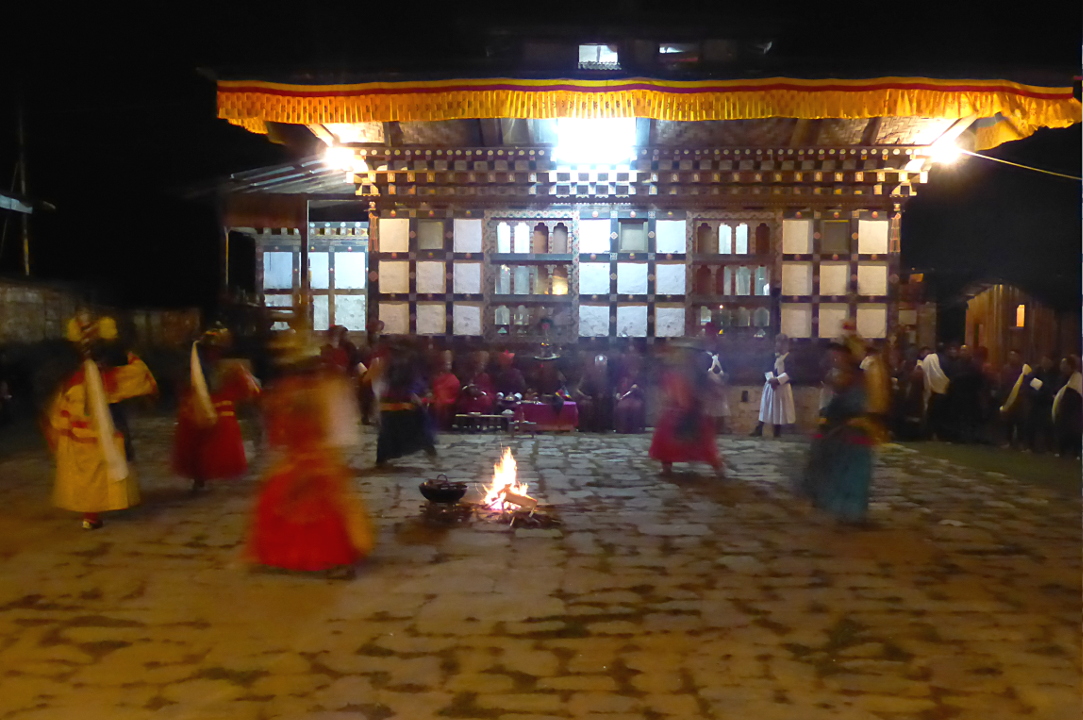
Tshering had been mentioning an after-dark ceremony in Domkhar village, which we had visited that afternoon, but he hadn't been specific. The time was often set at the last minute. He also asked, separately, about when we prefer to go to sleep at night. Joan realized what he was being indirect about, and let him know that even though we generally turned in early, we certainly were up for special events even if they took place after dark. Thus, we found ourselves attending the fire purification ceremony that night (May 8th).
There was almost no other chillips (foreign visitors) that evening, perhaps two. The events began just after 8pm (Bhutan does not observe daylight savings time) with the lighting of a fire in the center courtyard of the temple grounds.
Here's a closer look.
The musicians assemble,
and the dancers arrive for the ceremony to purify the grounds in advance of tomorrow's tsechu (religious festival).
To my point and shoot camera they were blurs. An attempt at video came out dark, in only shades of grey.
In the next phase, the iron bowl was placed atop an enlarged fire, while four masked men holding long poles stood buy. (Click on the photo to enlarge.)
The fire was carefully tended by several individuals, including the atsara, who we'll see more of tomorrow. The figure of the atsara is a combination of clown and trickster.
Those aren't horns attached to his mask, they're musical instruments being held by band members in the background.
Then it was time for the pole guys to start raising and lowering -- flapping, if you will -- a cloth attached to the poles.
This culminated in a surprise huge flash, of which I captured only the aftermath.
Torches were ignited from the central fire and handed out to several dancers.
Music played and the torch-wielding dancers danced as the crowd moved to an adjacent farm field, where a fire gate had been erected earlier.
Fire Dancing at Domkhar Tsechu, opening evening from
Ben Branch on
Vimeo.
The fire gate consists of juniper boughs lashed to a framework. The boughs are set afire,
and those who dare, or seek more purification, run under and between the flames. Initially people of all ages, even entire families, made the run. Towards the end, as the dash becomes riskier, there is a loop of young men running through the gate again and again.
Running through the fire gate at Domkhar Tsechu from
Ben Branch on
Vimeo.
The dancers from the courtyard gathered, still in costume, at the edge of the burning gate, along with at least one dignitary (note the fellow with the red kabney, or robe, standing next to the dancers; ordinary gents wear white).
Staying up after dark? No problem!
Domkhar Tsechu
The next morning, on our way to breakfast, I took these photos of the Padmai Denzin Lhakhang (temple) on the grounds of the Chumey Nature Resort.
Its dedication sign.
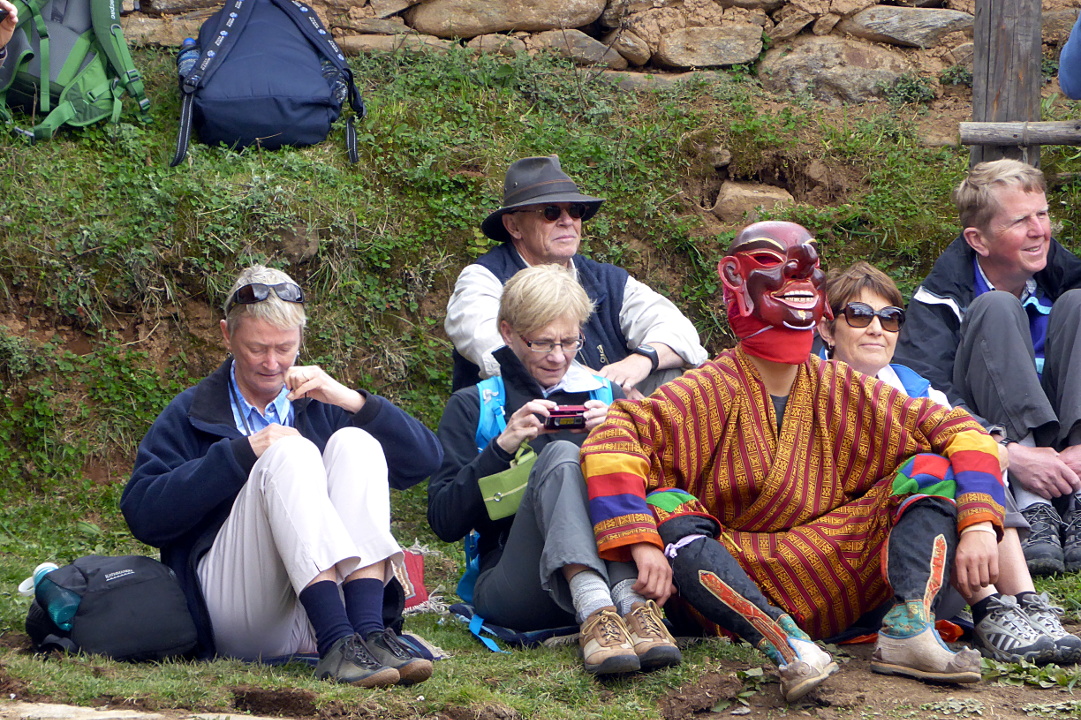
Then we drove down to Domkhar village to spend the morning watching the tsechu. This time we were not the only chillips in attendance; Joan and I stopped counting at 40. Larger tourist groups had come down from the town of Jakar, perhaps forty-five minutes or an hour away. We felt lucky to be staying five minutes away at Chumey. Joan and I settled down on a concrete stoop, and Tshering and Kaka (the driver) went off to do other things.
The event opened with a traditional women's singing dance. Note the little boy with the toy helicopter who enters from the left about 21 seconds into this video clip. He was charmingly underfoot most of the morning.
Ladies Dance Opens the Domkhar Tsechu from
Ben Branch on
Vimeo.
After this dance the masked male dancers took the stage, with accompaniment from two musicians.
The crowd began to swell. Eventually the musicians shared their stage with a changing cast of visitors.
The dancers performed barefoot on the stone slabs.
The atsara spent some time supervising and tucking in any stray bits of costume for the performers.
Then he began paying attention to and playing games with the foreign tourists.
One of the atsara's jobs is soliciting funds to defray the cost of putting on the tsechu, maintaining the costumes, and so forth.
He also has fun with the Bhutanese in attendance. Note the Barbie purse carried by the girl in the lovely purple outfit.
Matching blue shoes here ...
A closeup of one of the dancers.
This fellow was guarding the entrance to the building holding the various costumes and masks. Sometimes he used the whip to urge stray dogs, of which Bhutan has many, out of the courtyard. Once or twice he seemed to be enjoying this duty too much.
One youngster toddled forward for a better view.
Between the dances and the people-watching plenty was going on. Joan and I remained on our concrete stoop for two and a half or three hours, occasionally chatting with other chillips. Some Westerners become enthusiastic about Bhutan, like us, and some find it mildly interesting but not special. Then Tshering and Kaka returned, and it was time to return to the Chumey Nature Resort for lunch.
In the afternoon Tshering would test our hiking ability again.