Friday, September 2, 2016

Galapagos: Santa Cruz (Part 1 of 2)

In a complete change of activities today, we visited Santa Cruz, the second largest island in the Galapagos with between 12,000 and 20,000 inhabitants, depending on the source. It was a dry landing at Puerto Ayora -- the zodiacs coasted up to the floating docks.
There was a town map at the docks,
but our first destinations were the Charles Darwin Research Station and the associated Tortoise Breeding Station run by the Galapagos National Park Service. Buses would take us through town, and then there was a half-mile walk. We soon encountered Charles Darwin.
The walk was not without its perils: the treacherous leaves and sweet-tasting fruit of the manzanillo (also known as manchineel).
This specimen was large and leaned into the roadway.
Joan made sure that our pigs of the trip, Dimples and Knuckles, had their visit recorded. 
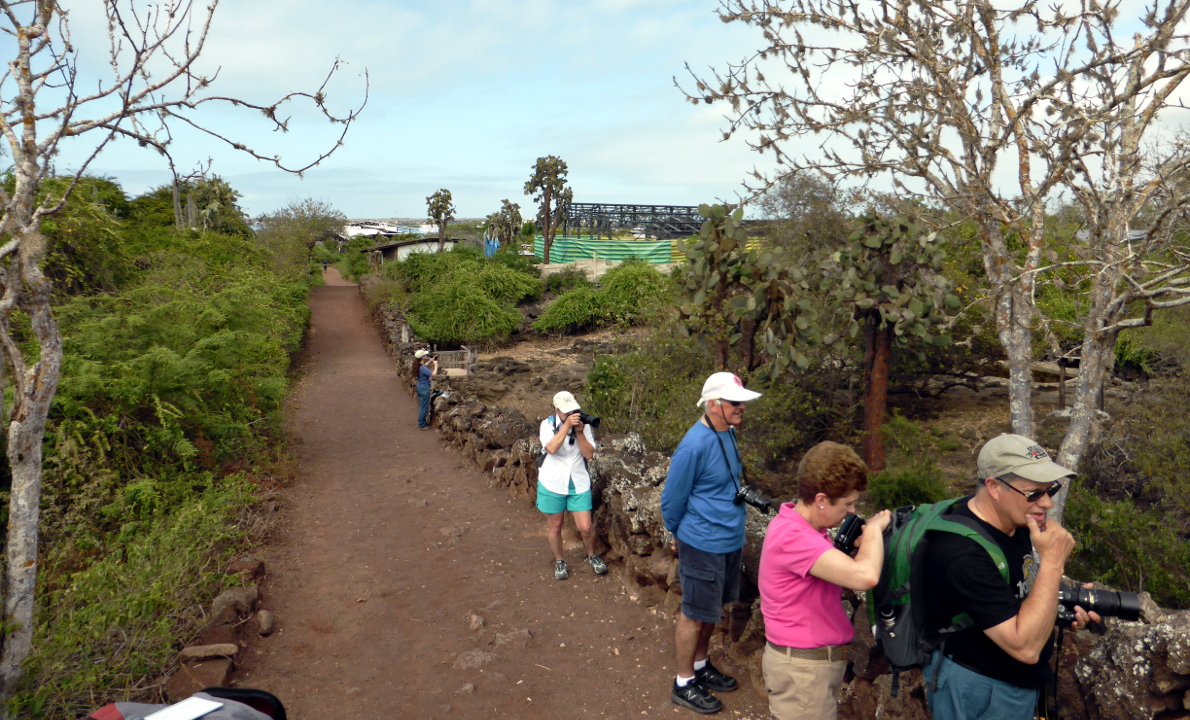
Various experimental plots lined the walkways.
In this photo there's a cactus "nursery" device. The plate funnels rainwater to the tender seedling, and the cone protects it against sun, wind, and some pests. We'll see a different version of this device in use on tomorrow morning's hike.
Charles was waiting for us at the end of the road.
Then it was time to mosey over to the Tortoise Rearing and Breeding Center. Eleven of the original 12-15 subspecies of Galapagos tortoise still survive, and it's possible that the Pinta tortoise, made famous by Lonesome George, now deceased, might be re-bred from recently discovered hybrids with Pinta DNA.
Lizards enjoyed the compounds and the rock walls. Some kept an eye on us.
But we were here for the tortoises.
The initial tortoise residences tempted us to linger.
What stoic faces they present.
There were further corrals to visit. Note the raised carapace on this (sub)species of tortoise -- it allows him to raise his head higher, to reach cactus blossoms and other fruits. It doesn't come into play here.
The establishment of the center preceded funding of serious conservation efforts, so still today, the tortoises are crowded much closer to each other than they would be in the wild.
There is also an exhibit building at the Foundation.
The interior is dominated by a skeleton of a Bryde's whale.
The whale had washed up, deceased, in 1995.
Our friend Rick got this photo of the skeleton showing the head and jaws.
Then we were on our own to stroll back into town, take in the sights or shop, and all meet again at a café, The Rock, for further adventures. Here is what I call the "ceramics wall" just off the main street.

Joan had been in touch with Ros Cameron, who, along with her son, Mason, we had met on a Lindblad Antarctic trip in 2003. In this photo, we see Ros, Joan, and a young Mason.
Ros worked for the Darwin Foundation at the time, but now works for the Galapagos Conservancy, where she is currently the Development Officer. She has a wide knowledge of the doings in the Galapagos, both official and local, and we had arranged to meet her at the café. But she came down the street on her bicycle as Joan and I were walking towards it! Joan called out and we had a mini-tour with Ros on our way to the café.

Next to the docks at Puerto Ayora is the fish market. Rick, visiting at different time, took much better pictures here than I did.
As you can see, pelicans were clustered around, hoping for a treat, perhaps a stolen fish head. Rick was intrigued with the pelicans and captured this stunning shot of one coming in to land.
A molting sea lion was nestled among all the human feet.
Ros also took us inside the Catholic cathedral. She reported that the Galapagos is collage of religions and proselytizers: Catholic, Latter Day Saints (Mormons), Protestant (evangelical and otherwise), and various offbeat groups. This statue of St. Francis is outside the cathedral; note the tortoise in the left background.
The interior is light and airy, appropriate for the hot climate of these islands.
A closeup of the colored panel -- pelicans!
Close by on the docks was the display of the cigarette crusader. (We'd seen it earlier, briefly, but came back to visit.)
This man, an ex-fisherman, collects the cigarette butts from the local streets and bags them to make a point. He also has two statues, "Nico" and "Tina," made from the same noxious material.
And he sells a book about his 77 days adrift in a fishing boat whose engine failed. We bought a copy.
Then it was off to the café for a cool drink, and further chin-wagging with Ros. She would also join us for dinner aboard the Islander in the evening.

Rick had decided to begin the next stage of the day with a three-mile mountain bike ride, while Joan and I took the last bus. All of us were headed for an artisanal coffee and sugar cane planation, "El Trapiche." But that will start the next post.

Monday, August 29, 2016

Galapagos: Floreana (Part 2 of 2)

After the first two activities of the day, and before lunch, it was time to go snorkeling for the second time on this trip. Both the advanced and the beginner groups would swim just off Champion Islet, the advanced snorkelers on the more active side in terms of current, and the beginners on the calmer side. However, unlike the first snorkeling trip for beginners, there would be no beach; we would slip into the water from the zodiac and never set foot on a solid surface. This was enough of a step-up in challenge for me that I decided to again use the snorkeling flotation vest, and leave the underwater camera behind. (I will have underwater photos, just later in the trip.)

Lynn Fowler, the expedition leader, accompanied our beginner group. I enjoyed it and felt a sense of accomplishment, although this was the first time I'd swum in a group. I needed to stick close to Joan, my snorkeling buddy, without bumping into anybody else. One highlight was when Joan spotted a chocolate-chip sea star.

After lunch Lynn gave an absorbing presentation on her graduate study work in the Galapagos. To quote from the Lindblad web site:
Lynn completed a doctorate (also at the University of Florida) in 1983, based on her research of the giant tortoises of Alcedo Volcano on Isabela Island, where she spent a year and a half living on the rim of the crater collecting data.
Then the Islander began to sail around Floreana to the site of the first "post office" in the Galapagos. In this photo, taken from the stern, Champion is on the left and Floreana on the right.
It's a wet landing at the post office beach.
Here's the post office. It was established by whalers in 1793; seafarers would deposit letters in the barrel and pick up the ones they could carry onward.
Vanessa explained the history and operation of the post office.
Then all the letters and cards were brought out of the barrel, and the destinations read out by our three naturalists, Vanessa, Christian,
and Jeffo, whose picture hasn't appeared in this blog until now.
There were one or two Ohio-bound pieces, but none close enough for Joan and me to consider hand delivering.

After returning to the Islander there were two activity choices: kayaking and zodiac cruising. Joan and I opted for the zodiacs, but saw some of the kayak operations. Here the kayakers are being helped into their vessels from the embarkation zodiac. (Click on the image to enlarge.)
The kayakers' zodiac kept an eye on things after all the kayaks set out.
This zodiac cruise was the best so far. Early on we approached a beach full of resting sea lions.
The sand must make a great back-scratcher.
Some sea lions were enjoying the surf.
At least one was determined to investigate us.
Sally Lightfoot crabs, and oystercatchers.
Here's a brown pelican.
I love this picture of the snoozing sea lion and the sally lightfoot.
This great blue heron didn't want to pose for me, but instead sat stealthily in the mangrove, where these birds nest.
Two kayakers passed in front of a large mangrove thicket. These salt-tolerant plants have extensive underwater root systems that provide invaluable shelter for young fish and turtles. The extensive nutrients in the brackish water (sea water diluted by freshwater seepage) also encourage bird nesting. The endemic and endangered Galapagos penguins of Isabela island depend on mangroves.
This clump shows that the tide is in.
Kayaks as well as zodiacs must take the channels between rocky islets.
Other tour boats are at anchor here, but we seem to own this patch. The Islander does have the 2pm-6pm slot.
A visit from another Islander zodiac.
Rick shares our zodiac, and he's having a great time too.
Sunset comes quickly at the equator -- the sun doesn't approach the horizon at an angle, but drops straight down.
It's time for everybody to return to the Islander and the evening program.
Not to mention dinner!

Thursday, August 25, 2016

Galapagos: Floreana (Part 1 of 2)

This post covers only half of May 10. As with most days of this week-long Galapagos trip, it was almost non-stop.

We awoke at the Galapagos island of Floreana, having sailed west during the night.
Joan and I joined the pre-breakfast outing, which began with a wet landing at Punta Cormorant (named for a wrecked ship, not the bird). In Lindblad-speak, a "wet" landing means the zodiac will go as far up the beach as it can, and then you slide out into an inch to a foot of water and walk the rest of the way. This means wearing appropriate footwear, and perhaps changing it at the beach.

Punta Cormorant is known for its brackish-water lagoon that attracts flamingos, and for having two different kinds of sand: Green Beach, built from ground olivine crystals, and the Flour Beach, made from pulverized coral. Our wet landing was at Green Beach. We split into groups, and Joan and I joined the one led by the naturalist Jefferson "Jeffo" Marquez. A heavy fog hung over our heads as we made our way to the observation point for the flamingo lagoon, where it was difficult to see much.
The trail led up over a low ridge and back down, to the Flour Beach. Green sea turtles nest at this beach.
A frigate bird, hoping to spot an egg or baby turtle, patrolled up and down the beach.
Various other birds were using the beach, including yellow warbler, plover (probably semipalpated, but there are 5 species in the Galapagos), and sandpiper (25 species!) The lighting wasn't good for photographing active little birds ...
Sally Lightfoot crabs abounded.
What are these pits in the sand? (Click on the image to enlarge.)
Jeffo explained that they weren't green turtle nests, but were borrow pits from which the turtles scooped dirt to refill a nest and cover up the eggs. A true nest might be harbored somewhere around the rim.

We returned the way we had come,
to discover that visibility at the flamingo lagoon had improved.
Most of the flamingos were on the far side, sharing the waters with a heron ...
but two came in closer. Our binoculars proved worth carrying into a wet landing.
A striated heron snatched a meal.
Then it was time to return to Green Beach and the waiting zodiacs.
An alert went up! Just down the beach a pair of blue-footed boobies were going through courtship/bonding rituals. Here is a collage (click on the image to enlarge).
Returning to the ship, we launched into breakfast. Afterwards our expedition leader, Lynn Fowler, announced zodiac tours to the islet of Champion, barely off the coast of Floreana, to view wildlife and scout snorkeling locations. Of course Joan and I went. In this photo we're leaving the Islander behind.
There was more than one zodiac ... note the sea lion peeking up at left.
Vanessa Gallo was the naturalist on our craft.
She pointed out these prickly pear cacti, a variety elevated on trunks instead of growing closely to the ground. This occurs on islands where the plants would otherwise be consumed by herbivores including the land iguana, 80% of whose diet is the pads, fruits, flowers, and even spines of the prickly pear.
Also visible on Champion were candelabra cacti.
On our tour we saw sea lions on land, usually snoozing,
and curious pups in the waters around us,
sometimes several at once.
Resting birds included the brown noddy,
and the swallow-tailed gull.
As we turned around a frisky sea lion youngster saw us off.
Snorkeling time was imminent -- in the next post.