Sunday, June 10, 2012

Those Darn Pushpins

I earlier documented the construction of my current computer, Juno. Last month it suddenly, overnight, began turning itself off just a few seconds after being turned on. At first I wasn't sure if it was the power supply, or something else, and I was even considering swapping power supplies. However, after being turned off overnight (and cooling off completely), juno would run just long enough for me to log in, and fortunately one of the programs that starts automatically when I log in is a system monitoring application called gkrellm. Thus it was revealed to me that the MCP (media and communications processor) on my motherboard, a combination of an interface to the memory and an integrated graphics processor (IGP), an nForce 730i, was rapidly getting so hot (over 90°C) that it was automatically shutting the system down to prevent damage to itself.

I was now confident of what I would find when I opened up the computer case. The heatsink on top of the MCP had probably come loose, robbing the MCP of any means to be cooled. The heatsink used by this particular motherboard, a Zotac 9300 mini ITX, is fastened atop the chipset by spring-loaded pushpins. Just two of them, on opposite corners. When building Juno, I had accidentally popped one of the pushpins out. Though I had successfully reinserted it, my thought was that this was the likely weak spot. It was.
Just pushing that pin back through the hole didn't work; it would immediately pop out again. It was going to be necessary for me to access the underside of the motherboard, which meant largely disassembling the computer.

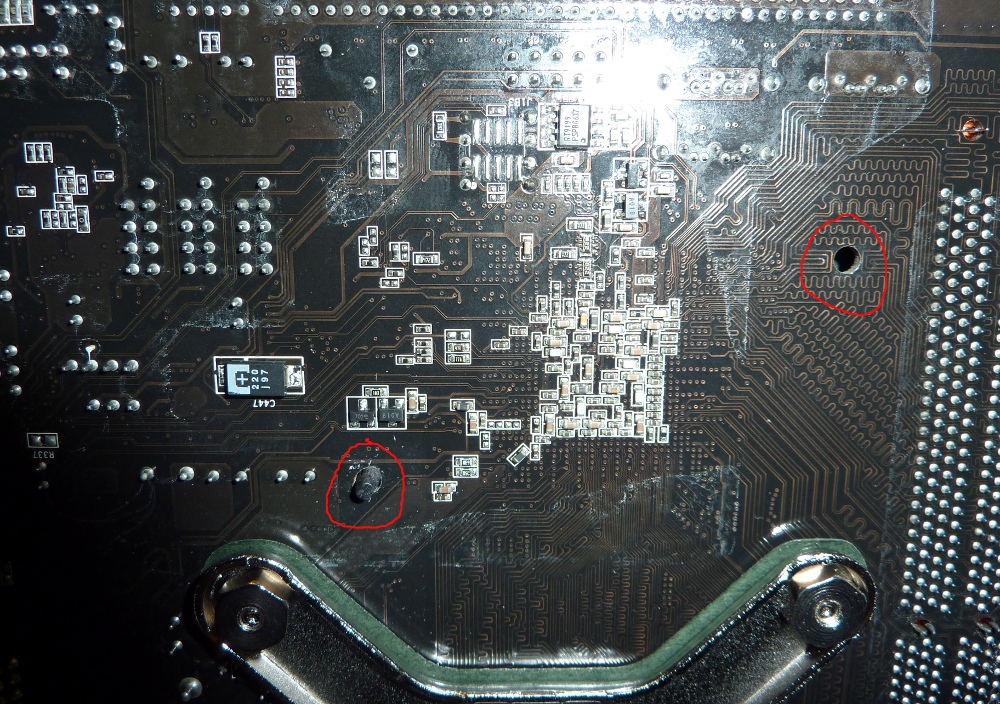
Here is the underside of the motherboard. The locations of the two heatsink pushpin holes are circled in red. One is holding a pushpin, and one isn't. The bolted arms at the bottom of the photo are part of the mechanism that holds the heatsink for the CPU -- much more reliable than pushpins.
I inspected the failed pushpin. There was some beveling of the lip; perhaps I could spread the tip, or perhaps I should try something else; if I employed this pushpin again, the next failure might be in two months rather than two years.
The smallest machine screw at the hardware store (#4) would fit through the pushpin hole without forcing, so that was my choice of repair.
Here is the underside. Two thin, flexible washers protect the motherboard.
I carefully reassembled Juno, and pressed the power button. It booted normally, but then I looked at gkrellm and saw that the MCP was running about 15°C hotter than before.
Although technically acceptable, this was distressing. Two possible causes occurred to me. First, that the separation of the heatsink and MCP had scrambled or churned the thermal grease, which might have become thicker or dried out over the last two years. Second, that an imbalance of force exerted by the one remaining pushpin versus the nut-and-bolt might have lifted one corner, a small amount to be sure, but enough to interfere with heat transfer. Especially since only two of the four corners of this heatsink were secured or securable. If it had to have pushpins, why not four?

Both of these possibilities would mean disassembling the computer yet again. Worse, because the CPU heatsink hovers over a third of the MCP heatsink, I might need to remove the CPU heatsink to get sufficient access to the MCP to replace the other pushpin. To clean surfaces and replace the old thermal grease, I would almost certainly have to take off the CPU heatsink. Here's a top-down view.
I didn't feel that the reward would be worth the effort of a complete teardown. The temperature was still within specs, after all. But I enjoy tinkering when there's time, and so decided to try a couple of easier remedies.

First, I replaced the downward-blowing CPU fan, 120mm in diameter, with a 140mm fan. Thus more air would be blown onto the MCP, theoretically reducing its temperature.
The 140mm fan didn't quite fit into the case; I attached it to the CPU heatsink with only one screw so that it would rotate a few mm, allowing the case cover to close. Sad to say, this didn't lower the MCP temperature at all, and might have even raised it a degree or two. The airflow pattern of the larger fan was less suitable than that of the smaller one! I put the 120mm fan back on.

Then I tried attaching an 80mm fan to blow horizontally at the MCP heatsink. It turned out to fasten only in such as way that it could blow air towards the vicinity of the MCP, but not directly at it.
It didn't change the temperature a bit. I reversed the fan, so that it would push hot air out of the case, but that didn't change the temperature either. I then slapped it onto the back of the case, in a location which had some ventilation but still blocked perhaps a quarter of the fan, again to blow hot air out, and that may have improved the MCP temperature by 1°-2°C.

At this point I'd invested enough time. After all, the nVidia settings program considers the MCP to be only one measly bar into the yellow.

Juno is chugging along well, and I'm slowly growing accustomed to the higher MCP temperatures. They haven't interfered with writing this blog post!

Thursday, May 31, 2012

Strawberry Pickin' and Eatin'

The Friday before Memorial Day Joan and I drove out to Doran's Farm Market to pick strawberries. This is an annual ritual for us, and for two or three days we have strawberry shortcake for much or all of our dinner.
It was supposed to (and did) get hot that day, so we arrived early. We brought our own buckets, which Doran's weighed, but they also supply cardboard baskets for those without.
The signs above the baskets explain the rules of picking, which are also explained out loud by the guy who meets the tractor down by the berries. Most people don't read the signs anyway.
The tractor, which had just delivered some pickers to the berries, returned for another load.
After the briefing everybody starting picking. Of course, you have to sample the berries as you work, and Doran's understands and encourages this.
The flags mark how far up the row the previous picker picked. It's important to carry the flag with you and plant it when you're done, and if you have small kids, to emphasize that it's not a toy. The color of the flag indicates the variety of strawberry; this allows the Doran's representative (in the yellow shirt above) to steer you to different species based on your preferences, such as jam berries versus eating strawberries, or fruity or extra sweet.

Joan found one mutant strawberry. This is the view from the top.
And from the bottom.
The previous couple of weeks had been fairly dry, making the strawberries less likely to rot (or be nibbled by slugs or worms) the instant they touched the mulch. We made quick progress down a pink-flag row and soon realized that if we were going to top it off with berries from a blue-flag row, it was time to move. Then we were done.
The tractor departs for the barn, where you pay, with a load of happy strawberry pickers.
Here are some of our strawberries rinsed, hulled, and sliced.
If you store some in the refrigerator for consumption the next day, do not rinse them (or do anything else). Wet berries are liable to mold or go bad quickly. Joan stores them as-is in a colander loosely covered, so they receive plenty of air circulation in the fridge. Our Friday berries were good for shortcake on Saturday and Sunday as well.

One technique Joan uses is to take out some of the strawberries, give them half the sugar of the overall recipe, and puree them, adding that back in to the bulk of the berries with the other half of the sugar. The proportion is approximate; for the two large servings she gave two cups the puree treatment. Here's a bowl with the puree added back in:
And the final product ... yes, that's what we mean by one serving.
We limit ourselves to one picking expedition each year, for the sake of our waistlines. 

Sunday, May 27, 2012

The Wetlands at Slate Run Metro Park

In mid-May Joan and I explored the walking trails at Slate Run Metro Park, especially those around the wetlands at the western end of the park. Joan had visited earlier and was eager to show me the flora and fauna there.

The abundance of frogs was astonishing. Heads were popping out of the waters everywhere, often only a few feet apart.
They were mostly the common American Bullfrog.
Their concentration made me think that the larger birds, such as the great blue heron, should be very well fed this spring.

Joan was hoping to show me the water snakes she had seen on her previous visit, but was concerned that they wouldn't be visible again. She didn't need to be. First, we saw a water snake swimming through one of the ponds. It slowed down as it struggled through some algae, and I captured this photo.
Further along, water snakes were out sunning on the same log where she had seen them before. Two clusters of snakes, in fact; here's a picture of one group intertwined on the log.
The smaller ones are males and the larger one the female. (Click on the photo to enlarge.) Because there is more than one suitor still remaining, we assume the female hasn't made her choice yet.

We also saw a female red-winged blackbird, who was unwilling to fly to her nest until we drew further away. This was educational encounter for me; I would have guessed this bird to be some flavor of sparrow, not a red-winged blackbird. She doesn't need to dress brightly to attract the males, however, and her camouflage quotient is much higher than theirs.
There was a much larger bird circling constantly during the first portion of our hike:
Yes, that's Air Force One, the President's aircraft, although if the Vice President has borrowed the keys to the 747 the call sign for the aircraft would be Air Force Two. Joan later contacted the Columbus Dispatch, which knew of a fundraiser in northeastern Ohio that Joe Biden would be attending the next day, but had no idea why the plane would be circling Rickenbacker airport for hours, and practicing touch-and-go (sometimes the landing gear was down).
Joan suggested that it was an attempt to reduce the federal budget deficit by offering paid rides, or that Joe Biden had told the pilots "I'll only be a short while, just circle the block rather than parking."

We nearly stumbled over a turtle ... a midland painted turtle, the only painted turtle in Ohio. This was turning into a fruitful expedition.

The spiderwort was common in some locations.

One section of the wetlands trail system includes a boardwalk over a pond and nearby swampy area, giving the observer a closer look at the aquatic environment.


This gave us some spectacular looks at sunning and swimming water snakes.
Any closer would have been too close.
Just beyond, there was a stand of blue flag iris, Iris virginica var. shrevei, a wet soil or swamp lover.
After finishing the boardwalk we walked up to an observation deck atop a small hill. Looking west is looking across terrain scraped by glaciers, so even a modest hill gives a good view. The tip of a telescope on the deck is at far right.
From the deck our path took us along a field edge, which was good for bird activity, and then into the woods as far as the Shady Grove Picnic Area. Almost an hour after leaving the deck, I spotted this woodland toad.
We saw and listened to an acadian flycatcher, what Joan and I know as the "pizza" bird, after its call, which sounds like"peet-sah."

Returning along the field edge, I managed a good shot of this male bluebird. The gods of photography were smiling on me: this was the best of only three attempts before he flew off.
Near the end of our walk -- 6 or 7 miles in total, Joan tells me -- we passed by a tall pole with purple martin nest boxes.
Then we arrived back at the car, about 4½ hours after we began. Life was in full bloom, and except for the parking areas and a couple of joggers close to the picnic area, we didn't meet any other examples of homo sapiens var. buckeye. Well, it was a Tuesday.

Thursday, May 24, 2012

A Second Owl Family

A few afternoons ago, May 22nd, Joan entered the woods behind our house to track down young barred owl calls, expecting to discover one of the youngsters that we've been watching since May 3rd. Instead she discovered a much younger owl:
She called me out to see, and we realized that there were three young owls, two more clinging just above the first!
These were younger than the pair we had being seeing. Those owls were almost as big as their parents now, but these were still downy and large-eyed. I walked around the tree and zoomed in on the upper two for this photo.
If these were not the original chicks, as seems almost certain, then there is a second breeding pair of barred owls in our woods ... these chicks had not traveled far from their nest, nor would they for a few weeks. A second pair was not implausible; the Blacklick Woods Metro Park has three pairs this year. But it was certainly unexpected. Perhaps some of the chicks from 2009 or 2010 have set up housekeeping here in their birthplace? In any case, this would add up to nine owls (two sets of parents, and a total of five chicks) in our woods!

Joan and I were astonished, and thrilled. Our owl-watching season was suddenly extended. Then, not even half an hour later, I was called out to the deck. One the parents, being harassed by outraged robins, had decided to take a breather in the dogwood tree next to our deck.
When I mention outraged robins, I mean outraged. They are astonished and indignant that owls would dare be anywhere near their nests, and they must insist to the owls that their kind is not wanted, each and every day. Loudly. Repeatedly. That's how we know when to look for owls, by listening for upset robins (or, sometimes, crows). This robin is the one that dared get closest to this owl.
The barred owl was taking it easy in the dogwood. The foliage was dense enough that the robins couldn't execute a harassing high-speed flyby, and they dared not linger near the owl. Small birds can outmaneuver the owl, but if they become complacent, they become a tasty snack.
Often it was nap time. Our presence on the deck was of no concern, as long as we didn't make sudden moves or startling noises.
Sometimes he would look around.
Sometimes he would check for any action below him.
 He would let us approach within just a few feet.
Sometimes he would open a weary eye just to see if we were doing anything interesting.
 This was also a good time for grooming. Feet, for instance,
or feathers.
After a satisfying grooming session he looked twice as large. Airing the feathers out on a hot day must have felt oh-so-good.
Puffed or sleek, the feathers of the barred owl create a stunning combination of patterns within the limited, brown-and-white palette. The head is mottled, while the chest is streaked, and the wings and back form bands. As camouflage, it's perfect. We've seen a barred owl fly into a tree and then become invisible when his back melts into the bark.

May 22nd ... a red-letter day for owl watching.