Saturday, August 20, 2011

Sailing the San Juans: A San Juan Day

Our breakfast, as always at Roche Harbor,  was at the Lime Kiln Café at the end of the dock. If you click on the photo, the nearer building says "Roche Harbor Lime & Cement Co. Largest Lime Works West of the Mississippi." We'll see more about the history of this place in a later post.
Melissa greeted us wearing a hat woven from cedar strips, the traditional material and technique used by the original islanders for many articles of clothing.
We headed off towards American Camp, on the far south side of San Juan Island. This is the encampment site for the U.S. troops protecting the American claim to the San Juans, a twin to the English Camp we visited earlier.

On the way the bus stopped at the Westside Preserve.
The view included Vancouver Island, just across the strait, and the Olympic Mountains that give the San Juans their drier climate, to the left in this panorama.
We continued south, and bypassed the main Visitor Center for American Camp in favor of driving down to South Beach. The extensive grasslands on the southwestern side of the island show how little rain falls compared to the other sections.
In the above photo we are paused on Pickett's Lane to admire the grasslands. Yes, that Pickett, who in 1859 was a captain in the U.S. Army and landed with the first U.S. troops to contest ownership of the island with the English. Four years later he would lead a division of the Army of Northern Virginia at Gettsyburg, a continent away.

South Beach had the usual signage about park rules and regulations; of particular interest to me was this diagram of the rules of orca-watching. The sign is actually out-of-date, recently the no-go radius was increased from 100 to 200 yards.
The tides and winds deposit a lot of driftwood on South Beach, as this Google Maps image shows.


Absorbing the landscape, we scanned further and further along the horizon, and then spotted what we eventually decided was Mt. Rainier shimmering through the haze on the horizon.
Candy and Pat also strolled up the beach to admire a bald eagle perched on the driftwood.
On leaving the beach the bus turned southeast. Our goal was to walk down to a lagoon on the northern side of the island, which is not far at all because the island is less than a mile wide at this point: 


However, the bus could not turn around on the narrow road, and we continued down Cattle Point Rd. until we could take advantage of a loop. On the way, we made a fortuitous stop wherein we discovered a fox in the flowers.
Once the bus was pointed in the right direction, those who wanted to stroll down to the lagoon disembarked and followed a nature trail through the woods. This pocket of the island was still wet enough to support banana slugs, including this black beauty.
The lagoon was enjoyable to see, and the leg stretch was welcome, but we didn't discover as much wildlife as we had hoped. It turned out this would be compensated for in the afternoon.
We returned to Roche Harbor, and sailed out for a second and final orca-watching expedition around 2:30pm. There was a lot to see just leaving the harbor area, but first, a picture of our boat for the afternoon.
On the parallel dock, the most important service boat offered by the harbor.
Leaving the harbor, we saw this floatplane come in ...
and there was this sailboat ...
and the seals were hauled out in the sun.
Traveling by water parallel to our morning's track on land, we soon approached the Lime Kiln lighthouse.
The kayakers had likely put into the water just north of the lighthouse, at San Juan County Park.
We began to see various creatures as we continued southbound. Here, a guillemot (in the rather large Alcidae family) has popped up to the surface with a beak full of small fish.
For a while there were harbor porpoises also feeding.
Then J pod appeared, and this time they were awake and barreling up from the south. Some of these photos stretched the limits of my point-and-shoot camera, but they should give you an idea of what we were seeing in person and through binoculars.

This orca is falling back into the water after having leapt completely out of the sea.
Several of the orcas were also lobtailing, or slapping their tail fins against the sea, making a loud splash. You can feel the exuberance radiating from them when they do this.
This jumper is perfectly posed, so I offer it despite any fuzziness or graininess in the image.
As the pod swiftly approached and passed us, we had many excellent looks at the orcas. The speed and unpredictability of their actions made it hard to always snap the camera at the right time or at the right orca, but here is a good shot of a youngster swimming with his mother; only her fin is showing.
Here a jumper is landing on her back with a big splash. The rings from the jump out of the water are just behind her.
One orca passed by so close to the stern of our boat that all our jaws were agape.
J pod continued to zoom north, and Melissa laid out a spread for us to nosh on after we calmed down.
We stayed out a while longer, as the laggards of J pod passed by, but this trailing edge was not as acrobatically inclined, and any pictures would just be more fins, and just fins. Then it was time to return to Roche Harbor, grinning.
We had a satisfying group dinner at McMillin's restaurant, overlooking the harbor, despite the glare of the lowering sun on our table. Unfortunately, tomorrow we would leave Roche Harbor, to eventually return to Bellingham, and that meant it was time to pack again.

Sunday, August 14, 2011

Sailing the San Juans: Orcas Island Surprise, and an Orca Watching Transfer

Several of our group started the next day (June 2o) with an early-early morning hike with Melissa to Cascade Falls in Moran State Park. I "slept in," which meant having breakfast at 7:00am. After breakfast we followed Melissa for her big surprise, which was at the Orcas Island Historical Museum.
Outside there was a sculpture, a requirement for any town in the San Juan Islands, or so it seemed.
We arrived well before the regular opening hour of 11 AM, but one of the advantages of traveling in a small group with as enthusiastic a leader as Melissa is her ability to schedule a private showing of a valuable object. We were about to see a 14,000 year old bison skull -- not a replica, but the original -- that had been found on Orcas Island along with 98 bones or bone fragments.
This skull is from the extinct giant bison (Bison antiquus). Some of the 98 bones show marks indicative of butchering with tools, strongly implying human population of the region 800 years before the time of the Clovis culture. We also saw a cast replica of a tibia with probable cutting marks on it.
It is not easy to decipher the history of the islands during this era, with the rising and falling of sea levels with the advance and retreat of the Ice Ages, but this find is a huge clue.

Afterwards Melissa showed us her sea-mammal cord. In the back yard of the museum, she unrolled a long cord which had a tag at different locations marking the size of different sea creatures. Thus, the tag for the harbor porpoise was only a few feet from the beginning of the cord. The tag for the blue whale did not appear until the cord was stretched across the grass, filling the yard on the diagonal. Melissa's tangible demonstration was a warm-up for our combined orca-seeking expedition and transfer to San Juan Island.

While the bus took our gear by ferry, we boarded a whale-watching boat in Deer Harbor. When we first arrived at the harbor, the tide was definitely low.
Some of the boats tied up there did not appear to have moved in recent history.
Our orca-watching boat, the Squito, has both indoor and outdoor seating. (Orcas are not whales, they are the largest member of the dolphin family, so I don't dare call this a whale-watching trip, even if the colloquial name is "killer whale.")
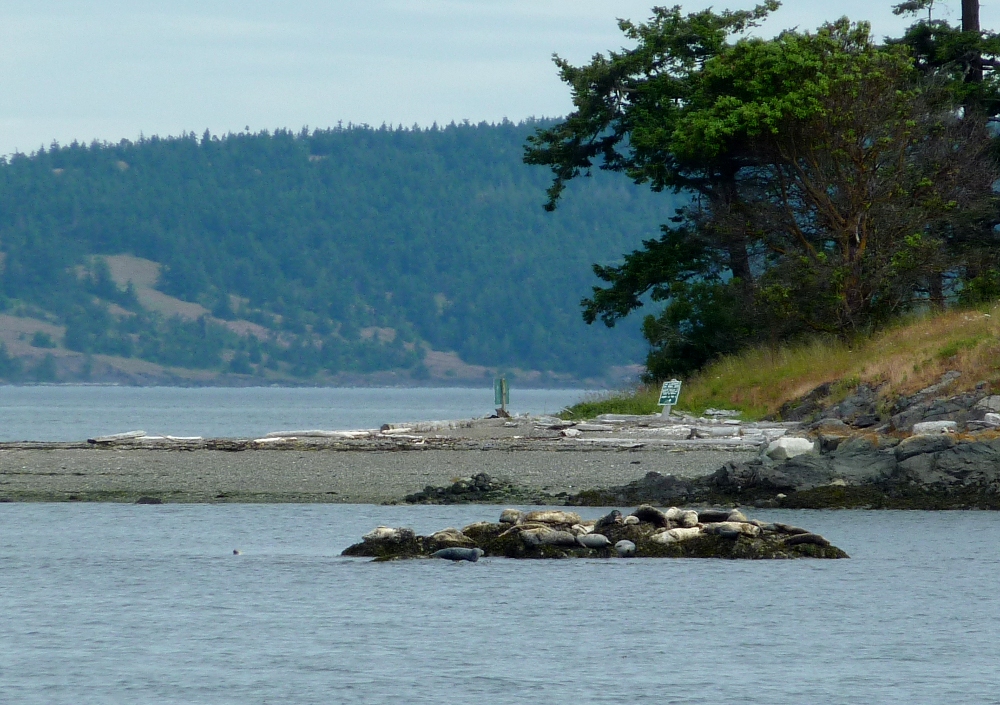
The Squito started motoring down a particular channel, based on the current reports of orca spottings. There are innumerable minor islands in the San Juans, and we passed a group of seals hauled out on a rock in front of one of them.
At one time a wealthy owner of a private island stocked it with exotic animals. Of course, introducing them onto a small island that he later lost interest in did not work out well. Nonetheless a few of the species still survive on the island, which we sailed past.
Then our captain heard a report that orcas had been sighted on the west side of San Juan Island. This was J pod, and the designation requires some explanation: orcas in the Pacific Northwest have (so far) been divided into "resident" groups, "transient" groups, and "open ocean" groups. The resident groups spend much of the year in a particular area, although that area may be a hundred miles long and wide, and they eat fish, primarily salmon. They are organized into familial groups called pods, and individuals within each pod can be identified through their markings. In the San Juans, there are three resident pods, J, K, and L. This year, 2011, K pod blew through quickly, and L pod had not yet been seen.

In contrast to the resident groups, transient groups pass through unpredictably and eat marine mammals (seals, dolphins, porpoises). Needless to say, the local seals can quickly identify whether a pod is resident or transient and get out of the water fast if it's a transient pod.

We changed direction and about forty minutes later arrived in the area where a portion of J pod was swimming north. Orcas can swim and sleep (resting at least half of their brain) at the same time, which is what J pod was doing when we first saw them. They continue to breathe, of course, but they don't dive or engage in any hunting or exploratory behaviors. Here, they have just passed a group of kayaks. The photo is an accidental panorama; I took a picture of the orcas, at far left, and another of the kayaks, at far right, and they by chance overlapped enough to stitch them together.
If you look above and to the right of the orcas, just at the top of the rock face, you will see a white bench (click on the photo to expand it). The human residents of the islands know where the orcas can frequently be seen, and want to observe in comfort.

While the orcas were "just swimming," I accumulated dozens of photos of backs and fins. For all I knew, this might be the best photo opportunity of the trip, and I had plenty of room on the camera's memory card. To see these creatures at all was a privilege. Here is one of my fin photos.
There are rules and regulations for orca-watching that are designed to prevent human activity from interfering with their lives or driving them away from their home area. Recently the keep-away limit for boats was raised from 100 yards to 200 yards; a boat is to approach no closer than that radius. Also, the boat should not park itself in front of the pod's travel to deliberately intercept them. This is yet another example of the rule to always take binoculars with you.

We were not alone in our quest.

The sleeping behavior does not separate the youngest orcas from their mothers; they will swim close enough to maintain physical contact or swim over the mother's back.
After an hour J pod began to wake up, and we saw spy-hopping behavior. The orcas indulge in human-watching behavior just as we watch them.
Then it was time to sail into Roche Harbor on San Juan Island, be reunited with our luggage, and check into our rooms at the Quarryman Hall. Those rooms were definitely top-notch. Joan and I had one with a balcony overlooking the harbor, which by no means fits into just one photo.
We had a snack at the harbor to supplement the snacks on board the Squito, and then headed off to visit the historic site called English Camp.
Most of our time at English Camp was spent on a short hike to Bell Point. This photo looks back at the historic structures of the main encampment area.
The path was level, with both sun and shade and views out onto Garrison Bay.
By this time we were ready for dinner, and we began driving back to Roche Harbor to pick up the non-hikers in our group. But we had an unscheduled stop on our way. There was a cluster of cars pulled over, and pedestrians were sitting in the middle of a side road, favoring the shade. What was going on? Our bus pulled over and we joined the audience. Creatures -- eagles, ravens, and a fox, at least -- were investigating what must have been a kill in a grassy strip beyond the side of the road, and the humans were investigating the creatures. It seemed a very strong coincidence, and perhaps a human had placed the kill in this conspicuous and convenient location.

The ravens were the most aggressive.
When the ravens departed, a fox visited.
The eagles just watched, intrigued but unwilling, for whatever reason, to challenge. They watched from the sky,
and both juveniles and adults watched from the trees.
But the eagles never, as long as we watched, came down.

We picked up the remainder of our group, and by the time we passed the kill site again, everyone and everything had departed. We drove on to the one real town on the island, Friday Harbor, where the ferries dock and shopping abounds.


Dinner was welcome, and the flowers outside the restaurant provided my final photo for the day.
 Tomorrow would be another busy day on San Juan Island, by land and by sea.

Wednesday, August 10, 2011

Sailing the San Juans: An Orcas Island Day

The next morning took us to the Glenwood Springs Hatchery of the Long Live the Kings organization. But first, Mike O'Connell, the manager of the hatchery, had a wonderful slice of Orcas Island history to show us. On the shore, near one of the hatchery facilities, erosion had uncovered ancient tools and an extensive midden. Here, Mike is talking to us about the site.
This photo is an overview of the midden, which is ten or more feet tall and a hundred or more feet long.
The vast majority of the midden is shells of sea creatures, discarded after the tasty parts had been eaten.
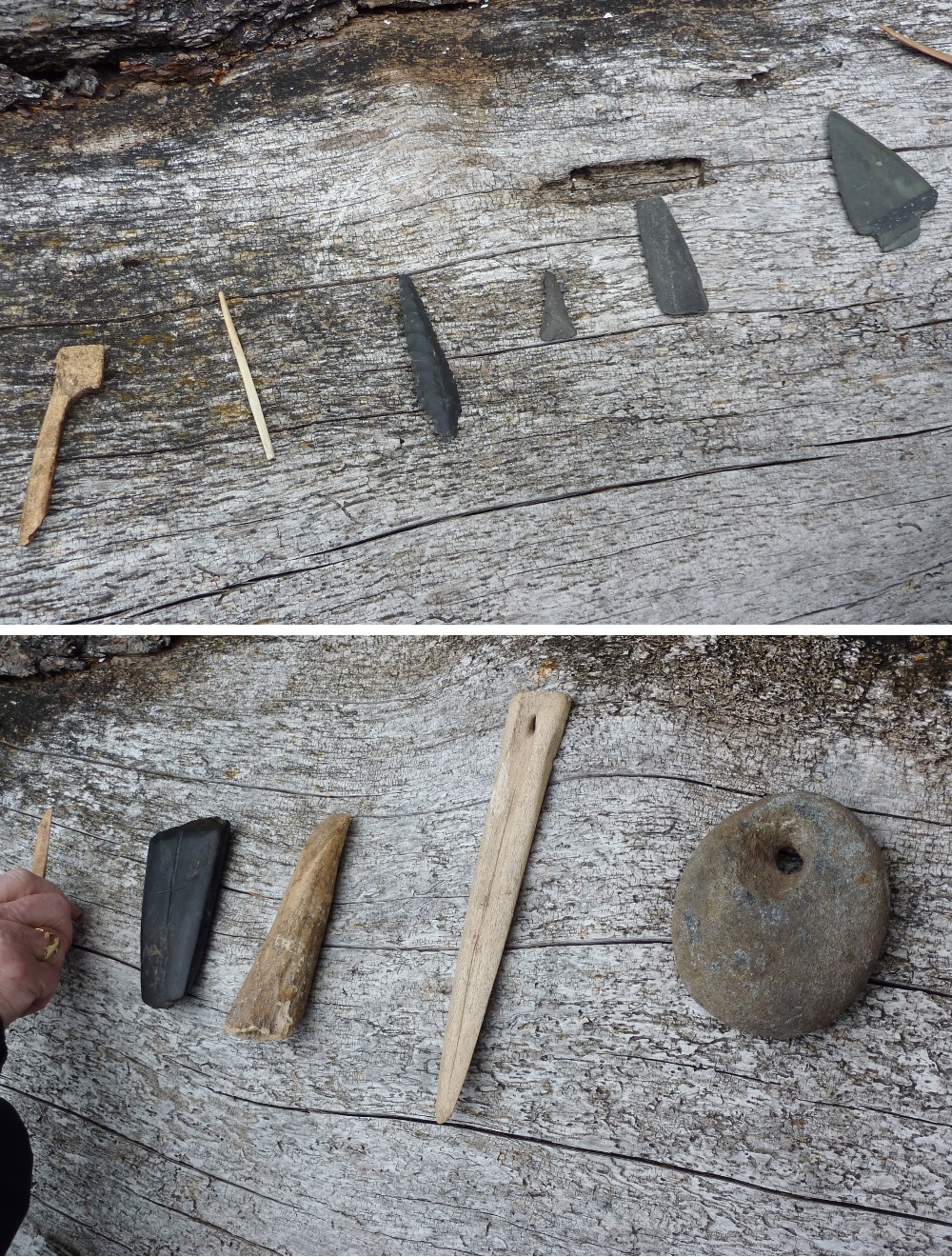
 The midden also disgorges the occasional stone tool, bone needle, or other artifact. Mike makes a point of checking the shore and the edge of the midden after winter storms.
When the salmon return from the sea, they swim and jump into this holding pool. Here the staff extract the eggs and sperm from the salmon for raising the next generation.
At Glenwood Springs Hatchery the growing salmon (and some trout) inhabit outdoor ponds, where they lead much more natural lives than they would in an indoor holding tank. There are bugs to eat (with food supplements as needed), and predators, such as osprey or raccoons, to avoid. This picture is of one corner of a pond. When the time comes to release the fish, the wheel in the photo is hand-cranked to drain the pond, and the fish soon realize that it is time to go.
 Our next stop was the main building of the hatchery. Mike is bringing out a bucket of fish food for an adjacent pond.
The fish are eager for the chow.
There is art everywhere in the Pacific Northwest, and the entryway to the hatchery is not an exception.
The hatchery has an unusual origin. In short, the founder wondered if a brand-new chinook (or king) salmon run could be established by growing and releasing chinook in a watershed that had no salmon. It worked!

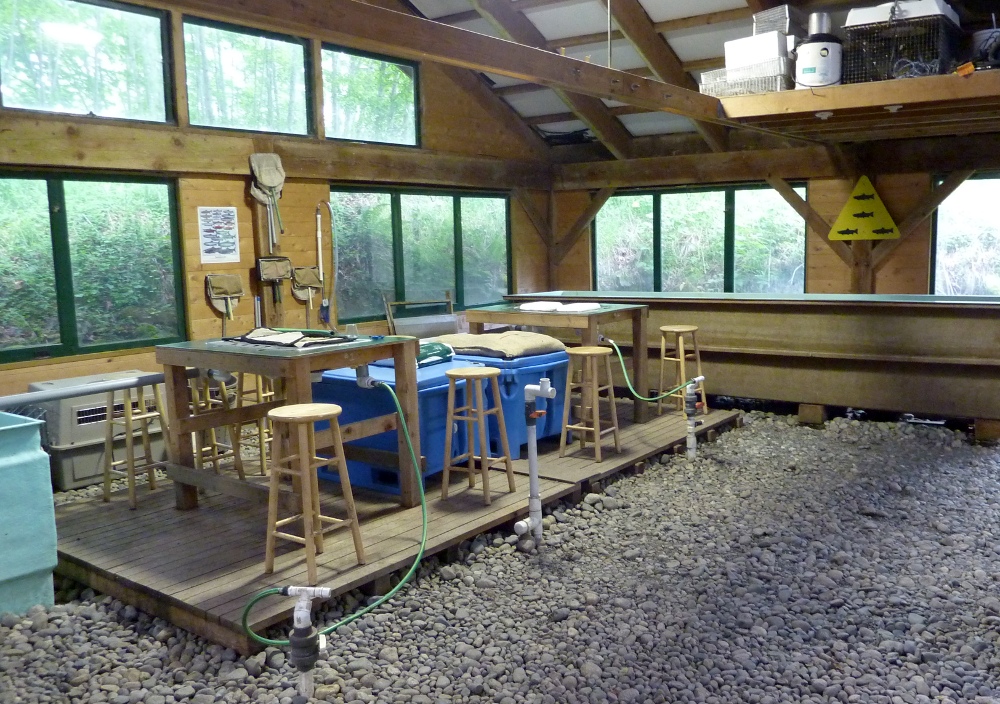
The building's interior has a gravel floor, because there's a lot of water splashed around when working with salmon.
Another corner of the building.
Mike explained the several kinds of equipment and the phase of raising salmon that requires each one.
All hatchery salmon are marked by clipping their adipose fin, which allows the fishermen who catch them years later to distinguish between wild and hatchery fish. Most interestingly, 15% to 20% of the salmon are injected with a coded wire tag. This allows the hatchery to determine where its fish are being caught, how much they contribute to sport and commercial fishery, and what the approximate survival rate of their salmon is. The work is all done by hand, so there are seasonal surges of labor at the hatchery followed by quieter times.

From the hatchery we drove over to Moran State Park.
We had a short break at a camping and picnic area. One of the first things we saw was a "tree cookie," a cross-section of a tree that was very old when it died.
The three markers on the tree cookie show its size when the Pilgrims landed at Plymouth Rock (1620), when George Washington was born (1732), and when Moran State Park was dedicated (1921).

Then we drove to the trailhead to see a living old-growth tree, which Melissa called "Big Bertha." This photo is looking back at a bridge on the road after we've started our gentle downhill walk to Big Bertha.
We were not alone on the trail.
It's impossible to fit all of Big Bertha into one photo.
To visualize Bertha's girth, Melissa had us form a human chain, reaching out at arm's length to the next person, encircling Big Bertha. Then we recreated the chain in open air to realize just how big she was. Being a part of the chain, I have no photo of it, but here Candy serves as a smiling model to provide scale.
After leaving Big Bertha, we returned to the road and then to the picnic ground for lunch. At the end of our repast, preparing to board the bus, we saw a young American Dipper. This is the bird that forages by walking underwater, snatching the small creatures that live on the stream bottom. This one was too young to be scared of us, as long as we didn't get too close. It is plump, so it may have left the nest only recently.
Then those who were interested were driven to the trailhead for a hike on the west bank of Mountain Lake. The trail was broad and easy to follow. We were wide-eyed at these emerging saprophytic plants, commonly called "candy stripe" or "candy stick."
Saprophytic plants have no chlorophyll, so they cannot photosynthesize; their food is decaying organic matter. These candy sticks extract their nutrients through a symbiotic relationship with fungi in the soil.

In places the trail was very close to the lake.
Mountain Lake is long and narrow; this is a view from near the northern end.
Our turnaround point was a grove of cedars just beyond the tip of the lake. The trail went on ...
We paused and sat there for a few minutes, absorbing the sights and smells.
Now, in retrospect, I wish I had taken several side-by-side vertical/portrait photos, so that I could stitch them into a forest panorama.

Our return walk and the evening's dinner completed an excellent day. Melissa promised us a surprise for tomorrow morning, creating some suspense.