Sunday, August 7, 2011

Sailing the San Juans: Cypress and Orcas Islands

The next morning brought rain and drizzle, but that's not unusual for the Pacific Northwest. Melissa had chartered the Gato Verde for today's sailing to Cypress Island and then Orcas Island.

The Gato Verde is a "green" catamaran ("Gato Verde" is Spanish for green cat), which can sail under wind power, or a bio-diesel fed engine, or, for silent cruising, up to two hours on batteries. The captain/owner, Todd Schuster, also uses open source software for his GPS mapping, which endeared him to me even more. Here we are gathered in the stern for a briefing from Todd. We're still at the Bellingham dock.
The rain gradually let up over the morning hours. Here several of us are practicing our deck-walk from the stern to the bow and back.
After the precipitation ended the first adventurous souls relaxed on the net on the bow between the two hulls.
There is a (very small) bathroom in either hull. In the bathroom is a window, with the ocean rushing by a foot or two below. There is an admonition posted on the window, "Do not open this window while the vessel is under way." Yessir!

Our first destination, Cypress Island, is the last largely undeveloped island in the San Juan group. Over 90% of the island is managed by the Washington Department of Natural Resources; the population is about 40. The island was named by the explorer George Vancouver, who misidentified its juniper trees as cypress.

We took the opportunity to hike across the northern neck of the island, commuting to and from the beach by zodiac.
From the zodiac we could finally see the complete lines of the Gato Verde.
For those who preferred not to wander through the wet vegetation, that is, not to take the hike, the beach offered its own opportunities.
Almost immediately we encountered our first banana slug. Now I knew we were truly in the Pacific Northwest.
These creatures come in plain green, green with dark spots, green with dark stripes, or sometimes with a brown background, and sometimes even black. It became quite ordinary to see one after the first hour, but still we kept an eye out for them, lest we coat our boots with squished slug.

Cypress Island was certainly green. Even though the San Juan Islands are in the rain shadow of the Olympic Mountains and, to a lesser extent, Vancouver Island, and generally get half the annual rainfall of Seattle, the wetness varies widely from island to island, and even from one point to another in the larger islands.
Flowers also loved the weather.
Our halfway point was Duck Lake, which is slowly turning into a marshy wetland as it fills with eroding soil and dead vegetation.
We began to descend down the eastern side of the island towards Eagle Harbor, where the Gato Verde and its zodiac awaited us. This side of the island was less choked with low vegetation; whether it is due a difference in the microclimate or the history of the island I cannot say.
After reboarding the Gato Verde we sailed through Obstruction Pass and started up the East Sound of Orcas Island, which was named for a viceroy of Mexico, not for the marine mammals (orcas, or killer whales). It looks in outline like two islands glued together, or perhaps like an island that had been gouged by the claws of a monster.


Todd tried valiantly to sail up the sound with the wind -- the Gato Verde can sail in breezes as low as four knots -- but we were moving too slowly for the schedule, and the engine was turned on. We were approaching the docks next to the Rosario Resort & Spa, halfway up the East Sound, where we would say goodbye to Todd and the Green Cat.
The back steps are built into the catamaran.
The story of the Rosario is a familiar one. An industrial baron of the Gilded Age, in this case Robert Moran, who arrived in Seattle in 1875 with only one dime and became a shipbuilding magnate, bought 7,000 acres and built himself a mansion. The industrialist eventually died and the property passed through several hands, its purchase price declining each time, until it opened as the Rosario Resort and Spa in 1960. The expense of maintaining an century-old property is considerable.

We arrived at the end of a Saturday organ concert, and had time for a quick visit in the main building before the next event, a wedding. Here is view of the concert room from the balcony.
The organ keyboard must require dexterity and practice.
Part of the waiting room next to the restaurant.
The mansion is also known for its stained glass; here, a Tiffany chandelier and window.
The nautical theme of this window is appropriate for Robert Moran.
It was quickly time to reboard our bus and check into our accommodations, the Outlook Inn, located in town on the neck of land connecting the eastern and western parts of Orcas Island.
We had a spacious room and a small balcony with a view of the water.
Tomorrow we would explore more of Orcas Island.

Saturday, August 6, 2011

Sailing the San Juans: Begin in Bellingham

After returning from Boston, we had six days to prepare for our next adventure, three weeks in the state of Washington, starting with a visit to the San Juan Islands with Natural Habitat Adventures. This is the same company we traveled with to the Great Bear rainforest in British Columbia, in 2009, and many of the same people from that trip would be with us; it was another group pulled together by Candice Andrews.

Given the long chain of our route (Columbus to Cleveland to Seattle to Bellingham), we flew out a day early. Being early, we planned to take a taxi to the group's hotel, the Chrysalis Inn, but our NatHab guide for the trip, Melissa Scott, had some time and so met us at the airport. This was an unexpected bonus and set the tone for the trip.

This is an overview of the area near the Chrysalis Inn, which is very close to Fairhaven, a community in the southern part of Bellingham.


From our room we could see southern end of the South Bay Trail and Boardwalk, which is over the water on the southern end and then travels overland to downtown Bellingham. You can see it in the lower left of the map above.
The boardwalk gave me a good viewpoint to take a picture of the Inn.
Yes, that's an operating railway right in front (but slightly below) the Inn. In the Bellingham area and for a good distance south, we could see that development (homes, roads, railroads) favored a strip near the ocean. Perhaps everything grew up near the ocean originally because that was the easiest method of transportation. And ocean views are now the most desirable. As for the Chrysalis Inn experience, the railroad was not a true nuisance. It wasn't a location where the trains were obliged to blow their horns, so there was just the rumble of the trains going by every once in a while, and earplugs were available for those with sensitive ears.

Joan and I explored the boardwalk north to the Boulevard Park, returned to the Inn for an excellent dinner, and turned in. Our body clocks were still 3 hours ahead of the clocks on the wall.

The next morning we were on our own; our other group members would be trickling in during the day. Joan and I started off by adopting one of Melissa's suggestions, to see Sehome Hill Arboretum. The road rose steeply for several blocks as we walked east from the Inn, and then we went down a pedestrian path to the southern tip of Western Washington University, and arrived at the Arboretum. We immediately plunged into the walking trails.
It was remarkable to experience a wooded getaway tucked in between the university campus and, not so far away, Interstate 5. We even did some bird watching, and I took a few pictures of flowers. Back in Columbus spring was definitely over by late June, but here in the Pacific Northwest the climate was different.

After completing a loop at Sehome Hill, Joan and I walked down to Fairhaven through well-maintained neighborhoods with compact but expensive houses. The city was launched in 1889 in anticipation of a railroad terminus to the Pacific being built here, but a few years later, its investors were bitterly disappointed when the railroad went to Seattle instead. The historic district is well preserved and full of shops -- bookstores, cafés, arts and crafts, and other commercial businesses. Joan and I had some ice cream from Papa's Sweets before embarking on a longer walk on the Interurban Trail, a bike/pedestrian trail along the route of an old interurban railway. This trail includes dirt paths, gravel paths, sidewalks, indeed just about any surface, because the interurban rail had died many years before the trail was constructed, and much development had transpired in the meantime.

We felt like exploring and wanted some exercise to help our body clocks adjust. I did take one good picture, where a retaining wall of interlocking concrete blocks hosted some sun-loving succulent plants.
As we approached the Chrysalis Inn on our return, we saw familiar faces: the rest of our group had made it to Bellingham. Hugs and handshakes were exchanged, and later Melissa gave an overview of what the next several days might bring. Joan and I repacked, because we were carrying luggage for three weeks and for the first week we certainly didn't need everything! One duffel was stored at the Inn and one was taken with us, starting bright and early the next morning.

Sunday, July 31, 2011

A Reunion in Boston, and a Sloan Fellow

A dollop of stage-setting is required for this story!

For two academic years, from mid-1974 through mid-1976, Joan attended what was then named the Institut International de Glion, now renamed the Glion Institute of Higher Education. Primarily a hotel and hospitality school, in that era it also had a tourism track which attracted many international students from countries interested in growing a tourism industry. Joan was enrolled in this tourism curriculum.

The school is located in Glion, near Montreux, and thus in the French-speaking part of Switzerland. Glion is near the center of the map below.


Classes at Glion are conducted entirely in French. Joan's French was very good; she spent her junior year of college living with a French family in Nantes. Some of the international students, however, had only a six-week crash course in French before being thrust into classrooms. Joan became good friends with a student from Malaysia, Latiff, who needed help with his French. Having already had some real-world work experience he was able to help Joan with many of the technical terms and concepts being taught in the classes. It was a successful partnership; Joan graduated #1 in the class, and Latiff was #2. Here is a grainy snapshot of Latiff on graduation day, from a scanned 35-year-old slide.

While Latiff was at Glion his second child, a son named Khalid, was born in Malaysia. Later, in 1980, when Joan and I visited Latiff and his family in Malaysia, we met a 5-year-old Khalid. Now, in June 2011, Khalid was graduating from a one-year Sloan Fellows Program in Innovation and Global Leadership at MIT, having been sponsored by his employer, Petronas, the state-owned petroleum company. Latiff and his wife, Balkeesh, were coming to the United States in a whirlwind to see their son's graduation, visit one of Latiff's work contacts, and see a small slice of Boston and New York.

We came to Boston for a few days to have a reunion; we had not seen Latiff, Balkeesh, or Khalid for 31 years.

Khalid and Latiff met us at the airport, as a surprise, and dropped us off at our hotel, the Kendall, to check in and get settled before the evening's outing. (This photo is from later in the visit, just after a rain shower.)
The Kendall was perfectly located for our purposes, being a short walk from the MIT campus, from the Charles River, and from the apartment in married-student housing where Khalid and his wife Shahida lived. The front part of the hotel was originally a Victorian-era firehouse, built in 1895, and came close to being demolished until the Kendall began renovations in 2000.

Our first activity with Latiff, Balkeesh, Khalid, and Shahida was a boat tour on the Charles River that evening. The boats come up to the back of a huge shopping mall, the Cambridgeside Galleria, through a small canal and basin.
We rested and chatted for a few minutes waiting for the next tour.
From left to right are Balkeesh, Latiff, Shahida, Joan, and myself. Khalid took the photo, and we'll see him momentarily.

Boston was enjoying a day of cool, dry air, and evening photography on the Charles River was beckoning to everybody.
There were a great many pictures taken of each other. Here are Balkeesh and Latiff at the stern of the boat.
A closeup of Latiff.
A flash photo of Khalid. Doesn't he look like a younger version of his Dad? A chip off the old block.
 Khalid and Shahida at the bow.
 The three ladies: Shahida, Joan, and Balkeesh.
Daughter-in-law and Mom. They do seem to enjoy each other's company.
There is never-ending activity on this stretch of the Charles. Private sailing docks, MIT docks, other institutions, tour operators, all going strong until dusk. This photo is of a "duck boat," a boat with wheels that can come onshore to load and unload.
Sailboats.
Practicing for a dragon boat competition.
Individual sculling.
We turned around just upstream of the John J. Weeks pedestrian bridge, connecting parts of the Harvard campus.
A downstream view headed back towards Boston.
The light is almost gone (for photography) as we draw near the "Leonard Zakim Bunker Hill Memorial Bridge." Aren't cable-stayed bridges lovely?
By the time we docked it was 8:30 or so and definitely time for dinner, and then to rest. Latiff promised us a big Boston tour on the morrow.

The Kendall is just one block from a stop on the Upper Deck Trolley Tours line. This outfit offers on-and-off privileges for two days and advertises the most sightseeing stops. The Malaysian clan met us at the Kendall after breakfast, tickets for everybody in hand, and we boarded the trolley. Here are two views of the trolley from later that day.

A front view.
The first portion of our outing was divided into three parts: first, take the trolley as far as the Boston Harbor stop, then get off for the harbor tour, and then resume the trolley tour.

I didn't try to take pictures through the bus windows that day. The trolley made a brief stop for everybody outside Fenway Park, the shrine to Red Sox baseball. There is a statue for the four Teammates, Ted Williams, Bobby Doerr, Johnny Pesky, and Dom Dimaggio.
Because of his great concern for and philanthropy regarding children, Ted Williams also gets his own statue.
I'm not a baseball fan, but it was fun to see these legendary locations anyway.

By noon the day was heating up, although the air was still not humid. Many people waiting for the harbor tour opted to find some shade from the bright sun. A couple of small ferries to outlying islands came and went, and then it was our turn.
Mom made certain to snap pictures of Khalid in the different sections of scenic Boston. Who wouldn't be proud of their Sloan Fellow son? Latiff now refers to himself as an "MIT Dad."
Waterfront living is available if you have the big bucks.
There was a large variety of watercraft enjoying the harbor on such a fine day. Here is the Liberty Clipper, which does day trips and extended excursions. Believe it or not, it's a replica of the Baltimore Clippers of the California gold rush era. Ships this size sailed around Cape Horn to California with a reputation for speed and safety!
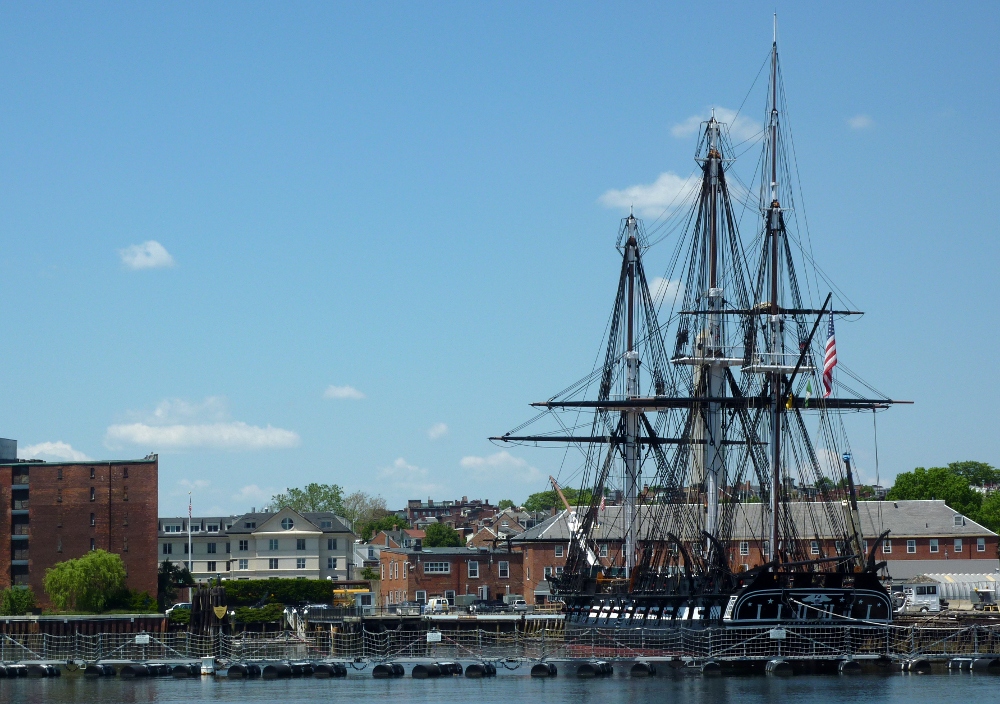
No tour of the harbor can be complete without passing by the berth of the Constitution, known as Old Ironsides. She is still a commissioned warship of the US Navy, and the oldest such, launched in 1797/98. (The oldest commissioned warship in the world is Nelson's HMS Victory, launched in 1765. But it is in dry dock, so the Constitution is the "oldest commissioned warship afloat.")
We also sailed by more modern vessels, such as the Coast Guard's Seneca.
After the harbor tour we resumed the trolley tour. We passed by many historic locations and buildings, and I must compliment our drivers on their friendliness and knowledge. If Bostonians are by nature gruff, we never saw it! The Freedom Trail and Old Ironsides would both be worth a second visit to Boston. The only photos I have to offer of this segment of our visit are of the Massachusetts State House.
We were there during the Stanley Cup finals, and zooming in, we could see that the State House was participating.
A closeup of the sign in front along the sidewalk.

We all know that plans sometimes do not work out, especially if you are a few days away from moving all your possessions halfway around the world. This afternoon Latiff told us of two developments. One was a promised and much-postponed last dinner with friends of Khalid, so Joan and I would be on our own for dinner that night. The true spanner in the works was that the movers hired to box all the stuff that Khalid and Shahida were sending back to Malaysia had gotten the promised date wrong, and now tomorrow was the only day they could tackle the job. Our Malaysian foursome invited us to a home-style Malaysian lunch tomorrow at Khalid's apartment, but for the rest of the day they would be consumed by packing, packing, and more packing.

When the tour trolley reached the Cambridgeside Galleria stop, it was time to part ways for the remainder of the day. Our friends would squeeze in some final shopping, while Joan and I transferred to the tour trolley for Harvard Square. It was late enough in the day, and we were tired enough, that Joan and I were happy to drink in the Harvard Square tour from the trolley, without disembarking for a student-led tour of the grounds. It didn't hurt that we had the most charming and enthusiastic driver/guide that I've yet encountered.

For dinner that night we repeated our visit to the restaurant of the night before, the Legal Sea Foods practically across the street from our hotel. Being so close to MIT, there was plenty of interesting eavesdropping to be done at the restaurant. Discussions about student problems, using a better solvent ("Amides generally do better with hydrogen bonding solvents"), and the proper use of liquid nitrogen were in the air. Back at the hotel, we had earlier seen a man carrying a binder for a course in nanotechnology engineering.

After the meal we took a walk along the Charles River. There is a bicycle and walking path (sometimes more than one track, sometimes wider and sometimes narrower) for miles along the river, between the riverbanks and Memorial Drive, and it is only a few blocks from the Kendall. It allowed us to stretch our legs, admire the sailboats and skyscrapers, and observe the wide range of dog walkers, joggers, runners, and casual and serious cyclists. It appeared to me that there were more female joggers than male on this path; perhaps it is well regarded for safety.

The following morning we went to the MIT Museum. The second floor in particular is full of wonders, given the long and illustrious history of MIT, including the history of the unit of measure called the smoot. There is a gift shop with many items available only at MIT. On this third day of the visit, Boston was clearly warming up, with a high above 90 expected.

We walked to Khalid's apartment at the appointed hour. The lunch was spicy and delicious, and we appreciated the effort that Shahida and Balkeesh made to prepare it at such a chaotic time. After we arrived there were six adults plus two or three movers in the one small apartment, which had a fan but no air conditioning. (I don't recall if it was broken or not present, but I believe the condition was uniform in the married student tower.) One of the movers asked Khalid, who seemed immune to the heat, how warm it was in Malaysia. His answer was, "This is about as cold as it gets."

It was good to see everybody again, even if the circumstances were distracting. Eventually we returned to the hotel, to do some preliminary packing for the flight back, and then had dinner there as well.

That evening we walked through the MIT campus and explored further downstream on the riverside path. One of the areas of the campus that we examined was Ray and Maria Stata Center, designed by Frank Gehry, known for his unusual architectural style, examples of which include the Guggenheim Museum in Bilbao. It was difficult to find a single good perspective for photography, so I shall inflict several photos on the reader. Also, they are the only pictures describing this evening!
I will note that MIT filed a lawsuit in 2007 over many problems they found with the design and construction (leaks, falling ice blocking exits, and the like). Gehry blamed cost-cutting measures in construction, and in any case, the suit was reportedly settled in 2010.

The next and final day was a short one, because we had decided on 12:00 noon as the time to head for the airport. We visited several galleries on campus, including the Hart Nautical Gallery. There were several special exhibits and art works for MIT's 150th anniversary year. On loan for one year is the statue The Alchemist, by Jaume Plensa.
We also visited the MIT chapel, which is very unprepossessing on the outside, but striking on the inside. It is of course non-denominational.
Then we returned to the hotel for our luggage and took a taxi to the airport. Standing in line to check in, my cellphone rang. It was Latiff, who had called twice earlier, probably while the taxi was in tunnels or otherwise did not see a T-Mobile signal. He was on his way to see us at the hotel before we left for the airport. I explained we were already at the airport, and handed the phone to Joan so she could say her goodbyes.

We hope it will not be another 31 years before we see them again! 

Let's end this account with a video of our takeoff from Boston Airport.

Saturday, July 30, 2011

WOW DTA (Digital Terminal Adapter) Poltergeists

This is a report, the third, on our experiences with the WOW (Wide Open West) digital transition (the dropping of analog signals for all except local broadcast channels). This entry is prompted by recent odd behavior by our DTAs (devices that convert the digital signal to analog for our analog TVs and VCRs).
 
Spontaneous Deregistration
One day last week we turned on the TV in our bedroom to discover the WOW digital terminal adapter (DTA) insisting that it must be registered before it could be used. This was odd, because it had been registered in March and worked fine ever since. Fortunately using the WOW web page for DTA registration satisfied the device, and all was well. The other three adapters had continued operating normally and were not disturbed by the re-registration.

I left a comment on the WOW Buzz blog (now defunct), in the technology section.
Today one of our DTAs stopped working — blinking power light, and the message on the TV that the device has to be registered to function. Odd, since it had been working for several months!
Re-registering it over the Internet worked fine.
I was wondering if WOW de-registers DTA equipment that has had no activity for some period of time? (30 days? 45 days?) This DTA was the least-used of our four, although it was always left powered on, and we were recently away for three weeks.
The author responded with clarity, consideration, and lots of information.
Ben:
Great question. I posed this to Gary Nilsen, our VP of Engineering (aka: “king video guru”), and he indicated that the DTA devices are strictly “one-way”, so the head end systems would not have any idea how long one had been on line (or off line). He suspects that your experience may have been a fluke associated with multiple power-down/brownout experiences associated with the storm activity we’ve had in the midwest this year. Certainly a power outage that might have occurred during video maintenance could also have caused this situation. Odd, though that the other DTA in the house were unaffected. Bottom line, if it becomes troublesome, he suggested swapping out the DTA for a new piece of equipment, and we’ll be happy to do that for you.
Steve
We certainly live in a part of town that has more than its share of power glitches, especially of the one-to-three second variety. But this is not the end of the story ...
 
The Big Freeze
Poltergeists must be inhabiting our house. Joan had scheduled some movie taping on our analog VCR, and Saturday (July 23) she went to inspect the results. They were not what she expected. There were six hours of one video frame, an “Executive Producer” credit, on the tape. The credit was still showing up on the TV, and the DTA would not respond to the remote – it would not change channels, it would not turn off. Oddly, the power light was off although the DTA was clearly sending a signal to the TV. Unplugging and replugging it cleared the problem.

We inspected our other three DTAs, and two were fine and one was frozen at the exact same channel and credit frame. What makes an explanation difficult is that two were on battery backup (each on a separate UPS) and two were just plugged into the wall, and of the ones on battery backup, one was frozen and one was not. Of the ones plugged into the wall, one was frozen and one was not. The only commonality between the frozen DTAs was that they were tuned to the same channel (AMC) and showing the same frame. The DTAs that did not freeze were not tuned to AMC.

The frozen DTAs were not the deregistered DTA. This means that we've had “events” on three of the four DTAs in the past 10 days or so.

Go figure.

Again, I left a message on the WOW Buzz blog, and another quick response came back:
Go figure indeed. Odd, though that two different DTA’s would freeze on the same channel in the same place. Almost seems like something coming from AMC froze the equipment, but there would be no technical explanation for that that I can think of. May run this past our video guru to see if he has any ideas, but in the meantime, the poltergeist explanation is as good as any!
Steve
There have been no further glitches (it's been one week). My advice to DTA users is, if you have set up unattended recording, to check the state of the DTA as close to the time of the recording as you can. The more complex your video arrangements are, the more points of failure there are.

Addendum 02/12/2012
The DTAs continue to be susceptible to spontaneous de-registration, but with no observable connection to events such as weather or electrical glitches. Last night we missed taping a movie because just one of the DTAs spontaneously deregistered.

Addendum 05/04/2015
The DTAs are susceptible to glitches after they've been powered up for a long time. We had one that refused to change the channel until we removed the power (unplugged the power adapter), waited a couple of seconds, and then turned it back on. Another lost all sound -- the video was fine -- again until it was turned off and back on. So if you're using one of these things, and experiencing odd difficulties with your setup, one of your first steps should be the power off/on drill.

Addendum 09/15/2015
I called WOW today to return one of my DTAs (no longer needed). In the past they've sent me a mailing label; I would box stuff up and send it back. Now they want $50 to that. I'm supposed to drive to the closest WOW office instead, for which there is "no charge." Just time and gas ... but because I'm paying $2.00/month for the gadget I have no choice.

Addendum 10/28/2015
Our final DTA stopped working last week -- it insisted that it needed to be activated, but activation, both by me and by customer support, didn't work. Swapped it for a new one which works perfectly so far -- it didn't even need activation once I plugged it in!