Friday, July 29, 2011

Island Odyssey: Sark and Guernsey

Our first destination on this last day aboard the Explorer was the island of Sark, one of the Channel Islands and much closer to France than to England. In the map below, it is the larger unlabeled island east of Guernsey.


Sark has a long, fascinating, and complicated history. Along with the other Channel Islands, it is a dependency of Great Britain. However, it is a Royal Fief with its own laws based on Norman laws, and its own parliament, even though its population is just 600. The currency is the Guernsey or Channel Island pound, which is pegged to the UK pound. (The Lindblad staff advised us that any Channel Island change we might receive would not be accepted back on the mainland.) The parliament became democratic rather than appointed in 2008, to comply with European Union regulations on human rights, largely due to a lawsuit brought by the Barclay brothers. To quote a snippet of an extensive Wikipedia entry:
Sark also exercises jurisdiction over the island of Brecqhou, only a few hundred feet west of Greater Sark. It is a private island that is not open to visitors. Since 1993 Brecqhou has been owned by David Barclay, one of the Barclay brothers, co-owners of The Daily Telegraph. They contest Sark's control over the island.
The Barclay brothers, fabulously rich, appear to have been troublemakers since purchasing Brecqhou. Perhaps they hope to replace the traditional Sark government with a plutocratic one.

Since the early 20th Century Sark has been known as a tourist destination. Except for farmers' tractors, no motor vehicles are allowed. It recently qualified as the first dark sky island.

This was our view of Sark as the zodiacs were being lowered into the water.
The choice of landing dock is dictated by whether the tide is high or low. Here we disembark at a high-tide causeway.
The road from the dock to the central part of the island is narrow, steep, and dangerous for pedestrians due to the possibility of encountering a bicycle or a tractor. Everyone was encouraged to take the arranged transportation.
It was well organized, showing Sark's experience as a tourist destination. There were tickets for the drive up, for the round-trip cart ride to the La Seigneurie Gardens, and for the drive back down. This might be a way of tracking tourist volumes, and it keeps visitors honest who, unlike us, are not prepaid.

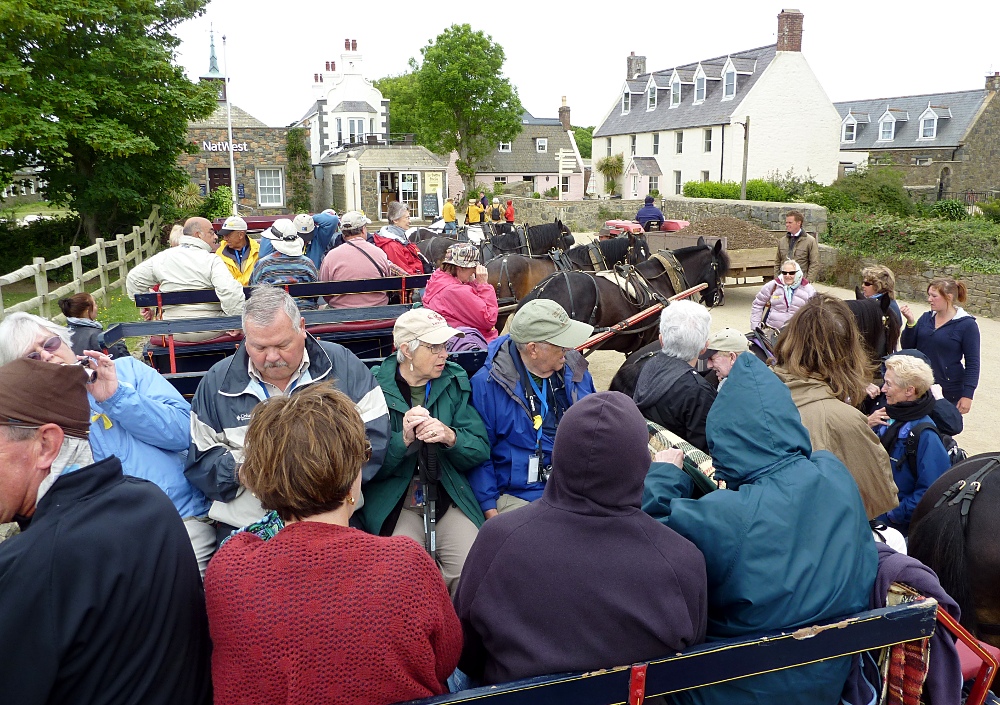
At the central point we were distributed among the horse-drawn carts. Our driver, a young woman just back from higher education on the mainland, told us that at Sark's peak of tourism a couple of decades ago the island had 70 such carts, but could muster only 20 or so now.
The island has handsome horses.
Here is the superhighway on the way to the gardens.
Thelma and Louise pose on our friendly horse as we disembark for the gardens.
The La Seigneurie Gardens are the formal gardens on the estate of the Seigneur, who holds the island as a fief from the Crown of England. On Wednesdays the wife, Diana Beaumont, of the current Seigneur leads a guided tour, but we were here on a Monday. In addition to the gardens, you are free to poke around the exterior of the estate (there is an entrance fee of course). Naturally, there is a bistro and gift shop as well.

The main building, La Seigneurie, rises behind the chapel as we walk towards the garden entrance.
The gardens are laid out in sections (soft fruit, orchard, flowers) with a long east-west walkway connecting them.
Here is a montage of some of what we saw.
This is the dove-cote, or pigeon house. In earlier times the privilege of owning pigeons was strictly limited to the Seigneur.
The battery contains an old grist wheel as well as cannons from different centuries. Part of the original terms by which Queen Elizabeth I granted the island to the first Seigneur was that he be able to raise 40 armed men to defend the island.
After a while the carts returned to deliver a second shift of Lindblad guests and take us back to the central village.
Joan and I chose to follow a footpath to a headland called Hog's Back.
The headland still has a cannon, although it has not been fired in a long time. The Germans, who occupied Sark during the Second World War, did not disturb it.
And there was a truly great view.
From Hog's Back we could see the causeway that links Great Sark to Little Sark. Before the walkway with rails was constructed, children from Little Sark going back and forth to school on Great Sark would often crawl across the causeway on their hands and knees to avoid being blown off into the sea below.
And I do mean below.
After returning from Hog's Back -- nothing is that far away in Sark -- we had time to browse a bit. In one shop we bought some Sark chocolate. No, the cacao beans aren't grown on Sark, but local dairy can be used, and the different ingredients are brought together here. There are also at least two bicycle rental shops on the island, and one was located in a very small plaza with a dragon out front to lure the curious and inspire the admirers of dragons.
Then we took a tractor cart down to the low-water dock and returned to the Explorer, where lunch was served while we sailed over to Guernsey.
Guernsey is much larger than Sark, and in some ways diametrically opposite. It has about 65,000 inhabitants, one hundred times more than Sark. The main city, Saint Peter Port, is a bustling business center with traffic problems. Many corporations have headquarters here due to an extremely low tax regime. On our walk, Joan and I saw modern office buildings with shiny brass plaques that said (I paraphrase) "for a list of tenants please inquire inside." And lots of men in neatly tailored suits.

But we arrived by zodiac.
The Explorer might have been too large for the harbor, or, given the rapid turnover of ferries, there might not have been a berth for us.
 At the top of the dock we were greeted warmly and handed some Guernsey maps and tourist literature. Because we had only the afternoon to explore, Joan and I needed to prune the list of things to see. Our first stop was the Castle Cornet, visible from anywhere in the harbor, and located at the tip of the southern harbor causeway.
On our way over, it was clear that the tide was out.
The Castle Cornet has several museums, including one about the castle, about maritime history, about the local RAF squadron, and so forth. But it was already almost 3pm, the Castle closes at 5:00pm, and the admission was £9 (almost $15, now it's £10.50). You can get in for £1 between 4:00 and 5:00, but then how much would we see? Joan and I both greatly enjoyed the book about the German occupation of Guernsey in WWII, The Guernsey Literary and Potato Peel Pie Society, and the PBS dramatization of the occupation, Islands at War. So we walked briskly down to La Vallette Military Museum, a museum of the military history of Guernsey with an emphasis on the German occupation.

Here is a view of the exterior of the museum from the causeway to Castle Cornet. There isn't much to see: it is housed inside an underground German facility from the war.
The Germans created a series of concrete-reinforced tunnels for what they intended to be a U-boat refueling station.
Four large tanks were installed, but only one was filled with fuel before the Germans abandoned the effort. One was left in place for the museum.
The museum has many souvenirs and mementos of the war, including old German equipment and posters that announced various regulations and punishments.
One display case showcased several extant examples of homemade radio sets from the war, among other items. In the this picture, note the yo-yo near bottom left made from scrap.
After spending some time in La Vallette, Joan and I decided to walk into town rather than spending a brief interval at Castle Cornet. Along the way we passed this tidal swimming pool, which refills itself with each high tide.

Our goal was to find a high viewpoint from which to look down on the harbor. I was the pathfinder, with the map of the downtown area in hand, with the notion of passing by Candie Gardens on the way up. But the old downtown roads are a twisty bunch. We ended up walking too far west and not enough north to hit Candie Gardens, but it didn't really matter. The entire area is much too built up to find a good view of the harbor, unless one could climb to the top of a church or clock tower. We did see the tip of the gardens on the way back, after we had walked off the map and then come back down the hill past St. Andrew's Church of Scotland (on the map again!) and the Old Observatory.

Again at the level of the docks, we came across a small plaza next to a Swiss bank (UBS). Did I mention that banks pay only a 10% tax in the Channel Islands? In the plaza was a statue and a diorama dedicated to Otton de Grandson, a Swiss nobleman who became the right-hand man of King Edward I of England. The local connection is that he was appointed Governor for life of Guernsey in 1277. He did not visit much, however. In the plaque, the archaic spelling of Othon is used.
The diorama was fascinating, cast in metal, and depicting several scenes from the major events in Otton's 90-year life.
Then it was time to reboard the Explorer. It was our last night aboard ship, and there was the Farewell Reception to attend, then dinner, and then repacking everything that had exploded across our cabin over the last eight days, in ways suitable for airline security and baggage compartments.

On our arrival in Portsmouth the captain discovered that a ferry was still in our assigned berth; we docked half an hour late. The couple who had intended to leave in a taxi even earlier than our early departure ended up traveling with us, making about 10 in the small van heading for Heathrow airport. The driver was cheerful and conversational, which was valuable during a long delay when traffic was funneled through a small town to detour tunnel construction on the main highway. Joan and I got off at the van's first stop, and boarded our flights back to Philadelphia and Columbus without any difficulties. I hope the couple who originally planned to take a taxi fared as well.

Once home, we kept busy with deferred chores. We knew there would be only 19 days until we flew to Boston.

Friday, July 22, 2011

Island Odyssey: Fowey

Our next stop was not an island, but the small harbor town of Fowey (pronounced "Foy") on the English mainland. This turned out to be a very photogenic day, creating a very long blog entry!


The Explorer arrived early in the morning, and was gently nudged into position by a tug.
Here was the view looking down the estuary towards the mouth of the River Fowey.
Our ship was immense compared to the other vessels in the harbor, and one small craft had not been warned by the harbormaster that we would be mooring barely forty feet to his port. He had quite a shock awakening to the clangor of the tug and the Explorer looming over him!

The first outing of the day was a 30-minute drive through the Cornwall countryside to the Eden Project. This facility, built on the site of an abandoned open-pit clay mine, struck me as one-third botanical research facility, one-third public education effort, and one-third Disneyland. Cornwall has a long history of open-pit mining for clay, granite, and slate, and this Google Maps image just west of Fowey shows it very clearly.


The bus park and entrance for the Eden Project were modern, and at 10:00 on a Sunday morning it wasn't yet congested. This sign revealed how the original clay mine had looked.
The ticket offices, main restaurant, gift shop, and such had been built on the lip of the old pit. Once allowed in, we walked down a series of gentle switchbacks and observation galleries to the exhibit level. From partway down, the main domes of the project looked like this:
These domes are constructed with two layers of plastic, separated by a pressurized air gap. With them the Eden Project can create a wide variety of spaces and climates. Some are available for booking private events such as a wedding.

There are several innovative and educational sculptures on the grounds. The bee is on the path to the domes' entrance.
The WEEE (Waste Electrical and Electronic Equipment) man is alongside one of the major paths to go from one part of the grounds to another. His existence requires an explanatory sign. (Click to enlarge and read the print.)
The WEEE man stands at least two stories tall.
With a photo zoom, I can capture his face.
The domes, especially in the bright sun, enable the Eden Project to create habitats with different degrees of heat and humidity. Cold is forbidden.

This picture shows several elements within the "wet tropical" dome, including lush vegetation, a paved pathway, faux display elements, and near the apex of the dome, a special observation platform.
Additionally, there were human dwellings set up representative of several different locations; here, one for Indonesia/Malaysia and one for one of the African vegetation zones.
Visitors can go up to the apex platform, but you must first sign a waiver. Also, if the top of the dome gets too hot, the platform may be closed. You climb a series of staircases to get there.
The view from the platform is wonderful, but the heat -- you are at the top of a huge greenhouse, after all -- discourages lingering. This panorama has some flaws, but taking pictures of curved surfaces that are not far away presents challenges!
The object in the lower left corner is the balloon. Yes, there's a hot air balloon that the staff botanists can use to reach the treetops.
Of course, there were flowers, trees, and bushes, indeed all kinds of plants to admire. Our limited time at the project prevented an extended perusal, but here are two samples.
The warm and dry dome, or Mediterranean climate, featured a slope covered with figures from Greek mythology.
But the best part of this dome was a series of PIG SCULPTURES done in natural wood, in thick sticks such as driftwood.
A more conventional building on the site is used for various presentations and events, such as educational workshops for children. In the lobby there is a "plant processor," which is really one of those mechanical marvels that lifts steel balls up to a great height and then releases them to flow back down to the bottom through chutes, drops, levers, and such. This one was special in that it was not automatic; it was hand-cranked. The faster you crank, the faster the next ball gets lifted to the top. (The crank is on the far side, invisible to the photo.)
At this point or in its proximity we started back towards the main building, on the top of the pit, to do some gift shopping. Fortunately we encountered some fellow Lindblad tourists who told us that the gift shop was closed until noon. I am certain this must be against T.A.R. (Tourist Attraction Regulations) -- to allow guests entry two hours before the gift shop opens. For us, it presented the dilemma that there would not be enough time to shop at noon and still be back at our bus on time. So we dashed back to the first dome, which had a modest gift nook, and found a couple of small items.

On our way out we took in the Plant Takeaway, an animated exhibit about what would happen if plants disappeared. Hint: they are important.

I have a video clip of about 97% of the show. The captions are on a near the top of the frame.

Those who wished to see the Lost Gardens of Heligan took buses and had lunch en route. Joan and I were going for the long walk, which meant taking the bus going back to the Explorer for lunch.
The hike (variously described as between 4 and 6 miles) was a loop, including zodiac rides to/from the ship and the main dock at Fowey, two ferry rides, and several different terrains. I've marked up a snapshot of Google Maps, where the zodiac and ferry rides are in blue and our walking is in yellow.
Our first ferry ride was from Fowey to Bodinnick.
After a short but steep climb from the ferry landing we saw the marker for the trail.
The early part of the path was in woods with occasional openings for a view.
The first mile on the trail had several historical markers. This is a memorial to the citizens of Fowey who died in World War II.
As we neared Penleath Point there was a small stone shelter with this historical plaque.
We had a long stroll until the Pont Pill (Creek) had shrunk enough to cross on a footbridge. Here is a look back down to the Fowey River and the village of Polruan.
There were old farm buildings on the north side of the crossing.
Long ago this was a thriving quay (dock) where barges would unload coal, fertilizer, and limestone.
The swans were popular and their cygnets adorable.
One side note is that Pont Pill is considered by many local people to be the inspiration for the popular book The Wind in the Willows. Author Kenneth Grahame often holidayed in Fowey and hiked in this area.

Up a footpath, a short distance on a road, and another footpath took us to an old church. This was the only stretch of the trail that had the potential for confusion, but our leaders knew or appeared to know where they were going.

I had not written down or saved any information on the church, but upon asking Mr. Google it became apparent that it is St. Willow's Church. Now I can state that it's a church with Norman origins, with at least one stone dating to no later than the 8th Century. Restorations are known to have occurred in the 14th Century and in 1904-1905. The interior was not well lit for cameras, but by holding my breath and being very steady, this image was successful.
Looking back along the road towards the church.
At this point our group began to break up into smaller clusters, and for a short while we were along country roads until the path cut across the last few fields before the coast.
At the coast there was a spur trail to a headland, and the main trail lost altitude and continued west along the coast. This view is shortly after we began giving back some of our hard-won climb.
Looking back we could see the headland, a path down to a small beach, and to the right, a zodiac from the Explorer and several divers in the water.
There aren't any further pictures from the coastal section of the walk. They would look much like the above two. Joan and I did pause from time to time in search of birds that we could hear chirping in the brush, with mixed success. Entering the village of Polruan, walking down to the ferry, we could see the outsized Explorer.
This was our ferry to the lower dock on the Fowey side.
About an hour after our return, another tug appeared to ease the Explorer from her mooring and assist her turn-around to head down the Fowey to the Channel.
We successfully passed the pair of blockhouses that flank the entrance, and then went inside for a well-earned dinner.
Tomorrow we would visit the Channel Islands of Sark and Guernsey.