Tuesday, September 17, 2013

Arctic Journey: Breiðafjörður (Breidafjord) and Flatey

On the morning of July 20th, after a welcome night of sleep, we entered the Breidafjord, a large shallow bay which separates the Westfjords from the rest of Iceland. On the port side of the Explorer was the Latrabjarg, Europe's largest bird cliff at 14 km long and 441 meters high. If you don't count Greenland or the Azores it is also the westernmost point of Europe. Capped with a layer of fog or cloud, it looked most mysterious.

Joan and I were two of four guests on the bridge when a large creature came close by the starboard side. Consulting with the captain, he identified it as a basking shark, the second largest fish after the whale shark. Many of my at-sea photos were taken from the bridge, which provides an elevated viewpoint and knowledgeable and experienced spotters, including the captain. In addition, you are sheltered from the weather on the bridge. The only downside is that I'm taking photos through windows.

A bit later everyone on board had a good look a small pod of orcas, or killer whales, that we encountered further into the bay. They hung around for at least half an hour.
The youngster always stayed close to its mother.
Here is a closer look at the accompanying male, with the large dorsal fin.

The pigs accompanying us on this voyage, Katy and Posy, usually watched from the cabin window, although they sometimes attended lectures if there was the possibility of interesting pictures.
During lunchtime, guests can take their meal in the observation lounge, where the views are better, instead of the dining room. On a pretty day such as today it fills up rapidly.
Flatey island, our goal, is indeed flatter than most of Iceland, as this view from our approach shows.
The Explorer was too large to use the ferry dock, so we reached the shore via zodiac.
Flatey was a commercial and cultural hub for a long time. For example, a monastery was founded in 1172. The island had a large population for its small geographic size from the mid-18th Century through the 19th Century, but in the 20th Century it dwindled, until now the year-round population is only five. However, there are a large number of summer homes and guest houses on Flatey, so its population swells during the summer.

Flatey is visited year-round by a ferry. From the settlement of Iceland to this day it is easier to travel by boat from any point on the Breidafjord to another than to use the roads.
This photo shows how the village center appears from the spot of our zodiac landing.
The first leg of our walkabout was to the ferry dock, which has a small café and gift shop. Outside fish were drying.
Sheep have been the major livestock of Iceland for a thousand years.
They are very relaxed and comfortable.
Next we visited the church, built in 1926.
The interior of the church was painted with scenes of island life and history in the 1960s by a Spanish painter, Baltasar Samper.
Here is a closeup of one section.
Close by is the library, the oldest and smallest in Iceland, established in 1864.
Inside, among other books, is a copy of the Flateyjarbók, or Flatey Book, written in the late 14th Century. The original book remained on Flatey until the mid 17th Century, and was repatriated to Iceland from Denmark in 1971.
Then it was time for us to walk through the village on our way to the bird sanctuary. On our way we stopped to admire the knickknacks and trinkets that some of the youngsters had created and displayed for sale. When we reached the bluffs,
it was PUFFIN TIME. There was a flotilla of Atlantic puffins just off the shore (click on the photo to enlarge).
A few souls clambered down for a better, more contemplative look.
Too soon it was time to wander back to the zodiac landing for a zodiac cruise. On our way we watched a couple of families come out to play in the small harbor in what must have been very cold water. But then, these are hardy Icelanders!
One of the zodiacs on its cruise ...
Our cruise consisted of circumnavigating the small bird island just off the harbor. There were closeups of puffins outside their burrows,
hanging out on rocks,
and swimming in the water,
as well as nesting kittiwakes.
Then it was time to return to the Explorer and the captain's Welcome Cocktail Party. This began 36 hours at sea, crossing the Denmark Strait to Greenland.

July 21st, the transit day, was filled with lectures and time to hang out on the bridge. Lectures included The Geologic History and Tectonic Setting of Greenland and Iceland, Introduction to the Vikings, An Introduction to Greenland and Arctic Landings, and not least Guest Speaker Tim Severin and the first part of his description of the Brendan Voyage. Also our boots, poles, and jackets were, as necessary, decontaminated to avoid bringing non-native species of plants, insects, and the like to Greenland.

The next morning would find us off the east coast of Greenland and Skjoldungen Island.

Wednesday, August 21, 2013

Arctic Journey: Reykjavík

On July 18th Joan and I flew to Iceland to begin a back-to-back (two itineraries strung together) with Lindblad Expeditions, which would visit Iceland, Greenland, and two islands of Arctic Canada, Devon and Baffin. This post is the first in a series, which will take a couple of months to complete, describing that trip.

We arrived in Reykjavík at about 6:00am, which was 2:00am by our home clock, so it was a day without a night (or sleep). Our contingent was bussed from the Keflavik airport to the hotel Icelandair Natura, on the grounds of the domestic airport.

There we were given day rooms in which to recuperate and wash up before a group lunch. Joan and I take the approach of "bash on" in coping with jet lag, so after a brief pause in the day room we embarked on a walk. First, we headed up through a park to the Perlan (Pearl) situated on top of the adjacent hill.
The hemispherical structure was added to four hot water storage tanks in 1991, creating space for restaurants, shops, and a museum. We didn't go inside -- it hadn't opened yet -- but circumambulated the structure and headed down the hill, passing by an artificial geyser.

Joan and I strolled past the University and paused at the edge of the Nauthólsvik geothermal beach, which opened in 2000.

After our group lunch back at the hotel we all boarded buses for an afternoon city tour before boarding our ship, the National Geographic Explorer. Our city tour kept us rolling; the National Museum and the Hallgrímskirkja Church were where we spent the most time. I don't have any pictures from the museum -- our group was milling about and I'd been up for, oh, 36 hours at this point. One great "exhibit" was the outline of a Viking longship in the floor. If you think that spending hours in a cramped airline seat is torture, imagine spending weeks at sea in one of these open-air warships.

Here's a photo of the exterior of the church, the primary landmark of Reykjavík. There is freedom of religion in Iceland, but the state church is Lutheran.
The interior, front ...
and towards the back.
In front of the church is a statue of Leif Ericson, donated by the U.S. in 1930, on the 1000th anniversary of the founding of the Althing, the Icelandic parliament.

Then our bus arrived at the ship, which wasn't ready for us yet. We were supposed to arrive no earlier than 5:00pm, but the guide thought the instruction was no later than 5:00pm, and we showed up on the dock at 4:30. We had to wait a few minutes while the staff scrambled into proper dress and position, and then we boarded the Explorer.

While the ship was still docked I could see the historic harbor locomotive Minor, now on exhibit, one of two sent to Iceland in 1913 for the harbor project.
With us in the harbor was an Icelandic Coast Guard ship.
In addition to being experts at sub-Arctic search and rescue, disposing of World War II naval mines, and the like, the Coast Guard was involved in the Cod Wars with Great Britain.

The large building in the background is the new Opera House, which opened in 2011.
Then it was off to sea, to arrive in the morning at Breiðafjörður, Iceland's second largest bay, and the island of Flatey.

Sunday, June 16, 2013

Tuning Jolly

I've decided it's time to ride a two-wheeler more often. For the last ten years I've mostly been riding a trike from ICE (Inspired Cycle Engineering); my model (Explorer NT)  isn't offered any more. While the trike has its good points, it is slower than a two-wheeler, and I'm sitting low enough that it's hard to look over the corn. Joan has to wait for me to get to the top of hills, and she hates to wait. Or slow down.

My long-time bike was a 1984 Cannondale, yes, almost 30 years old. Much of the equipment on it, while still functional, was obsolescent and tricky to replace. In May I bought a new bicycle from a local Trek store, a Surly Long Haul Trucker, or LHT.  (Surly is the brand name). This post is about the modifications I've made to the stock Surly.

Here's a picture of the LHT, named Jolly, soon after I picked him up. He looks good, but several things needed tweaking to suit me.

Gearing
The LHT stock gearing has a top end that's absurdly high for me; how often will I want to pedal at 30mph? If I'm at 30mph, I'm zooming downhill. I found a custom cassette -- the nine gears on the back -- online at Harris Cyclery. This gives me a top end more like 24mph at comfortable pedaling rates. I purchased the cassette and took it along with me when I picked up Jolly, and the Trek store put it on for me. Issue #1 solved. (For you gear geeks, the small cog is now 13 teeth instead of 11 teeth.)

Pedals
 The bike comes without pedals, because the manufacturer expects riders to have definite ideas about what kind of pedal/shoe system they want. I felt retro and wanted toe-clip compatible pedals, not click-in pedals such as are on the trike. I had the Trek shop where I purchased Jolly put on the best "regular" pedals they had in stock, which was $20 wasted. I immediately replaced them with the Shimano 105 pedals (vintage 1987) that had been on the Cannondale. That was issue #2 solved.

Seat Post
The next problem to come up was the seat post. To avoid having the seat tip up or slide under stress it was necessary to crank down much too hard on the fastening bolt. As you can see in this picture of the stock seat post,
the two-piece bracket that holds the seat by its rails sits on a curved but smooth surface. Here's a closeup. 
The matching channel in the seat bracket is smooth as a baby's bottom too.
Therefore, the only gripping surface involved in the whole shebang is the small piece held by the bolt.
Everything else is just smooth metal on smooth metal, and any sudden pressure, such as hitting a pothole or thumping your behind back down onto the saddle, will tend to shift things. This is in contrast to the classic Laprade design, where the bracket has a convex bottom, grooved, which nestles into a concave bucket on the seatpost, also grooved. Here's a picture from the Web.
My first two rides on Jolly convinced me that the seat post had to be replaced. My closest bike shop, a local, two-store outfit called Bicycle One, had a $20 Laprade style seat post on their web page. I inquired by email whether it was in stock, and it wasn't. But the good news was that they had a Cannondale seat post that had been taken off a new bike (perhaps the purchaser wanted to upgrade) that I could have for $20. Aluminum alloy, and wrapped in carbon fiber for that snazzy look. It also had an advanced two-bolt seat post mechanism. Looking online, I could see that I was getting a $50 part for $20. Sweet. Here's a photo of the business end.
There is one bolt in front (left in the photo) and one in back, giving almost infinite adjustment of the seat angle. Best of all, the design of the mechanism doesn't depend on grips or grooves to keep things in place: the bolts do that.

Handlebar Bag
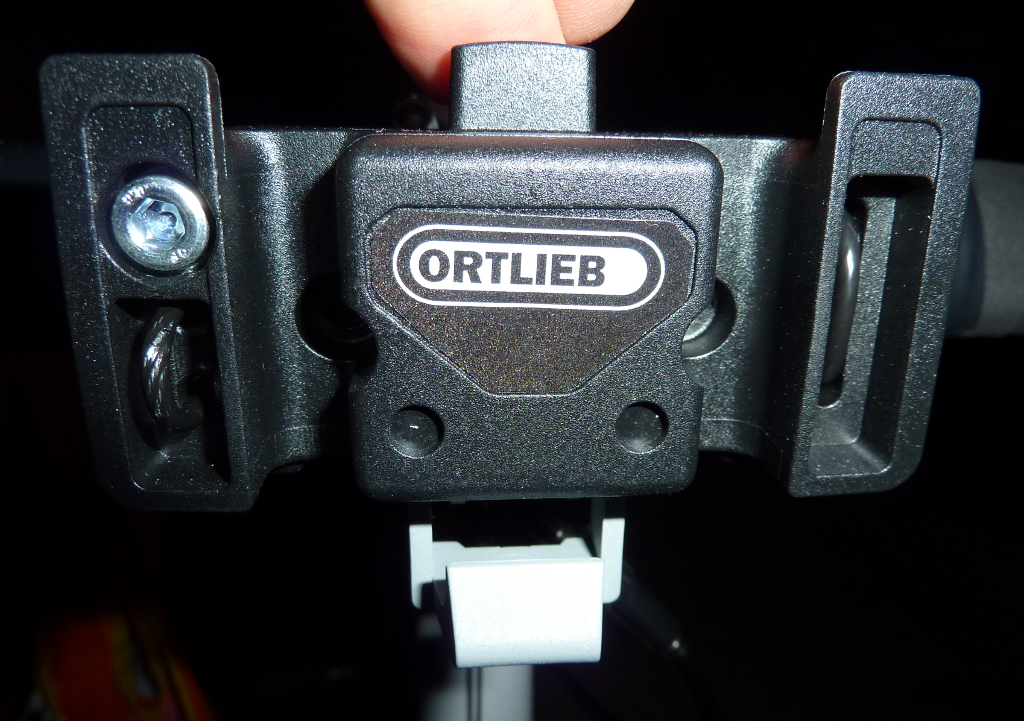
Next I needed to search for a handlebar bag. My old handlebar bag wouldn't fit on the new, thicker handlebar stem. Did I mention obsolescence? And the old panniers don't fit on the new rack. After some Internet shopping I settled on an Ortlieb bag. It has a novel attachment mechanism: wires. The plastic-coated wire threads in and out of the bag mount and over and under your stem, impossible to describe and barely possible to show in a photo:
Here is the front of the bag mount. The hex head nut on the left is how you tighten all the slack out of the wire.
It holds a just-right amount of stuff ... not too much, not too little.
There is a map flap (purchased separately).
It can unfold into 10" x 10", but this covers up the handlebars and the bike computer!

Brake Shoes
The final piece of tweaking was the brakes. The trike had spoiled me by having disc brakes that did an excellent job of stopping. I felt that on a two-wheeler I didn't need the extra expense or special hubs required for disc brakes; however, the brakes on Jolly seemed soft on the first two rides (better on the second after I adjusted them, but still not the best for a panic stop).

Web research quickly led me to the Kool Stop "salmon-colored" brake pads. I ended up ordering the dual compound brake pads. Here are the stock and the Kool Stop pads, off the bike.
Jolly has cantilever brakes:
From the top, it looks like this.

Aligning the new pads is a bit of work because you're busy in multiple dimensions. The pads must be properly positioned so that they are not higher or lower than the wheel rim, the pad surface must be parallel to the rim surface (not tipped up or down), the pad must follow the curvature of the rim and not dip below or above the rim, and then there's the matter of toe-in: to reduce or eliminate brake squeal, it's often recommended to have the front of the brake a bit closer to the rim than the back. You have to adjust all these things at once and then lock them in by tightening the outer bolt cap with a hex wrench, which tends to rotate the pad if you aren't gripping it firmly. It took me a while! But the new pads are working well. Here's a daylight picture:
Also, a photo of the new handlebar bag in context.
And an overall look at Jolly with his new bling. (The pig is optional.)

Tuesday, June 11, 2013

Our Ashes Are Dying

We live in a neighborhood where the effects of the emerald ash borer are clearly hitting home this year. This Asian insect was first discovered in North America near Detroit in the summer of 2002, likely a hitchhiker in wooden pallets or packing materials. By now it has spread to a considerable portion of the United States.
Here is a photo of the borer, courtesy of Wikipedia Commons. Small but deadly.
It took the borer a few years to arrive in central Ohio, and death takes three to five years of larvae munching on the inner bark of ash trees, but this is the time, this is the year that the die-off in our neighborhood has taken hold. Here a photo with an ash tree and another type of tree, taken on June 3rd.
When the entire ash tree is visible, the result can be stark.
While some are completely dead, some are hanging on but sickly and doomed.
This one has one small leader still alive. The old squirrel nest is exposed.
Some houses have an entire row of dead or dying trees looming above them.
The various arborists and tree-trimming outfits have already been busy this year.
Sometimes the ash will develop bleached bark or will shed bark.

We had three of our ash trees, the ones close to the house, treated in the fall of 2010 with injections of emamectin benzoate, with a repeat treatment every other year. So far they are still thriving. Our fingers are crossed.