We arrived at the Phobjikha valley, and then at the hotel, as the light was fading. At the Dewachen Resort, the generators go off about 9pm. Largely because of the black-necked cranes, overhead electrical wires have not been run into the valley, and all must rely on solar-electric or generators. Our camping headlights were still in play! For warmth, each room had a traditional stove, which the staff would stuff with wood (they held no more than three or four chunks), splash the wood with kerosene, and toss in a match. These stoves roared ferociously for no more than half an hour before completely consuming the wood.
We awakened early the next morning for a pre-dawn hike to view the black-necked cranes as they themselves stirred for the new day. Crossing the valley in the glow of my headlamp, following the person in front of me, I was aware both of the uneven footing and the altitude. (The Phobjikha valley is variously listed at altitudes between 9500 and 9800 feet.) The frost was heavy, and I breathed deeply as we climbed a small rise to the observation point. Are those cranes down there?
Yes, they are.
The cranes did not fly away en masse, but chose to depart in groups of two, three, or four over the course of an hour. I was glad I wasn't "wasting film" as I took shot after shot in the muted light. Finally, one worked out.
Eventually we began to retrace our steps. Wherever the sun hit, moisture rose, creating wisps of fog that joined tendrils of smoke above the frost.
The far side of the valley was now in full sunlight. I was still standing in mountain-shade and frost.
Tshering drove the bus down to the school, visible at the far left, to take us back to the hotel and an eagerly anticipated breakfast. Afterwards, as we gathered to ride to the crane center, Jim broke out the hacky sack for us to kick around.
Here is a photo of the sign at the center, taken during our 2005 trip to Bhutan.
A view of the exterior, from this trip.
The crane center has information, spotting scopes, a 3-D relief map of the area, and a gift shop. There is a documentary on DVD about the cranes, which we all watched in the main area. Joan and I picked up a carved wooden plaque of two black-necked cranes that we had long regretted not purchasing in 2005. Our next destination in the valley was Gangtey Gompa (also spelled Gonpa). This monastery is one of the primary centers of the second most popular school of Vajrayana Buddhism in Bhutan, Nyingmapa, and the head lama is the ninth incarnation of Pema Lingpa, a famous 14th-century saint. In 2005 the monastery was undergoing a multi-year restoration. Here, we see a woodcarver at work then.
The front of the central building, being worked on.
The front as we saw it on this trip.
A closeup of the front entry.
Offices and monks' quarters were distributed in the outer buildings that framed the courtyard. Many of the monks were away on their winter holiday, but at least one had done some laundry.
We were able to view several of the rooms, including a shrine room. An older monk was carefully conducting an inventory in that shrine room; with the renovation many old religious items had been replaced by new, and the originals were property of the government. A thorough inventory was coming due soon. We walked through the adjacent village of Gangtey, where an outdoor darts (khuru) tournament was going on. Bhutanese outdoor darts are large, wooden, and have a five-inch nail or equivalent as the tip. I don't have a photo of this dart match, but here's a snapshot taken on our first day in Paro. It's a scale model of an archery range, without bows.
We walked back to the hotel on a nature trail, passing through pine forest, where we saw women gathering fallen pine needles, and by farms, where we got a peek at some cranes.
The one in darker plumage is a juvenile, so perhaps this is a family. Next, a quintessential Phobjikha scene with prayer flags, cranes in a harvested field, Bhutanese architecture, and a solar panel.
Next on the agenda was lunch. This may be a good spot to insert a picture of the dining room, on the second floor, and its view.
The exterior of the Dewachen.
After lunch we had our own miniature archery lesson. Miniature in that the range was along the first terrace in front of the hotel, and was nowhere near 100 meters long. Ten meters might be generous. The hotel staff and our guides had located a traditional cane bow and a few arrows, and we each took turns taking advice and aiming shots. Most of us got one hit, but it was difficult to find the sweet spot between pulling too hard (overshooting the target) and not hard enough. After archery we took another hike. This time, the bus took us across and down the valley, and we hiked back. We disembarked from the bus just outside a small community, where we met a man with a Bhutanese "lute" he had made. Namgay played it for us.
The instrument maker declined to be photographed, but this photo was of Namgay and was thus OK. Just inside the village, a chicken was inspecting the drying turnip harvest.
We crossed the valley and walked up the road on the other side, observing birds, dogs, crops, and kids.
Then our second evening in Phobjikha was upon us. I had not shaved since the start of the trek, and I decided that it was time to bid the itchy stubble adieu. But I preserved the evidence of a beard with mixed patches of brown and white. What a, umm, sight.
The next morning we took a short walk before boarding the bus for the drive to Punakha. And we had another good crane sighting.
I must mention how different Phobjikha felt after Trongsa. The valley of the Mangde Chu, cut by the river as the mountains rose, is like the impression of a cleaver whacked into dough. Phobjikha, a glacial valley, is much more U-shaped and expansive, extending on for miles and with tributary valleys that are smaller versions of itself. It's one of Tsewang's favorite landscapes of Bhutan.
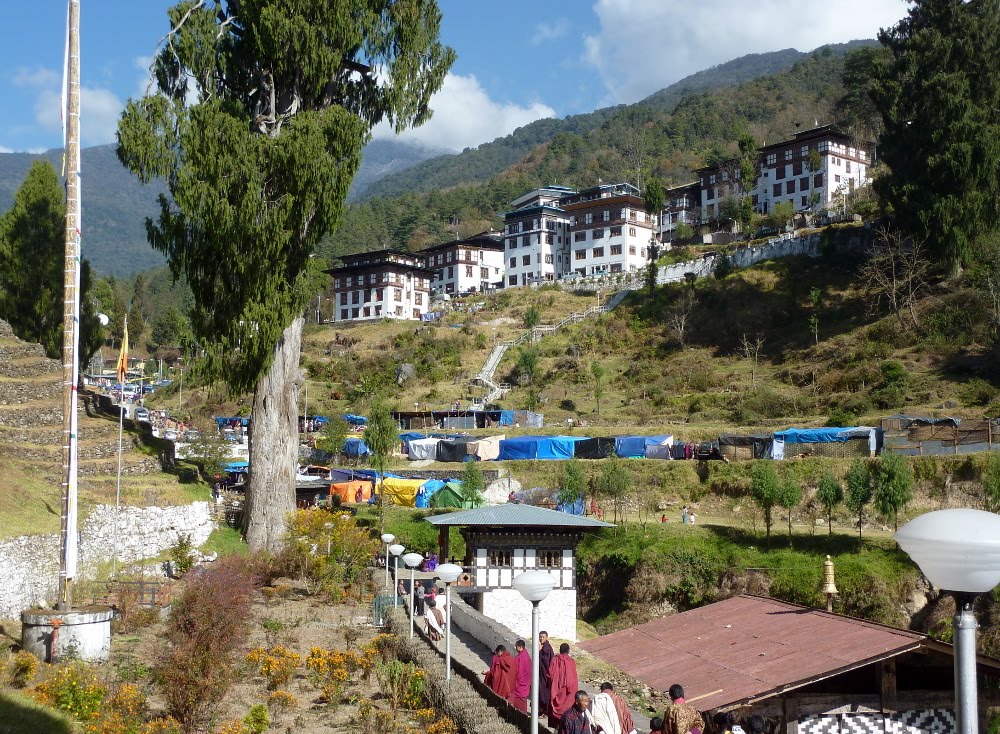
Early the next morning we were off to the second day of the Trongsa tsechu. Advance warning: with the festival being such a feast for the senses, I've got a lot of pictures and videos in this post. Take a deep breath and plunge in. With parking at a premium, the bus let us off a short way from the dzong.
The plastic tarps are temporary shops, bars, and videogame parlors. One of the snack and beverage establishments was run by the wife of Tshering, our driver. For now she lives in Trongsa with the four kids while Tshering, for his job, lives in Thimphu. It's not easy, but they're working hard. Here is Tshering with his two youngest.
People were beginning to gather at the main courtyard, where the performance space was marked off with red carpets. Some of the choice spots were already filling up.
Soon the procession of local notables began.
Here, the Guru Rinpoche figure is seated along the far wall, where he will remain for three or more hours, and an early segment of the dance of the Eight Manifestations of Guru Rinpoche has begun.
Here is a closeup of one of the figures.
Everybody dresses up for the tsechu.
If you're going to keep your spot, you need snacks, especially for the kids. Here is a brief closeup of a dancer and Guru Rinpoche.
A grandmother ponders the passing atsara.
This family group has it all, including pink mittens.
Those horns you've been hearing? Here they are.
The viewers sat or stood in the courtyard and along either side, while some perched on the wall of a higher courtyard. Here's the view down to the show.
As the time grew closer for the offering of blessings, the crowd grew thicker.
Here is a zoom-in of the blessings being offered.
Joan and I decided to take a break from the show, and wandered among the shops. We visited Tshering's place, watched a jeep almost get stuck in the mud near the darts range, and also glanced at some dice games. Here is another perspective on the rows of stalls.
When we returned, the line for offering respect and receiving blessings was as long as before. The dakinis have great stamina; they did their slow steps for hours.
Here is a closeup of a dakini. Although they are female celestial beings, they are played by men.
The apron and cuff ornaments are made from bone. This is a reminder of impermanence. Lo and behold, shortly after we reentered the courtyard, finding the rest of our group, Tsewang came up to us. The man has connections. He had acquired a blessed string (reddish shade of orange, with a knot in the center) for each of us! He gave us basic instructions for wearing it, including that it should be worn for at least three days. I'm a couple of days away from a month, and mine's still in good shape. Here, a policeman tries to squeeze past Guru Rinpoche as the saint takes his last circumambulation of the courtyard, and the attending atsara is not amused.
After the blessings, the Guru Rinpoche figure is escorted out of the courtyard.
After a morning full of sight and sound, it's time for us to leave and get lunch. The view leaving the dzong ...
After lunch, Tsewang and Jen pass through the gate at Yangkhil Resort.
Our bus awaits, clean and shining.
Our long afternoon drive was back up to Pele La, and then taking the side road into the Phobjikha valley, a winter home of the black-necked cranes. Along the way was one of the locations used in the filming of the movie Travelers and Magicians.
We arrived at Dewachen Hotel in Phobjikha after a very full day. And you're probably glad to finally reach the end of this post! Congratulations.
The next morning was the last one where we would awaken in a tent. Outside, one of the many Bhutanese dogs rested. Stray dogs can make a living in Bhutan because most Bhutanese will practice compassion for sentient beings by feeding them. There is a movement for neutering/spaying dogs, but it hasn't really taken hold yet.
Here is one of the orange trees growing at Nimshong. On the roof to the right red chilies are drying.
More onlookers.
In this photo, ponies approach us along the road. Our route down to the Mangde Chu was partially footpaths, and partially this road. The utility of the road has been diminished by Cyclone (hurricane) Alia, which hit the Bay of Bengal last May (2009), and dropped a lot of rain in Bhutan. The bridge across the Mangde Chu for this road, finished just a couple of months before, was completely washed away in the flood, as we will see.
Here we are making progress in our descent to the river. You may notice a small solar panel on the roof of this house. It was not uncommon for us to see an arrangement on this trek whereby a solar panel kept a small battery charged up, which would be enough to run a fluorescent light or two in the dark hours. But modernity is coming to this valley; along part of the route between Korphu and Nimshong a modest (by Western standards) right of way was being trimmed for electrical lines. I don't know how or if the lines will affect the future of the route for the trek, but I'm sure the villagers are looking forward to the juice.
Here we have reached the bottom. An abutment for the previous bridge is visible to the left; until it is rebuilt (higher), a temporary bridge lets us cross.
Joan waves as she crosses.
The air down in the valley was dusty, very dusty, from the road blasting. The finest particles appeared to stay suspended for days, and the foliage had a brown, fuzzy coating. From the river crossing, a wide but still unpaved nouveau road switchbacked up to the paved north-south road. My binoculars, camera case, and glasses all needed a cleaning when we got back to Trongsa. On gaining the road, Tsewang gave each of us a white scarf to congratulate us on completing the trek.
We had a final trail lunch.
Yes, that's a trail lunch! And then we said goodbye to the trekking crew before heading back to Trongsa.
On the far right is Toh (phonetic spelling), the camp boss, known to all as "the Hammer." At one spot, where the road had dipped down close to the river, the May floods had left nothing but a huge boulder field. The bus slowly bounced through this zone on a temporary road before regaining the pavement. Although December is off-season for road work, there was the occasional laborer here busting large rocks into a pile of medium-size gravel, by hand. As we drew closer to Trongsa it became clearer that we would get there too late to see the first day of the multi-day tsechu (festival). We would have all of the next morning to attend the tsechu, so everybody was content to get back to Yangkhil Resort to clean up and to repack yet again, stowing away trekking items and reorganizing the rest.
We awoke the next morning to our alarm, did our usual inside-the-tent routines, and waited for the hot tea. It seemed to be running late, and when voices began to draw closer, it didn't sound like the usual guys who brought the tea and hot water. Then one of them said, "Ho ho ho." It was Santa Namgay, wearing a cotton beard and bearing chocolate!
We learned later that delay was due to two things. It took a while to borrow the red jacket, which belonged to a monk (still asleep) that a lady in town knew. Also, the beard kept falling off. All was forgiven when this smiling visage bearing chocolate appeared. There was another surprise at breakfast.
This one was really yummy too. Today we took our breakfast plates to an overlook gazebo, separate from the dining pavilion.
The view into the valley was grand.
The trail on to our next destination, Nimshong, passed again through Korphu. Of course, some children noticed us.
As we walked by the house we had visited yesterday, our host called out to us, and a dialog ensued between him and Tsewang. Although we were running late, we went inside, and it was a fabulous experience. They were taking a break from the ABC (annual blessing ceremony) and offered us butter tea. I have never had butter tea before, and this was good. The butter is churned into the tea so thoroughly that there is not an oily film, just a rich texture. Tsewang is right to say that it's excellent for chapped lips. If the butter had been around too long, then the flavor would be off, but what we were served was excellent. Here the monks look on as the host assembles his family for us, to pose for a photograph.
This video clip of the same action gives you an idea of the sound of Bhutanese speech.
Here is the assembled family. The patriarch and matriarch are on the right.
As we stood up to leave, I got a better view of the monks. You can see some of the tormas on the altar in the upper left of the photo.
As we trekkers assembled in the courtyard the ceremony picked up again.
Korphu was a high spot of the trek. We had been greeted warmly, as welcome guests, and serendipity had smiled again in the variety of experiences given us. Today's hike would be to go downhill, almost to the valley floor, and then back up, reclaiming some but not all of the downhill, and then a rolling "level" until a final climb through the village of Nimshong. Shortly after starting the descent, a view opened up that explained why the fields of the Nabji/Korphu area are often called "the peacock tail."
Along the trail, we came upon a golden langur. Check out the length of that tail.
As we stared in admiration, the family came up to join him.
Twenty minutes later, we were treated to three male rufous-necked hornbills chilling out in plain view. Binoculars were useful, as the birds were not immediately by the trail.
Another twenty minutes down the trail, and we encountered the female.
Jillian takes a stretch.
At this point, a pony and his boy catch up to us.
As we got closer to Nimshong, agricultural terraces began to appear.
We paused to study a spot that had a lot of bird activity. In this photo, the barred underparts point to a lesser yellownape woodpecker, while the crest suggests a greater yellownape. Life is uncertain.
The village of Nimshong is spread out vertically, as you see, and our camp is at the top.
As we climbed up through the village, we got permission to take a picture of this family processing this year's grain, winnowing and grinding.
A view of our campsite from the dining area.
That evening, around the campfire, we did some singing. Joan, always a showtunes fan, sang "Oh What a Beautiful Morning." Tsewang expressed a fondness for the Beatles' "Eight Days a Week," which the group limped through -- my eternal weakness is remembering only snatches of lyrics. So in case you encounter Tsewang in future, here's a study guide.
Ooh I need your love babe,
Guess you know it's true.
Hope you need my love babe,
Just like I need you.
Hold me, love me, hold me, love me.
I ain't got nothin' but love babe,
Eight days a week.
Love you ev'ry day girl,
Always on my mind.
One thing I can say girl,
Love you all the time.
Hold me, love me, hold me, love me.
I ain't got nothin' but love girl,
Eight days a week.
Eight days a week
I love you.
Eight days a week
Is not enough to show I care.
Ooh I need your love babe,
Guess you know it's true.
Hope you need my love babe,
Just like I need you.
Hold me, love me, hold me, love me.
I ain't got nothin' but love babe,
Eight days a week.
Eight days a week
I love you.
Eight days a week
Is not enough to show I care.
Love you ev'ry day girl,
Always on my mind.
One thing I can say girl,
Love you all the time.
Hold me, love me, hold me, love me.
I ain't got nothin' but love babe,
Eight days a week,
Eight days a week,
Eight days a week.
And that was a very eventful Christmas Day. Its glow increases in memory as I review it for this post.