It was a sunny morning, and although it was cool, one bull seemed to be seeking the shade. Hay was drying on platforms or in trees.
Our first visit, not far from camp, was to the temple dedicated to Guru Rinpoche.
This temple, in addition to holding a teacher's chair, the shrine, and its offerings, encloses a large stone impressed with the thumb- or hand-prints of two kings, and of Guru Rinpoche, who mediated a truce between them. I should mention the two universal features of temple etiquette. One, take your shoes off. Stocking feet are OK, and I often wore two layers to defeat the chill. Two, photographs are not allowed inside the temple building itself (courtyards are fine). It turns out that Nabji is within one of the areas of Bhutan for which Google Maps has high-resolution images. Here's a good view looking down the valley as we descended towards the river.
Inscribed stones are all that remain of an ancient stupa; little is known about its original location.
Jen found the hollow of this tree to be a perfect fit.
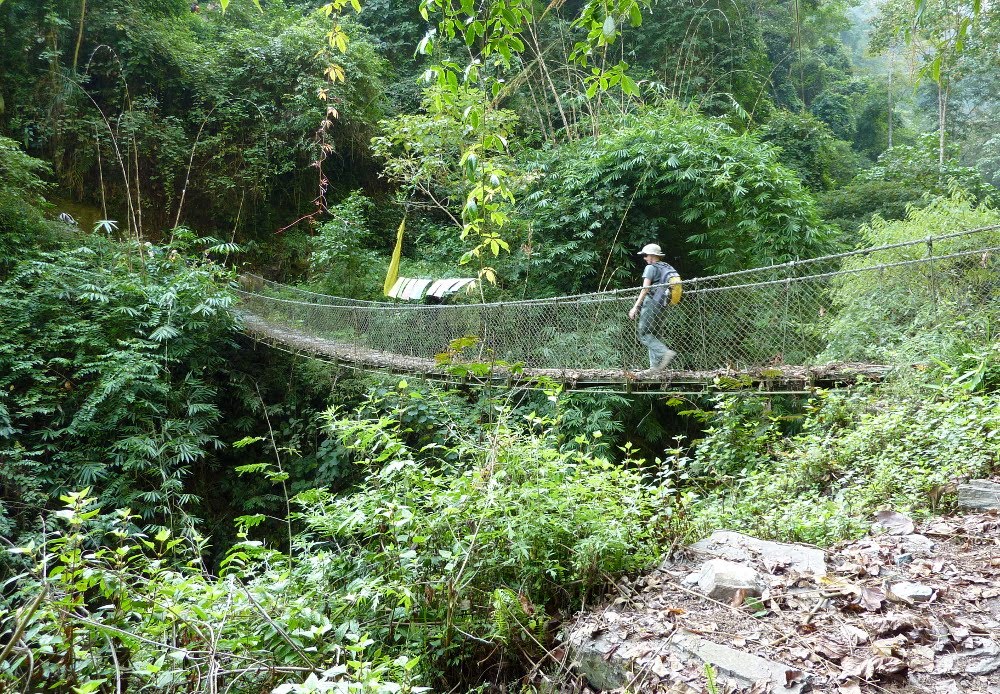
As we hiked down, we were often passed by villagers also on their way to Korphu. A ceremony performed at prescribed intervals for a recently deceased person was taking place at the temple there. Soon we reached the bridge across the Chamkar Chu and reached the other flank of the valley.
It was a steep climb up to Korphu, with plenty of switchbacks. Tsewang did give us opportunies to catch our breath, thankfully. My next photograph is looking uphill into the beginnings of Korphu village.
You may notice the interesting artwork at the first level of the house in front. I've been postponing this topic, but if you're still with me after a week in Bhutan, you're ready. You will see these exuberant phallus paintings on Bhutanese houses; they are commonly considered a sign of protection, derived from the stories of Drukpa Kinley/Kunley, the Divine Madman of the 15th Century, who is supposed to have subdued evil spirits using his phallus as a weapon. Some scholars point out that the phallic presence in Bhutanese culture considerably antedates the Divine Madman. Whatever its origins, it is omnipresent and not pornographic. I leave further exploration of this topic to you and Google; however, more such photos will appear. They are part of the landscape. (We will visit the temple dedicated to the Divine Madman in a few days.) Another house is decorated with swords of wisdom and the animals of the four directions (snow lion, garuda bird, dragon, and tiger).
Here we are about to enter the 'main street' of Korphu, with the temple courtyard just beyond the portal.
The kids appeared, and we and they had fun with the photos. Jen and Jillian got us started.
Once you've snapped their picture, the kids dash up to see how they look.
Some were sitting on the second level and just watching.
Through the doorway was the courtyard of the temple where the CFMRD (Ceremony for Family Member Recently Departed) was being conducted. We were allowed to peek inside, but there was no photography. After a while we walked down an elevated path on our way to the camp.
The campsite is one more good climb above the actual Korphu townsite. I paused to take a picture looking back, partway up.
And here's multi-level camping, as seen from our tent. For some reason they put Joan and me far away from everybody else ...
After lunch we had time to explore Korphu. On the way down, I made a quick clip of this long column of prayer flags. If you turn your sound way up, you may hear them rustling in the breeze.
Our first stop, if I recall correctly, was the cooking house for the CFMRD. The family of the deceased, as part of sponsoring the ceremony, supplies great quantities of food to the monks and attendees. Here a large sack of rice is being poured into a cauldron of boiling water.
The merit from the generosity of the family is dedicated entirely to the deceased person, benefiting him or her in the next life. I understand that a few of the poorest people in Bhutan, such as the transient road workers, have converted to Christianity to avoid the financial burden of traditional Bhutanese Buddhist ceremonies such as this. Next we visited the house of our local Korphu guide, Karma. We took off our shoes, sat down, and were offered ara. This was, I should note, our second encounter with ara, distilled liquor, or, having grown up in Tennessee, what I would call moonshine or white lightning. We had sipped at our first cup last night after dinner, in Nabji camp, and been introduced to ara etiquette. You always appear take a sip or three, but it isn't necessary to actually drink if you don't want to -- going through the motions to be polite is good. Being cautious Westerners, if the cup looks like it had water of unknown provenance sitting in the bottom as the ara was poured, we would not ingest. At Nabji camp and here at Karma's house, we did ingest, and everything was fine. Also, you always allow the host to add a second splash to the cup, even if you aren't really drinking. And at Nabji camp we learned that -- at least for informal campfire drinking -- one is supposed to come up with a one-word description after the first sip, such as "sweet" or "strong" or "bitter." Traditionally, the word you utter describes the housewife who brewed the stuff. I did find that ara was smoother than the white lightnin' I remember. It can be made from anything fermentable; grains or fruits are often used. After leaving Karma's house we paused in the temple courtyard, and encountered a fellow who conversed earnestly with Tsewang. Soon we were headed down the block to his house for snacks (the Bhutanese equivalent of nuts and chips) and, yes, ara. Monks were at work creating tormas (elaborate sculptures of flour, butter, and coloring) in preparation for a house blessing to be held tomorrow. It turns out that our gentleman host was a previous headman of Korphu village who now lived in Trongsa. He and every family member who possibly could came back to the old family home in Korphu to host an annual blessing ceremony, usually held during the slow winter season. This is a strong tradition all over Bhutan. In his front yard a musical instrument for tomorrow was propped up against the fence.
After this visit, it was time to hike back up to camp and have supper. The clouds that had built up over the mountains every afternoon had gotten even thicker today, and while supper was being prepared, a gentle rain began to fall. It did not interfere with dinner, nor, as it continued to soften, with another wonderful facet of our Korphu experience. A dozen or so young ladies from the village came to the campsite, wearing their good kiras and, by firelight, began to perform several traditional songs and dances. The rain stopped. After several dances they urged us to join them, and even to a dancing-impaired person (me) it was clear that participating was the thing to do. It was tough to follow the dance steps, even though they were not complicated, because I couldn't see their feet. The kiras obscured the only clues for us novices! At one point, the girls suggested that we show them a dance. Here I must give credit to Jim and Jillian, as Joan and I were drawing a blank: we did the hokey-pokey, most assuredly not a folk dance, but fascinating and amusing to our dancers. Then, it was time to retire. It was Christmas Eve.
Today's walk is eight or nine miles to Nabji, but without as many challenging ups and downs as yesterday. Here, Tsewang begins a couple of explanations.
The marks along this rock are thought by some to be the writings of dakinis. (Be sure to click on the image to get a better look.)
Here is the stone from behind which Guru Rinpoche is supposed to have conquered a demoness. He also sat and meditated there, hence the name "Guru Rinpoche's Seat."
One of our many stream crossings.
It's difficult to photograph the small, flitty birds -- they just won't sit still -- but today I snapped this shot, a chest view of a Mrs. Gould's sunbird.
As we walked along the ridge, the rice fields of Nabji and Korphu grew closer.
The camp crew was well ahead of us, and here we can see the tents below us, although we still had a ways to go.
We passed a decommissioned prayer wheel.
We finally arrive at our campsite.
Now that everybody had arrived at camp, Tsewang laid out the evening schedule. We had all expressed an interest in the traditional hot stone bath, where fire-hot stones are immersed in the water. Before supper there would be time for one bath, at 6:30 (well after dark). The other slots would be after dinner, the fifth and final one being a late 10:00. (The wooden tub would be emptied and fresh water added for each bather, so each slot needed at least 45 minutes.) Tsewang diplomatically had us draw lots, and I drew slot #1. Going first meant that I wouldn't learn from the others, but as it turned out, the only thing I really missed was a timepiece. I had no idea how much time I was using -- would I be dashing up just after getting in, or would I be late for dinner? Here I am, all 6' 3" of me, warming in the outdoor tub with a fragrant veil of artemisia leaves. The hot stones are along the vacant short side. I opted for a cooler bath than is customary, but still toasty -- I didn't want to be sweating for half an hour after getting out! (The attendant added a few buckets of cold water.) After the stones were removed, having given their thermal all, I was able to stretch out lengthwise.
During bath #2, Joan (who had drawn #5) visited the outhouse, to find a gathering in the alley between the two buildings, glimpsed above. Relatives of the attendants had come to help them refill, and then their friends visited ... Joan informed Tsewang, and soon only one person was in attendance if one of us was in the tub. It became apparent that Joan's slot would be quite late, and she decided to give it a pass. Further, less rustic, opportunities for hot stone baths were taken at Phobjikha (Dewachen Resort) and Paro, although not by yours truly. The Taj Tashi in Thimphu would have also been available but we were very busy there. The next morning, the porters watched as the trekking crew broke camp. Because it was a short walk that day, and it had been a late night, the morning schedule was pushed back half an hour.
Early in the morning we had a long downhill to negotiate. Joan and I were glad for our walking sticks. Here, the trekkers pause to regroup at a chorten.
Some of the porters catch up to us (we aren't nearly as tough as they are).
We get to the bottom and cross to the next ridge.
What goes down must go (back) up.
Partway up the long climb, we came to a rock which contains, it is said, a footprint of Guru Rinpoche and an impression left by a dakini. Guru Rinpoche, also known by the Sanskrit name of Padmasambhava, was a Buddhist saint/master of the 8th Century, widely traveled in the Himalayan region including Tibet, Nepal, and Bhutan. He is the founder of the Nyingma lineage of Tibetan Buddhism, and is considered by some to be the second Buddha. It's impossible to overstate his effect on the region. In many of the temples that we visited, his statue was the central and largest one in the shrine, and the historical Buddha (Shakyamuni) would be one of the supplementary statues. Of course, sometimes it would be the other way round. Some of the phenomena attributed to Guru Rinpoche may be apocryphal -- "George Washington slept here" -- but his presence in this area is factual, including Nabji, where he negotiated peace between two kings (Sindha Gyelp of Bumthang, and King Noeche), and imprinted their thumbs on each side of a large stone. The cavity on the left is Guru Rinpoche's footprint, and on the right, from a dakini (a female celestial being, or a female embodiment of enlightened energy).
Lunch was at a viewpoint overlooking the valley of the Mange Chu. We had been heading south, but now we would turn west and trek around a tributary valley, first on the north ridge, headed for the village of Nabji, and then return on the south ridge. Here we look down the Mangde Chu. The haze is largely due to blasting for extensions of the highway.
Some ponies caught up with us at lunch.
We were also greeting by a delegation from the village of Kudra, where we would be camping for the night. According to the trip literature, Kudra has only a few houses and a small school, so the size of the greeting committee was impressive.
Grandma was taking it all in with amusement. She was born into a land without even the concept of money (taxes were paid in commodities such as lampblack, or by labor for the King), and now Bhutanese with cellphones and chilip with digital cameras are visitors.
It was time to hike on. The trail gets narrow in spots, but it's nothing we hadn't seen already hiking in the Canadian Rockies.
Then we came across a rufous-necked hornbill (female). The bill and the blue eye-rings are striking.
Here's an impressive tree fern.
For a while the path wound along the edge between cultivated fields and the woods. Birds frequent this kind of habitat, and we were treated to a good look at a golden-throated barbet.
We came to a viewpoint where we could see across the valley, to villages we would walk through in a few days.
It became cloudier and cooler late in the afternoon, and with the diminishing light I neglected to capture any pictures of the Kudra campsite. It had the same elements as them all -- the camping terrace, outhouse, pavilion, cookhouse. Tomorrow, we would head to Nabji.
The trailhead is at about 3500' altitude; our first steps were down to a bridge across the Mangde Chu.
In crossing we entered the Jigme Singye Wangchuck National Park, formerly the Black Mountains National Park. Our destination was the village of Jangbi, in the homeland of the Monpa people, an indigenous tribe thought to have been the first settlers in Bhutan. Here is a description of the Monpa (who live in northeastern India as well). About an hour later, we encountered our first langurs.
At first we were told that it was a capped langur, but this specimen doesn't look much like the capped langurs in the book, even with unfavorable lighting. Our guides didn't feel that this was the endemic golden langur, but he sure looks like this fellow. There has been the discovery of hybridization between the two in this area, but there's none of the slate blue color here. At any rate, our langur didn't stay long.
On our arrival in Jangbi we visited the home of our local guide, and met his wife and brother. We were offered oranges (the orange crop was coming in and we were offered them everywhere in this subtropical region). Fresh and tasty, they were.
In the other direction were some of the lower fields of Jangbi, and if you peer at trees on the left, the trail to the campsite.
Here's a view looking down at the campsite. Each campsite on this trek had a gazebo/pavilion, a cookhouse/kitchen, a double outhouse, and a terrace for the tents. (Only the pavilion is visible in the next photo.)
Closer up,
It being our first overnight in camp, Joan and I had to work out our system for the next five nights; where to put our stuff in the tents, maneuvering in the dark using camper's headlamps (it's December and it gets dark early and stays dark late!), being served dinner by the campfire -- it was all new to us. Tsewang would let us know each evening when hot tea, the first public event of the morning, would be brought to our tent, and tea would be shortly followed by basins of hot water for freshening up. From those times we could extrapolate backwards when to wake up and meditate. Of course, packing gear back up doesn't happen until after the hot water arrives and you've freshened up. One at a time inside the small tent. It's good if everyone doesn't dash for the outhouse at once, and do you brush your teeth before or after breakfast? Small things, but when you're taken out of your normal routine and must examine these things consciously -- one of the benefits of camping, no doubt -- it takes a couple of days for them to become second nature! The highlight of the evening was the visit of a dozen or more villagers. Tsewang served as translator as we, and they, asked questions back and forth. And sometimes just sat in the others' presence in the firelight. I listened closely but didn't contribute, either because of self-imposed standards for how polished and complete a response needed to be, or because my brain was sluggish, filling up with experiences already. The next morning, everybody was ready by Tsewang's desired departure time (hurrah!). A group of men and boys was engaged in propping up, and then splitting a large rock, as if making slates, tiles, or pavers.
The building in the background is, as I understand it, a type of governmental agricultural office, almost completed. That, and the fact that Jangbi now has a school, is motivating some folk in the area to move to Jangbi. Next, nine miles to Kudra. It is at virtually the same elevation as Jangbi, but there's a lot of up and down along the way.